

[2024] Pass H12-351_V1.0 Exam - Real Questions and Answers
H12-351_V1.0 Exam Questions Get Updated [2024] with Correct Answers
Huawei H12-351_V1.0 (HCIE-WLAN (Written) V1.0) is an advanced certification exam designed for IT professionals who want to validate their expertise in wireless networks. H12-351_V1.0 exam is designed to test the candidate's knowledge and skills related to planning, designing, deploying, optimizing, and troubleshooting complex enterprise wireless networks. HCIE-WLAN (Written) V1.0 certification is an essential requirement for those who want to pursue a career in wireless networking, particularly in Huawei technologies.
Huawei H12-351_V1.0 certification exam is a challenging exam that requires a comprehensive understanding of wireless networking concepts and technologies. Candidates who successfully pass the exam are recognized as experts in wireless networking and are highly sought after by IT organizations and businesses around the world.
NEW QUESTION # 28
In a multicast solution, there must be reachable unlcast routes between multicast sources and receivers.
- A. False
- B. True
Answer: B
Explanation:
Explanation
In a multicast solution, there must be reachable unicast routes between multicast sources and receivers, because multicast routing protocols use unicast routing information to build multicast forwarding trees.
References: https://support.huawei.com/enterprise/en/doc/EDOC1100058940/8a8f1c9b/multicast
NEW QUESTION # 29
Either of the two APs that have established a mesh connection can send a Mesh Peering Close frame to the other AP to tear down the mesh connection.
- A. False
- B. True
Answer: B
Explanation:
Explanation
A mesh connection can be torn down by either of the two APs that have established it by sending a Mesh Peering Close frame to the other AP. This frame indicates that the sender no longer wants to maintain the mesh connection.
References: https://support.huawei.com/enterprise/en/doc/EDOC1100058940/8a8f1c9b/mesh-networking
NEW QUESTION # 30
Huawei Agile Cloud Authentication (HACA) supports only IMaster NCE-Campus as the HACA server.
- A. False
- B. True
Answer: A
Explanation:
Explanation
According to the Huawei documents and resources, Huawei Agile Cloud Authentication (HACA) supports iMaster NCE-Campus as well as Agile Controller-Campus as the HACA server. HACA is an authentication method that allows users to access a network without entering user names or passwords3. Therefore, B is the correct answer. References: 3: https://support.huawei.com/enterprise/en/doc/EDOC1100086527
NEW QUESTION # 31
Which of the following items is not involved in the HLD phase?
- A. Network design
- B. AP position planning
- C. Capacity planning
- D. Deployment planning
Answer: B
Explanation:
Explanation
According to the Huawei documents and resources, the HLD phase is the high-level design phase of a WLAN project. It involves the following items:
Capacity planning: Determines the number and types of devices required for the WLAN network based on the customer's requirements and network scale.
Network design: Designs the network topology, IP addressing scheme, VLAN division, security policies, and other network parameters for the WLAN network.
Deployment planning: Plans the deployment sequence, schedule, resources, and risks for the WLAN project.
AP position planning is not involved in the HLD phase. It is part of the LLD phase, which is the low-level design phase of a WLAN project. It involves the detailed design of AP positions, antenna types, channel allocation, power adjustment, and other wireless parameters for the WLAN network. Therefore, C is the correct answer. References: :
https://support.huawei.com/enterprise/en/doc/EDOC1100158948/9a0d5c37/wlan-project-design
NEW QUESTION # 32
Which of the following statements about WLAN roaming and signal strength Is false?
- A. STAs can roam between WACs in dual-link HSB mode.
- B. Generally, a STA roams when it detects that the signal strength is less than -75 dBm.
- C. Smart roaming can be enabled on the WAC to help ST As roam and associate with APs with better signals.
- D. In most cases, the signal strength of a STA should range from -45 dBm to -65 dBm.
Answer: B
Explanation:
Explanation
B is false because generally, a STA roams when it detects that the signal strength is less than -70 dBm or -65 dBm, not -75 dBm.
References:
https://support.huawei.com/enterprise/en/doc/EDOC1100058940/8a8f1c9b/wlan-roaming-and-signal-strength
NEW QUESTION # 33
Drag the reasons for AP onboarding failures on the left to the corresponding troubleshooting operations on the right.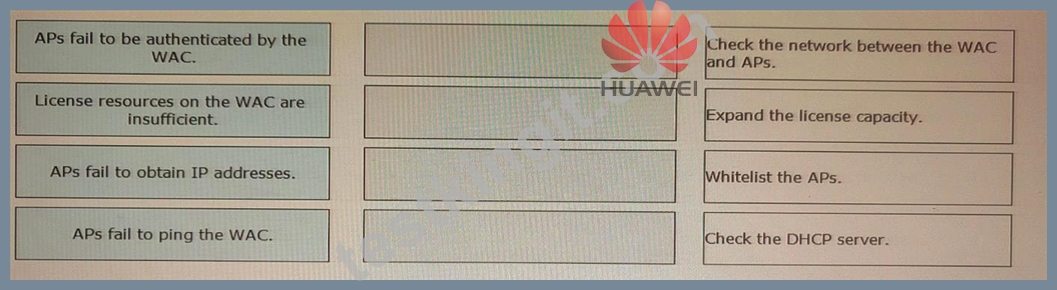
Answer:
Explanation: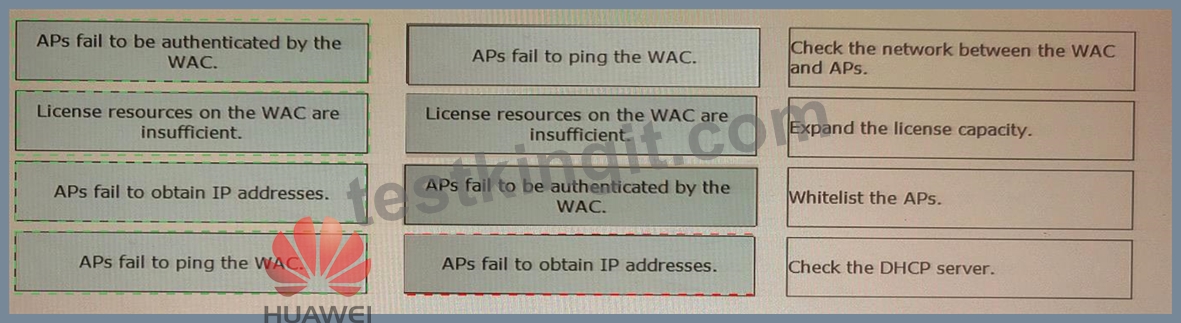
Explanation
According to the Huawei documents and resources, the troubleshooting operations for the AP onboarding failures are as follows:
APS fail to be authenticated by the WAC: Whitelist the APS. The WAC can authenticate APs based on their MAC addresses or SNs. If an AP is not whitelisted on the WAC, it cannot be authenticated and onboarded.
License resources on the WAC are insufficient: Expand the license capacity. The WAC can manage a limited number of APs based on its license. If the license resources are insufficient, some APs cannot be onboarded.
APS fail to obtain IP addresses: Check the DHCP server. The APs need to obtain IP addresses from a DHCP server before they can communicate with the WAC. If the DHCP server is not configured or reachable, the APs cannot obtain IP addresses and onboard.
APS fail to ping the WAC: Check the network between the WAC and APS. The APs need to ping the WAC to discover its IP address and establish a CAPWAP tunnel. If there is a network problem between the WAC and APs, such as incorrect VLAN configuration or firewall blocking, the APs cannot ping the WAC and onboard.
Therefore, APS fail to be authenticated by the WAC - c, License resources on the WAC are insufficient - b, APS fail to obtain IP addresses - d, APS fail to ping the WAC - a is the correct answer. References: :
https://support.huawei.com/enterprise/en/doc/EDOC1100158948/9a0d5c37/ap-onboarding-failures
NEW QUESTION # 34
In a dual-link HSB scenario, after an AP sets up CAPWAP links with the active and standby WACs, which of the following types of packets does the AP periodically send to the WACs to detect link status?
- A. Keepalive
- B. DTLS
- C. Join
- D. Echo
Answer: D
Explanation:
Explanation
In a dual-link HSB scenario, after an AP sets up CAPWAP links with the active and standby WACs, the AP periodically sends Echo packets to the WACs to detect link status. The Echo packets are sent every 30 seconds by default.
References: https://support.huawei.com/enterprise/en/doc/EDOC1100058940/8a8f1c9b/dual-link-hsb
NEW QUESTION # 35
When a STA roams from API to AP2 at Layer 2, AP2 notifies its neighbors of from this STA is encapsulated in a tunnel and sent to API for forwarding.
- A. False
- B. True
Answer: A
Explanation:
Explanation
When a STA roams from AP1 to AP2 at Layer 2, AP2 notifies its neighbors of the MAC address learned from this STA. The MAC address is not encapsulated in a tunnel and sent to AP1 for forwarding. Instead, AP1 deletes the MAC address entry of the STA and releases the IP address lease.
References: https://support.huawei.com/enterprise/en/doc/EDOC1100058940/8a8f1c9b/layer-2-roaming
NEW QUESTION # 36
In 802. IX authentication using port-based access control, once a user is authenticated successfully on a port, subsequent users on this port can access the network without authentication. When the authenticated user goes offline, all other users are denied access to the network.
- A. False
- B. True
Answer: B
Explanation:
Explanation
According to the Huawei documents and resources, 802.1X authentication using port-based access control is a method that allows only one user to access the network through a port at a time. If a user is authenticated successfully on a port, subsequent users on this port can access the network without authentication. When the authenticated user goes offline, all other users are denied access to the network . Therefore, A is the correct answer. References: 1: https://support.huawei.com/enterprise/en/doc/EDOC1100086527
NEW QUESTION # 37
After the HTTP domain name is entered in a browser, the user Is not redirected to the Portal URL. Which of the followings is the possible cause for this failure? (Select All that Apply)
- A. HTTPS redirection is disabled.
- B. The URL template is incorrectly configured.
- C. The DNS server IP address is not added to the authentication-free rule.
- D. The web server is incorrectly configured.
Answer: B,C,D
Explanation:
Explanation
C is false because HTTPS redirection is not required for Portal authentication to work properly.
References:
https://support.huawei.com/enterprise/en/doc/EDOC1100058940/8a8f1c9b/troubleshooting-portal-authentication
NEW QUESTION # 38
The display sync-configuration compare command is executed on the backup WAC in HSB to check wireless configuration synchronization. Based on the command output, which of the following statements are true?
(Select All that apply)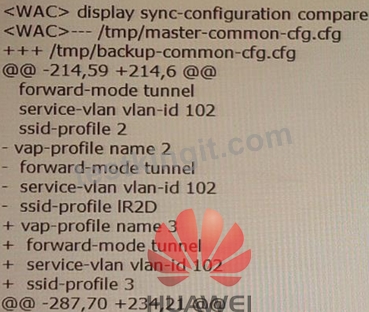
- A. This command is used to check whether the public configurations on two WACs are consistent after wireless configuration synchronization.
- B. The configuration of vap-profile name 3 exists on the master WAC but not on the backup WAC.
- C. The configuration of ssid-profile 2 exists on both the master and backup WACs.
- D. The configuration of vap-profile name 2 exists on the backup WAC but not on the master WAC.
Answer: A,B
Explanation:
Explanation
The display sync-configuration compare command is used to check whether the public configurations on two WACs are consistent after wireless configuration synchronization. The command output shows the differences between the configurations on the master and backup WACs. In this case, the configuration of vap-profile name 3 exists on the master WAC but not on the backup WAC.
References:
https://support.huawei.com/enterprise/en/doc/EDOC1100058940/8a8f1c9b/display-sync-configuration-compare
NEW QUESTION # 39
In a dual-link backup scenario, the active/standby link switchover mode is set to priority. When the active link recovers, the AP detects that the original active link has a higher priority and triggers a switchback. How many Echo intervals does the AP wait for before switching back to the original primary WAC?
- A. 0
- B. 1
- C. 2
- D. 3
Answer: C
Explanation:
Explanation
In a dual-link backup scenario, when the active link recovers, the AP waits for 15 Echo intervals before switching back to the original primary WAC. This prevents frequent link switchovers caused by unstable links.
References: https://support.huawei.com/enterprise/en/doc/EDOC1100058940/8a8f1c9b/dual-link-backup
NEW QUESTION # 40
When calculating the number of APs, you can divide the total required bandwidth by the maximum bandwidth of a single AP.
- A. False
- B. True
Answer: A
Explanation:
Explanation
When calculating the number of APs, you cannot simply divide the total required bandwidth by the maximum bandwidth of a single AP. You also need to consider other factors such as signal coverage area, user density, interference level, and application type.
References:
https://support.huawei.com/enterprise/en/doc/EDOC1100058940/8a8f1c9b/calculation-of-the-number-of-aps
NEW QUESTION # 41
In a dual-link HSB scenario, after an AP sets up CAPWAP links with the active and standby WACs, which of the following types of packets does the AP periodically send to the WACs to detect link status?
- A. Keepalive
- B. DTLS
- C. Join
- D. Echo
Answer: D
Explanation:
Explanation
In a dual-link HSB scenario, after an AP sets up CAPWAP links with the active and standby WACs, the AP periodically sends Echo packets to the WACs to detect link status. The Echo packets are sent every 30 seconds by default.
References: https://support.huawei.com/enterprise/en/doc/EDOC1100058940/8a8f1c9b/dual-link-hsb
NEW QUESTION # 42
Which of the following methods are used in IPsec to ensure secure transmission of service data on the network through encryption and authentication?
- A. Data integrity is verified.
- B. The receiver verifies the identity of the sender.
- C. The sender verifies the identity of the receiver.
- D. The receiver rejects old or duplicate packets in order to prevent attacks initiated by malicious users who resend sniffed packets,
Answer: A,B
Explanation:
Explanation
IPsec uses authentication headers (AHs) and encapsulating security payloads (ESPs) to ensure secure transmission of service data on the network. AHs provide authentication and integrity verification for the sender and the receiver, while ESPs provide encryption and optional authentication for the data.
References: https://support.huawei.com/enterprise/en/doc/EDOC1100058940/8a8f1c9b/ipsec
NEW QUESTION # 43
Which of the following statements about VXLAN is false?
- A. A Layer 3 VXLAN gateway is used for inter-subnet communication on a VXLAN network and communication with external non-VXLAN networks.
- B. A VBDIF interface is a logical interface created based on a BD. It is similar to a VLANIF interface on a traditional network.
- C. Layer 2 and Layer 3 VXLAN gateways must maintain VBDIF interfaces. Otherwise, users cannot communicate with each other through these interfaces.
- D. A Layer 2 VXLAN gateway forwards traffic to a VXLAN network and can also be used for Intra-subnet communication on the same VXLAN network.
Answer: C
Explanation:
Explanation
B is false because only Layer 3 VXLAN gateways need to maintain VBDIF interfaces for inter-subnet communication on a VXLAN network or communication with external non-VXLAN networks. Layer 2 VXLAN gateways do not need VBDIF interfaces.
References: https://support.huawei.com/enterprise/en/doc/EDOC1100058940/8a8f1c9b/vxlan-gateway
NEW QUESTION # 44
In Huawei's smart roaming solution, which of the following methods can be used by a WAC to discover and maintain neighboring AP entries of STAs? (Select All that Apply)
- A. The AP periodically and proactively scans neighboring APs of STAs.
- B. The WAC obtains such entries using 802. 11v.
- C. The AP listens to the Probe frames sent by STAs.
- D. STAs proactively report neighboring AP information.
Answer: A,C
Explanation:
Explanation
In Huawei's smart roaming solution, the WAC can discover and maintain neighboring AP entries of STAs by using two methods: passive listening and active scanning. Passive listening means that the AP listens to the Probe frames sent by STAs and reports them to the WAC. Active scanning means that the AP periodically and proactively scans neighboring APs of STAs and reports them to the WAC.
References: https://support.huawei.com/enterprise/en/doc/EDOC1100058940/8a8f1c9b/smart-roaming
NEW QUESTION # 45
Which of the fallowings is not an IPv6 address type?
- A. Multicast address
- B. Unicast address
- C. Anycast address
- D. Broadcast address
Answer: D
Explanation:
Explanation
Broadcast address is not an IPv6 address type. IPv6 does not support broadcast addressing, but uses multicast addressing instead. The other options are valid IPv6 address types. Unicast address identifies a single interface, multicast address identifies a group of interfaces, and anycast address identifies multiple interfaces but delivers packets to only one of them.
References: https://support.huawei.com/enterprise/en/doc/EDOC1100058940/8a8f1c9b/ipv6-address-types
NEW QUESTION # 46
Which of the following key factors is used by the CloudCampus cloud management platform to determine the tenant to which a device belongs?
- A. Device model
- B. Device IP address
- C. Device ESN
- D. Device MAC address
Answer: C
Explanation:
Explanation
The device ESN (Electronic Serial Number) is a unique identifier that is used by the CloudCampus cloud management platform to determine the tenant to which a device belongs. The device ESN is bound to a tenant when a device is added to the platform.
References: https://support.huawei.com/enterprise/en/doc/EDOC1100058940/8a8f1c9b/device-esn
NEW QUESTION # 47
Which of the following statements about fingerprint-based positioning technology are true? (Select All that Apply)
- A. The fingerprint map is obtained through onsite information collection.
- B. Terminals learn from each other to form a fingerprint library that can be shared.
- C. APs collect surrounding environment information to form a fingerprint library.
- D. The positioning engine generates a virtual fingerprint library through calculations based on the AP deployment and environment information.
Answer: A,D
Explanation:
Explanation
Fingerprint-based positioning technology is a method that uses the signal strength or phase difference of wireless signals to locate objects. There are two types of fingerprint-based positioning technology: virtual fingerprint-based positioning and real fingerprint-based positioning. In virtual fingerprint-based positioning, the positioning engine generates a virtual fingerprint library through calculations based on the AP deployment and environment information. In real fingerprint-based positioning, the fingerprint map is obtained through onsite information collection.
References:
https://support.huawei.com/enterprise/en/doc/EDOC1100058940/8a8f1c9b/fingerprint-based-positioning-techno
NEW QUESTION # 48
Drag the Huawei's wireless positioning solutions on the left to their corresponding features and application scenarios on the right.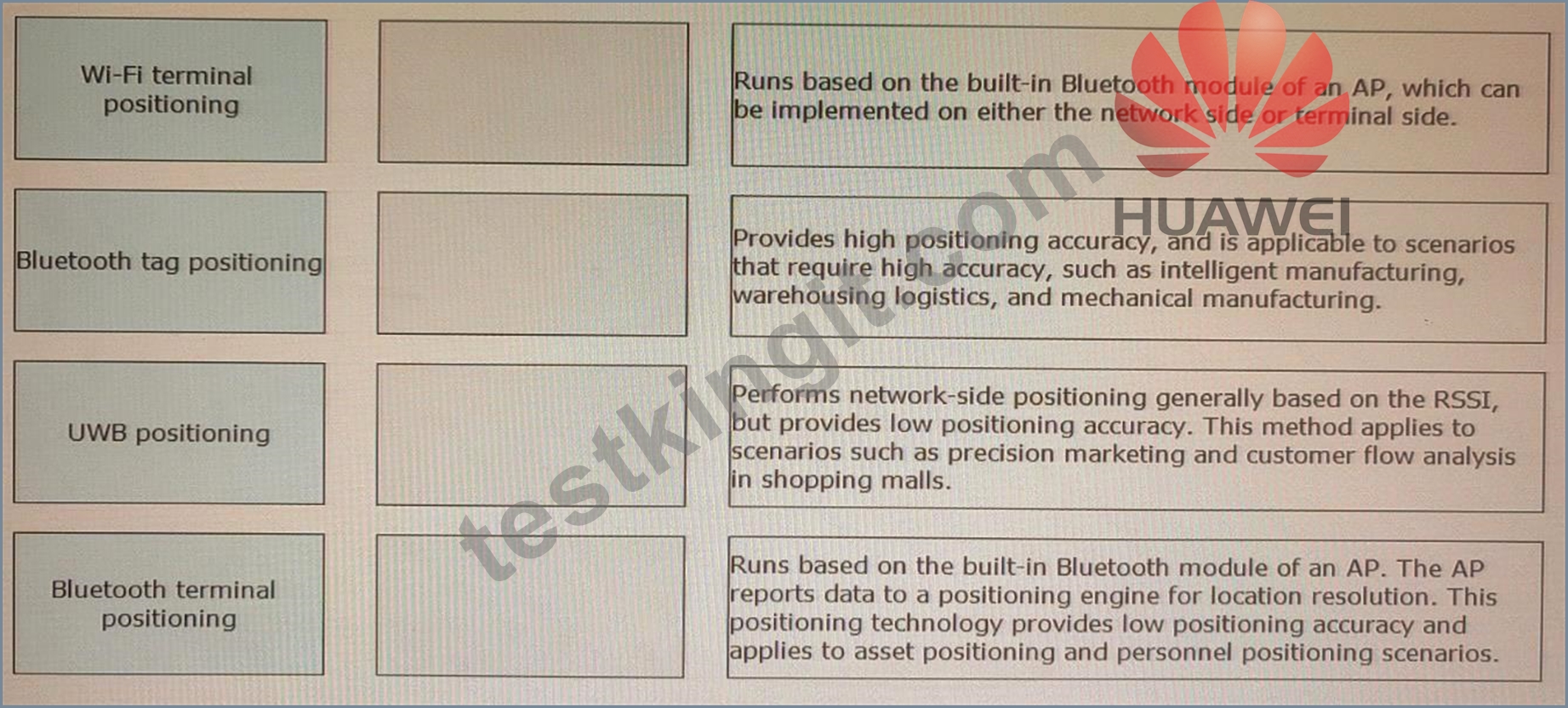
Answer:
Explanation: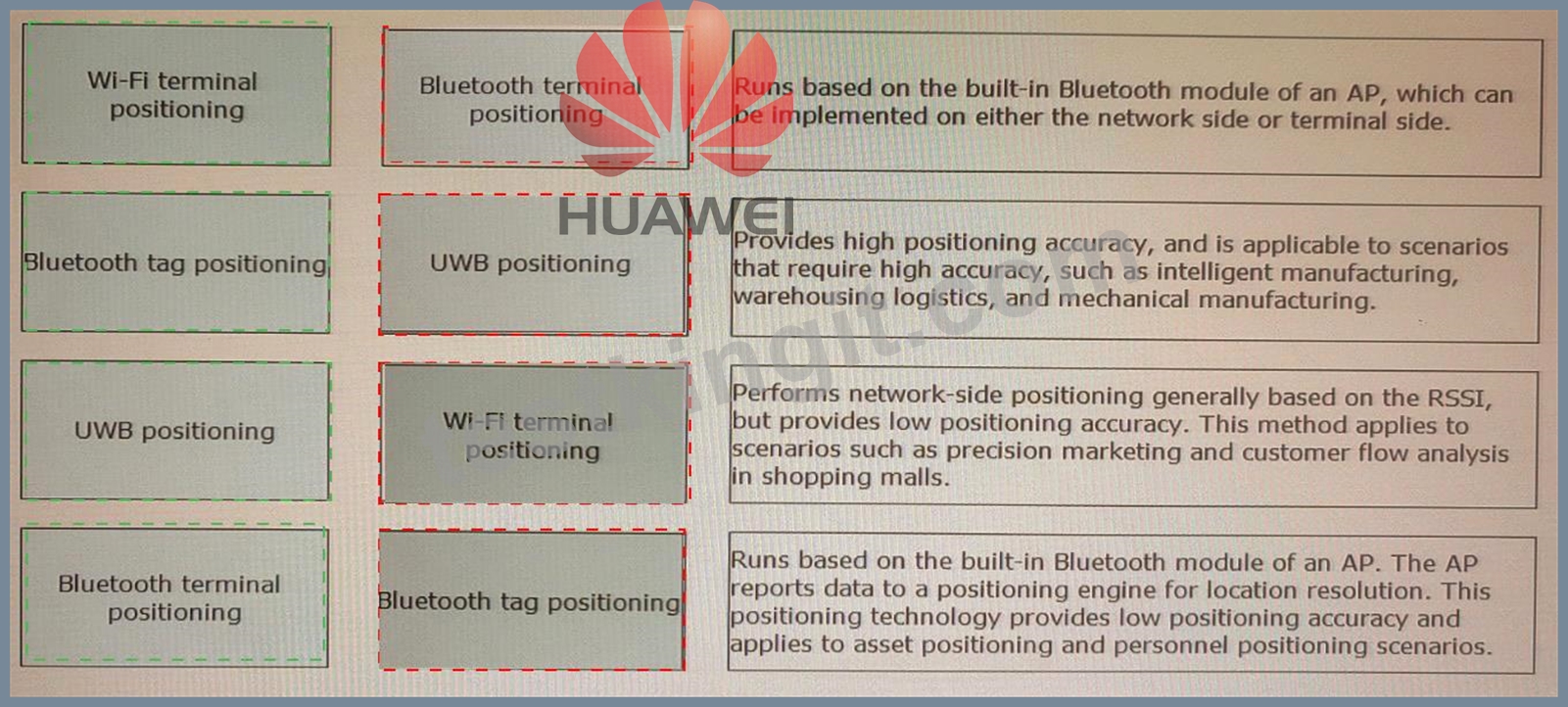
Explanation
According to the Huawei documents and resources, the features and application scenarios of the wireless positioning solutions are as follows:
Wi-Fi terminal positioning: Performs network-side positioning generally based on the RSSI, but provides low positioning accuracy. This method applies to scenarios such as precision marketing and customer flow analysis in shopping malls.
Bluetooth tag positioning: Runs based on the built-in Bluetooth module of an AP. The AP reports data to a positioning engine for location resolution. This positioning technology provides low positioning accuracy and applies to asset positioning and personnel positioning scenarios.
UWB positioning: Provides high positioning accuracy, and is applicable to scenarios that require high accuracy, such as intelligent manufacturing, warehousing logistics, and mechanical manufacturing.
Bluetooth terminal positioning: Runs based on the built-in Bluetooth module of an AP, which can be implemented on either the network side or terminal side.
Therefore, Wi-Fi terminal positioning - 3, Bluetooth tag positioning - 4, UWB positioning - 2, Bluetooth terminal positioning - 1 is the correct answer. References: :
https://support.huawei.com/enterprise/en/doc/EDOC1100158948/9a0d5c37/wi-fi-terminal-positioning :
https://support.huawei.com/enterprise/en/doc/EDOC1100158948/9a0d5c37/bluetooth-tag-positioning :
https://support.huawei.com/enterprise/en/doc/EDOC1100158948/9a0d5c37/uwb-positioning :
https://support.huawei.com/enterprise/en/doc/EDOC1100158948/9a0d5c37/bluetooth-terminal-positioning
NEW QUESTION # 49
Which of the following components is not included In a typical RFID system?
- A. Router
- B. RFID reader
- C. Information processing platform
- D. RFID tag
Answer: A
Explanation:
Explanation
A router is not included in a typical RFID system. A typical RFID system consists of three components: RFID tag, RFID reader, and information processing platform. The RFID tag is attached to the object to be identified, the RFID reader communicates with the tag and reads its information, and the information processing platform processes and stores the data collected by the reader.
References: https://support.huawei.com/enterprise/en/doc/EDOC1100058940/8a8f1c9b/rfid
NEW QUESTION # 50
Which of the following statements are true about the WLAN site survey In different typical scenarios? (Select All that Apply)
- A. In a stadium scenario, the onsite environment is complex and cabling is difficult. Therefore, confirm with the property management company about ELV rooms and cabling. If the transmission distance is too long, consider deploying more switches. During the survey, focus on the interference between APs and AP mounting modes.
- B. In a ward-round scenario, high requirements are posed on the coverage field strength, roaming effect, and bandwidth. Determine the interference of medical equipment and the areas where Wi-Fi signals are not allowed.
- C. In an office scenario, the load-bearing columns and partitions affect the signal coverage. If an integrated ceiling is used, deploy APs near maintenance entrances. If a metal ceiling is used, mount APs on the ceiling or wall.
- D. In a classroom scenario. If the walls are made of reinforced concrete, the signal attenuation Is high. In this case, you are advised to test the attenuation during the site survey. Additionally, pay attention to the locations of ELV rooms in the teaching building.
Answer: A,B,C,D
Explanation:
Explanation
Only: All statements are true about the WLAN site survey in different typical scenarios.
References: https://support.huawei.com/enterprise/en/doc/EDOC1100058940/8a8f1c9b/wlan-site-survey
NEW QUESTION # 51
In a VRRP HSB scenario, if the VRRP preemption delay is set to a small value, which of the following problems may occur after a master/backup switchover? (Select All that apply)
- A. The batch backup process cannot be started.
- B. Backup information is incomplete.
- C. Service data on the master and backup WACs is lost.
- D. A master/backup switchback is triggered too quickly.
Answer: B,D
Explanation:
Explanation
According to the Huawei documents and resources, the VRRP preemption delay is the time that an AC waits before preempting another AC with a lower priority. If the VRRP preemption delay is set to a small value, the following problems may occur after a master/backup switchover:
B: A master/backup switchback is triggered too quickly. If the master AC recovers soon after a switchover, it may preempt the backup AC again and become the master AC. This may cause frequent switchovers and affect network stability C: Backup information is incomplete. If the backup AC takes over services from the master AC too quickly, it may not have received all the data synchronized from the master AC through HSB. This may cause service interruption or data loss Therefore, B and C are the correct answers. References:
https://support.huawei.com/enterprise/en/doc/EDOC1100064368/80fc2ebd/example-for-configuring-vrrp-hsb
2: https://support.huawei.com/enterprise/en/doc/EDOC1100096325/1a753937/vrrp-hsb-configuration
NEW QUESTION # 52
Which of the following statements about EAP relay and EAP termination are false? (Select All that apply)
- A. The EAP termination mode simplifies the processing on an access device and supports various authentication methods. However, this mode requires an authentication server to support EAP and have high processing capability.
- B. In EAP termination mode, an access device encapsulates EAP packets sent by an 802. IX client Into RADIUS packets, without processing the data in the EAP packets.
- C. In EAP termination mode, an access device extracts client authentication information from the EAP packets sent by a client and encapsulates the information using the standard RADIUS protocol. The access device supports only the EAP MD5-Challenge authentication method.
- D. In EAP relay mode, an access device extracts information from EAP packets, encapsulates the information into RADIUS packets, and sends the RADIUS packets to an authentication server.
Answer: A,B
Explanation:
Explanation
A: In EAP termination mode, an access device encapsulates EAP packets sent by an 802. IX client Into RADIUS packets, without processing the data in the EAP packets. This statement is false because in EAP termination mode, an access device extracts information from EAP packets, encapsulates the information into RADIUS packets, and sends the RADIUS packets to an authentication server2.
D: The EAP termination mode simplifies the processing on an access device and supports various authentication methods. However, this mode requires an authentication server to support EAP and have high processing capability. This statement is false because it describes the EAP relay mode, not the EAP termination mode2.
Therefore, A and D are the correct answers. References: 2:
https://support.huawei.com/enterprise/en/doc/EDOC1100086527
NEW QUESTION # 53
......
Practice H12-351_V1.0 Questions With Certification guide Q&A from Training Expert TestKingIT: https://www.testkingit.com/Huawei/latest-H12-351_V1.0-exam-dumps.html
Free Huawei H12-351_V1.0 Test Practice Test Questions Exam Dumps: https://drive.google.com/open?id=1bxvU1UsrQJ3ax_vzBxeuyhVsYgUqIuwC