

Updated Nov-2021 Test Engine to Practice MCD-Level-1 Test Questions
MCD-Level-1 Real Exam Questions Test Engine Dumps Training With 100 Questions
How to book the MuleSoft Certified Developer - Level 1 Exam
These are following steps for registering the MuleSoft Certified Developer - Level 1 exam.
- Step 1: Visit to MuleSoft Exam Registration .
- Step 2: Sign up/Login to MuleSoft account.
- Step 3: Select local centre based on your country, date, time and confirm with a payment method.
Objectives for This Validation
There are varied topics targeting the MuleSoft Certified Developer - Level 1 (Mule 4) certificate. They are as follows:
- Handling Errors
This section embraces controlling default errors as well as custom global default inaccuracies, stating error handlers, structures for data, and an app mapping of errors. Also, you will have to differentiate between the On Error Continue & On Error Propagate parts and define the Mule Error object.
- App Network Fundamentals
This area includes such concepts as IT delivery gap, C4E (Center for Enablement), modern API, as well as the HTTP protocol. It is also about capabilities and elements accessible in Anypoint, which also target the API full lifecycle. Apart from these, candidates will get exposed to API connectivity, interface, execution, and invocation alongside application networking facets, requests, and responses.
- Debugging and Troubleshooting Mule Application
It takes care of inspecting Mules, installation of lacking Maven dependencies, and going through and interpreting error alerts from messages for logs related to Mule.
- Routing Events
This topic incorporates the usage of Scatter-Gather Router in multicasting events, Choice Router in routing events, and the use of Validation Module for validating data.
- Creation and Consumption of APIs
In this domain, candidates will tackle issues with the APIs lifecycle, query parameters, RAML, parameters for URI, and those data types that can be reused. What's more, examinees will be highlighted on samples for format independence, RESTful requests, headers, and nested sources.
- Accessing and Modifying Mule Events
This scope builds skills in data structure targeting Mule events, transformers, payloads, target parameters, and DataWeave features as well as expressions, which are essential in enhancing Mule events.
- Structuring Mule Applications
This sector concerns data and it goes ahead to cover tasks such as parameterizing applications, describing and reutilizing global configurations, elements of Flow Reference, private flows, and subflows in breaking an application. Additionally, you will have to identify which data is used between flows and before & after a call. Finally, candidates will have to be proficient in Mule events and resources used for external purposes.
- Building Execution for API
It handles creating interfaces called RESTful that target Mule apps, giving rise to REST Connectors form a RAML tool, comprehending how to carry out routing requests, and covers API alongside its strengths and weaknesses. Besides, the creation execution flows from a RAML file by making use of APIkit will be looked into within this section.
- Transforming Data with DataWeave
This topic goes into the matters of custom data varieties, DataWeave functions and scripts, Mule Flows, and DataWeave syntax. Additionally, candidates will get equipped with such skills as operating with JSON, XML, and Java data chunks as well as their content, and custom data pieces.
- Record processing
A domain like this refers to ways of processing data and Mule events, automatic and manual watermarks, and triggering flows. Apart from these, applicants will learn how to take advantage of the For Each scope, Batch Job, Batch Steps, and Batch Aggregator to accomplish record processing. Finally, the utilization of the Object Store will assist you in persisting data chunks between flows.
- Using Connectors
Here, candidates must have a comprehension of techniques for data retrieval, parameterized queries targeting SQL, passing arguments, SOAP consumption for the web, listing, and reading in addition to writing local as well as remote files. The final issue on this topic is centered on publishing alongside listening for messages related to JMS.
- Deployment and Managing of APIs & Integrations
This area relates to packaging Mule apps in readiness for deployment, deploying applications, developing and positioning API proxies, connection and execution of API, and utilizing policies for enforcing ID. Also, it takes in the creation of SLA tiers in addition to the application of SLA policies.
NEW QUESTION 51
Refer to the exhibit.
The main flow contains a Flow Reference for the child flow.
What
values are accessible in the child flow after a web client submits a request to http://localhost:8Q81/order?
color=red?
- A. payload
quantity var - B. payload
- C. payload
color query param - D. payload
quantity var color query param
Answer: D
NEW QUESTION 52
Refer to the exhibit. The input array of strings is passed to the batch job, which does NOT do any filtering or aggregating. What payload is logged by the Logger component?
- A. [ "Apptel", "Bananal", 2 ]
- B. Summary report of processed records
- C. [ "Apptel2", "Bananal2" ]
- D. [ "Apple", "Banana" ]
Answer: B
NEW QUESTION 53
Refer to the exhibit.
What data is expected by the POST /accounts endpoint?
A)
B)
C)
D)
- A. Option A
- B. Option C
- C. Option B
- D. Option D
Answer: D
NEW QUESTION 54
Refer to the exhibits.
The two Mule configuration files belong to the same Mule project. Each HTTP Listener is configured with the same host string and the port number, path, and operation values are shown in the display names.
What is the minimum number of global elements that must be defined to support all these HTTP Listeners?
- A. 0
- B. 1
- C. 2
- D. 3
Answer: C
NEW QUESTION 55
Refer to the exhibit.
The error occurs when a project is run in Anypoint Studio. The project, which has a dependency that is not in the MuleSoft Maven repository, was created and successfully run on a different computer.
What is the next step to fix the error to get the project to run successfully?
- A. Install the dependency to the computer's local Maven repository
- B. Add the dependency to the MULE_HOME/bin folder
- C. Deploy the dependency to MuleSoft's Maven repository
- D. Edit the dependency in the Mule project's pom.xml file
Answer: A
NEW QUESTION 56
Refer
to the exhibits. A web client submits a request to http://localhost:8081/fliqhts?destination=SFO and the Web Service Consumer throws a WSC:BAD_REQUEST error.
What is the next step to fix this error?
- A. set a JSON payload before the Consume operation that contains the destination query parameter
- B. set a property m the Consume operation equal to the destination query parameter
- C. set a SOAP payload before the Consume operation that contains the destination query parameter
- D. Set a header In the Consume operation equal to the destination query parameter
Answer: C
NEW QUESTION 57
To avoid hard-coding values, a flow uses some property placeholders and the corresponding values are stored in a configuration file.
Where does the configuration file's location need to be specified in the Mule application?
- A. a flow attribute
- B. The mule-art if act .json file
- C. The pom.xml file
- D. A global element
Answer: D
NEW QUESTION 58
Refer to the exhibit. The input array of strings is passed to the batch job, which does NOT do any filtering or aggregating. What payload is logged by the Logger component?
- A. [ "Apptel", "Bananal", 2 ]
- B. [ "Apple", "Banana" ]
- C. Summary report of processed records
- D. [ "Apptel2", "Bananal2" ]
Answer: B
NEW QUESTION 59
Refer to the exhibits.

A web client sends a POST request to the HTTP Listener with the payload "Hello-". What response is returned to the web client?
What response is returned to the web client?
- A. Hello- HTTP-] MS2-Three
- B. Hello-HTTP-Three
- C. HTTP-JMS2-Three
- D. Helb-JMS1-HTTP-JMS2 -Three
Answer: A
NEW QUESTION 60
Refer to the exhibits.

What payload and quantity are logged at the end of the main flow?
- A. [orderlorder2order3order4,14]
- B. [[1,2,3,4], 14]
- C. [[1,2,3,4], 10]
- D. [[order1, order2, order3, order4], 14]
Answer: B
NEW QUESTION 61
What is the correct syntax for a Logger component to output a message with the contents of a 3SON Object payload?
- A. #["The payload is: " + payload]
- B. The payload is: $(payload)
- C. The payload is: #[payload]
- D. #["The payload is: " ++ payload]
Answer: D
NEW QUESTION 62
A company has an API to manage departments, with each department identified by a unique deptld. The API was built with RAML according to MuleSoft best practices.
What is valid RAML to specify a method to update the details for a specific department?
A)
B)
C)
D)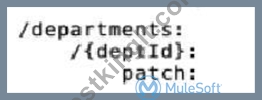
- A. Option A
- B. Option C
- C. Option B
- D. Option D
Answer: D
NEW QUESTION 63
Refer to the exhibit.
What is the response to a web client request to
- A. null
- B. After
- C. before
- D. Validation Error
Answer: B
NEW QUESTION 64
Refer to the exhibits.
Each route in the Scatter-Gather sets the payload to the number shown in the label. What response is returned to a web client request to the HTTP Listener?
A)
B)
C)
D)
- A. Option A
- B. Option C
- C. Option B
- D. Option D
Answer: D
NEW QUESTION 65
Refer to the exhibit.
The error occurs when a project is run in Anypoint Studio. The project, which has a dependency that is not in the MuleSoft Maven repository, was created and successfully run on a different computer.
What is the next step to fix the error to get the project to run successfully?
- A. Install the dependency to the computer's local Maven repository
- B. Add the dependency to the MULE_HOME/bin folder
- C. Deploy the dependency to MuleSoft's Maven repository
- D. Edit the dependency in the Mule project's pom.xml file
Answer: A
NEW QUESTION 66
Refer to the exhibits.
A web client sends sale data in a POST request to the Mule application. The Transform Message component then enrich the payload by prepending a vendor name to the sale data.
What is written to the sales.csv file when the flow executes?
- A. An error message
- B. The enriched payload in XML format
- C. The enriched payload in CSV format
- D. The enriched payload in JSON format
Answer: D
NEW QUESTION 67
Refer to the exhibit. The main flow contains an HTTP Request in the middle of the flow. The HTTP Listeners and HTTP request use default configurations.
What values are accessible to the Logger at the end of the flow after a web client submit request to
http://local:801/order?color=red?
- A. payload color query param
- B. payload
- C. payload quantity var color query param
- D. payload quantity var
Answer: D
NEW QUESTION 68
Refer to the exhibit.
How many private flows does APIKIT generate from the RAML specification?
- A. 0
- B. 1
- C. 2
- D. 3
Answer: B
NEW QUESTION 69
Refer to the exhibits.
The web client sends a POST request to the ACME Order API with an XML payload. An error is returned.
What should be changed in the request so that a success response code is returned to the web client?
- A. Set a request header with the name Content-Type to a value of applicatron/octet-stream
- B. Set a response header with the name Content-Type to a value of applkation/xml
- C. Set a response header with the name Content-Type to a value of application/octet-stream
- D. Set a request header with the name Content-Type to a value of application/xml
Answer: D
NEW QUESTION 70
Refer to the exhibits.

A web client submits a request to the HTTP Listener and the HTTP Request throws an error.
What payload and status code are returned to the web client?
Refer to the exhibits. A web client submits a request to the HTTP Listener and the HTTP Request throws an error.
What payload and status code are returned to the web client?
- A. Error response body: error, description Default error response status code: 500
- B. Response body: "Success - End" Default response status code: 200
- C. Response body: "Success - Begin* Default response status code: 200
- D. Response body: "Error" Default response status code: 200
Answer: D
NEW QUESTION 71
A Mule project contains a DataWeave module called MyModule.dwl that defines a function named formatString. The module is located in the project's src/main/resources/modules folder.
What is the correct way in DataWeave code to import MyModule using a wildcard and then call the module's formatString function?
A)
B)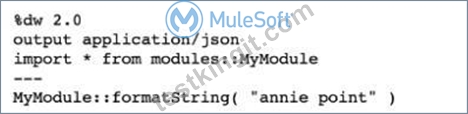
C)
D)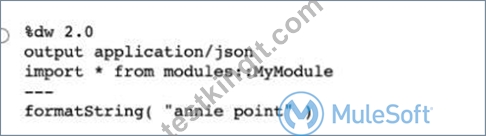
- A. Option A
- B. Option C
- C. Option B
- D. Option D
Answer: D
NEW QUESTION 72
Refer to the exhibits.
Each route in the Scatter-Gather sets the payload to the number shown in the label. What response is returned to a web client request to the HTTP Listener?
A)
B)
C)
D)
- A. Option A
- B. Option C
- C. Option B
- D. Option D
Answer: D
NEW QUESTION 73
What is the output type of the DataWeave map operator?
- A. String
- B. Array
- C. Object
- D. Map
Answer: C
NEW QUESTION 74
......
MCD-Level-1 Actual Questions Answers PDF 100% Cover Real Exam Questions: https://www.testkingit.com/MuleSoft/latest-MCD-Level-1-exam-dumps.html