

[Nov 18, 2024] AD0-E134 Exam Dumps, AD0-E134 Practice Test Questions
Free AD0-E134 Study Guides Exam Questions and Answer
Adobe AD0-E134 Exam Syllabus Topics:
| Topic | Details |
|---|---|
| Topic 1 |
|
| Topic 2 |
|
| Topic 3 |
|
| Topic 4 |
|
| Topic 5 |
|
NEW QUESTION # 42
A client is having issues with some query results:
* Many of the client's industry terms have the same meaning, and users do not always search the exact wording
* Many users search by typing in short phrases instead of exact keywords, ex:// "cats and dogs" What index analyzers should the AEM developer recommend?
- A. 1. Add a Synonym filter to the current indexes
2. Add a Stop filter to the current indexes - B. 1. Add a Mapping filter to the current indexes
2. Add a Stop filter to the current indexes - C. 1. Add a Synonym filter to the current indexes
2. Add a LowerCase filter to the current indexes - D. 1. Tokenize the current indexes with a Keyword tokenizer
2. Add a Mapping filter to the current indexes
Answer: C
Explanation:
A Synonym filter can help to map different terms that have the same meaning, such as "cat" and "feline". A LowerCase filter can help to normalize the case of the terms, so that "cats and dogs" and "Cats and Dogs" are treated the same.
NEW QUESTION # 43
Refer to the exhibit.
The current page has three children.
What is the final rendered html output for the code snippet?
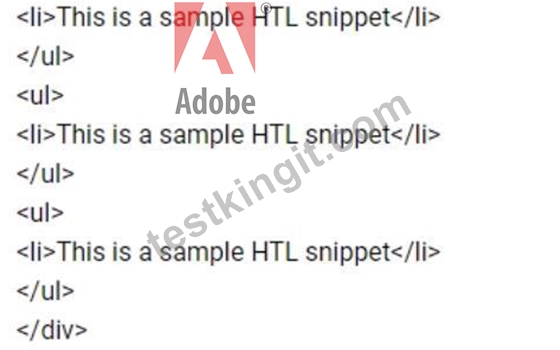
- A.
- B.
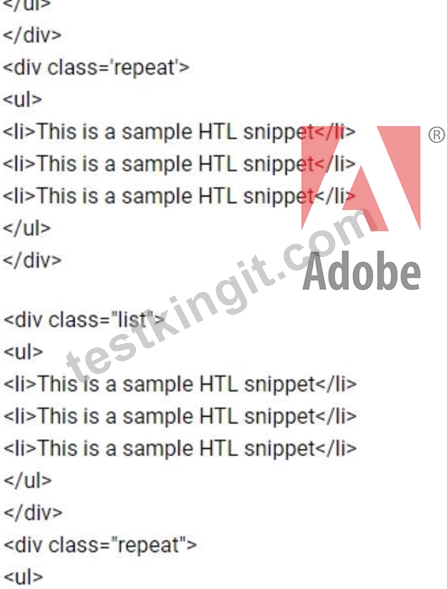
- C.
Answer: B
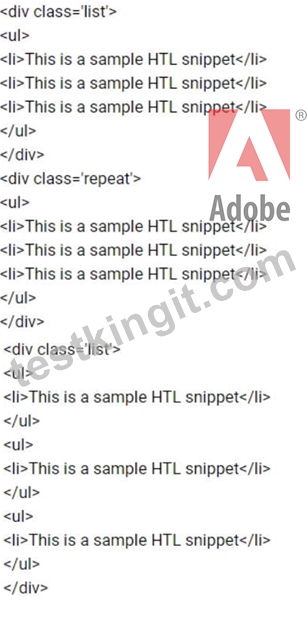
Explanation:
Explanation
Option B is the final rendered html output for the code snippet. The code snippet uses the data-sly-list block statement to iterate over the child pages of the current page. The data-sly-list statement assigns each child page to a variable named page and provides an index variable named i. The code snippet then uses the data-sly-test block statement to check if the index is odd or even and applies a different CSS class accordingly. The code snippet also uses the data-sly-element block statement to create an HTML element with the name specified by the elementName variable. The code snippet also uses the data-sly-attribute block statement to add an attribute with the name specified by the attrName variable and the value specified by the attrValue variable. The code snippet also uses the data-sly-resource block statement to include a resource with the path specified by the page.path variable and the resourceType specified by the resourceType variable.
References:https://experienceleague.adobe.com/docs/experience-manager-htl/using-htl/htl-block-statements.htm
NEW QUESTION # 44
In a non-optimized website, the final HTML generated for a typical page by publish instance includes a relatively large number of <script> elements that refer to other script files loaded from AEM environment. The developer wants to minimize these network calls by combining all required client library code into a single file to reduce the number of back-and-forth requests on page load.
Which step should a developer take to solve this issue?
- A. Embed the required libraries into an app-specific client library using the dependencies property of the cq:Clientl_ibraryFolder node
- B. Embed the required libraries into an app-specific client library using the embed property of the cq:ClientLibraryFolder node
- C. Embed the required libraries into an app-specific client library using the allowProxy property of the cq:Clientl_ibraryFolder node
- D. Add the categories property of the cq:Clientl_ibraryFolder node into an app-specific client library folder
Answer: A
Explanation:
The embed property of the cq:ClientLibraryFolder node allows embedding code from a client library into another client library. At runtime, the generated JS and CSS files of the embedding library include the code of the embedded library. This reduces the number of network calls and improves performance. Embedding code is useful for providing access to libraries that are stored in secured areas of the repository. References:
https://experienceleague.adobe.com/docs/experience-manager-cloud-service/content/implementing/developing/fu
NEW QUESTION # 45
Which configuration/section should be used to resolve the domain name by dispatcher?
- A. Configuration in filters.any
- B. Configuration in DNS
- C. Configuration in httpd.conf
- D. Configuration in vhosts file
Answer: B
Explanation:
Explanation
The configuration in DNS (Domain Name System) should be used to resolve the domain name by dispatcher.
The DNS resolves the domain names to the IP address of the web server that hosts the dispatcher. The dispatcher then matches the incoming request URL with the cached files or the AEM publish instances.
References:https://experienceleague.adobe.com/docs/experience-manager-dispatcher/using/configuring/dispatche
NEW QUESTION # 46
AMS recommends a learn to upgrade AEM servers with In-place Upgrade because the existing version has reached EOL What are two disadvantages of performing an In-place Upgrade to the latest version of AEM? (Select two.)
- A. Content revision history Is not preserved.
- B. Content Migration is required.
- C. Depending on the version difference between the old and new instances, the upgrade can be a long and arduous process.
- D. ACLs, users, and groups are lost.
- E. Complex developer setup and automation of the upgrade process.
Answer: C,E
Explanation:
When performing an in-place upgrade to the latest version of AEM, there are several potential disadvantages to consider:
* Long and Arduous Process:
* The complexity and duration of the upgrade process can be significant, especially if there is a considerable version difference between the old and new AEM instances. This is because the upgrade process must account for all the changes and improvements made over multiple versions, including content structures, APIs, and underlying technologies.
* References:AEM Upgrade Best Practices
* Complex Developer Setup and Automation:
* Upgrading AEM involves setting up and configuring the environment, updating custom code, and ensuring that all integrations work seamlessly. Automating these tasks can be complex and time-consuming, requiring significant developer effort to script and validate the upgrade process.
* References:Automating AEM Upgrades
These disadvantages highlight the potential challenges and resource investments needed for an in-place upgrade.
NEW QUESTION # 47
A developer needs to create sling models for two fields name and occupations. The dialog has two fields, name - a single value field, and occupations - a multi value field.
The following code is included in sling models inherited from interface com.adobe.aem.guides.wknd.core.models.Byline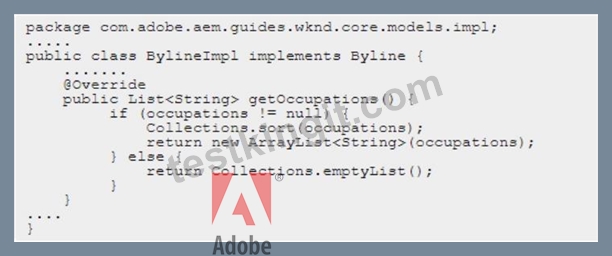
Which method should be used to used to represent this model in HTL?
- A.

- B.

- C.

- D.

Answer: C
Explanation:
Option C is the correct implementation for the Sling Model. Option C uses the @Model annotation with the adaptables parameter set to Resource.class. This allows the Sling Model to adapt from a resource object and access its properties using the ValueMap interface. Option C also uses the @Inject annotation with the name parameter set to "./name" and "./occupations" to inject the values of the name and occupations properties into the name and occupations fields. Option C also uses the @Named annotation with the value parameter set to
"byline" to specify the name of the Sling Model that can be used in HTL scripts. References:
https://sling.apache.org/documentation/bundles/models.htmlhttps://experienceleague.adobe.com/docs/experience
NEW QUESTION # 48
An AEM developer is assigned a task to design a workflow. The workflow is supposed to collect data from the participant and then determine the reviewer/approver branch to proceed further.
Which workflow step should be used by the developer?
- A. Dialog Participant Step
- B. Dynamic Participant Step
- C. Form Participant Step
- D. Workflow Initiator Participant Chooser
Answer: B
Explanation:
To design a workflow that collects data from the participant and then determines the reviewer/approver branch to proceed further, the developer should use theDynamic Participant Step. This workflow step allows for dynamic determination of participants based on the data collected or any other logic implemented in the workflow.
Here's how to implement a Dynamic Participant Step in AEM:
* Create the Workflow Model:
* In AEM, navigate to Tools > Workflow > Models.
* Create a new workflow model or edit an existing one.
* Add Dynamic Participant Step:
* Drag and drop the Dynamic Participant Step into your workflow model.
* Configure the Dynamic Participant Step:
* Click on the Dynamic Participant Step and configure it by specifying the participant chooser class.
This class should implement the logic to determine the next participant.
@Component(service = ParticipantStepChooser.class, property = {
"service.description=Dynamic Participant Chooser"
})
public class CustomParticipantStepChooser implements ParticipantStepChooser {
@Override
public String getParticipant(WorkItem workItem, WorkflowSession workflowSession, MetaDataMap metaDataMap) {
// Custom logic to determine the participant based on workflow data
String reviewer = // logic to determine reviewer
return reviewer;
}
}
* Implement Participant Chooser Logic:
* The CustomParticipantStepChooser class should contain the logic to determine the next participant based on the workflow data. This can include reading workflow variables, making decisions based on conditions, or any other custom logic.
* Deploy and Test:
* Save the workflow model and test it by starting a new workflow instance. Ensure that the dynamic participant determination works as expected.
By using the Dynamic Participant Step, you can create flexible workflows that adapt to the data and context, ensuring that the appropriate participants are chosen dynamically.
References:
* Adobe Experience Manager Workflow
* AEM Dynamic Participant Step
NEW QUESTION # 49
An AEM as a Cloud Service implementation customer wants content to be replicated as soon as the On Time and Off Times are reached.
What must the developer configure?
- A. Enable Auto Replicate via On Off Trigger Configuration
- B. Configure the Publish content tree via Workflow Models
- C. Enable On Time or Off Time via Page Properties
Answer: A
Explanation:
Explanation
The Auto Replicate via On Off Trigger Configuration is a feature that allows content to be replicated as soon as the On Time and Off Times are reached. This feature can be enabled by creating an OSGi configuration for the com.day.cq.wcm.core.impl.servlets.OnOffTimeServlet service. This service listens for changes in the On Time and Off Time properties of pages andtriggers replication accordingly. References:
https://experienceleague.adobe.com/docs/experience-manager-65/deploying/configuring/replication.html?lang=e
NEW QUESTION # 50
Refer to the exhibit.
The current page has three children.
What is the final rendered html output for the code snippet?
- A.
- B.
- C.
Answer: B
Explanation:
Option B is the final rendered html output for the code snippet. The code snippet uses the data-sly-list block statement to iterate over the child pages of the current page. The data-sly-list statement assigns each child page to a variable named page and provides an index variable named i. The code snippet then uses the data-sly-test block statement to check if the index is odd or even and applies a different CSS class accordingly. The code snippet also uses the data-sly-element block statement to create an HTML element with the name specified by the elementName variable. The code snippet also uses the data-sly-attribute block statement to add an attribute with the name specified by the attrName variable and the value specified by the attrValue variable. The code snippet also uses the data-sly-resource block statement to include a resource with the path specified by the page.path variable and the resourceType specified by the resourceType variable.References:https://experienceleague.adobe.com/docs/experience-manager-htl/using-htl/htl-block-statem
NEW QUESTION # 51
A customer who is running an AEM application on premise reports that the application is slowing down over time and even crashes The issues seem to start occurring after a new production deployment. The AEM developer knows that the described symptoms could be caused by a memory leak.
Which two steps should be taken after confirming the problem is related to a memory issue? (Choose two.)
- A. Open the error log and look for messages with 'OutOfMemoryError'
- B. Create a thread dump for analysis
- C. Increase the cache ratio of the application
- D. Create a heap dump for analysis
- E. Analyze the request log and make sure the number of requests are below the expected threshold
Answer: B,D
Explanation:
Creating a heap dump and a thread dump are two steps that should be taken after confirming the problem is related to a memory issue. A heap dump is a snapshot of the memory usage of the Java Virtual Machine (JVM) at a given point in time. A heap dump can be used to identify memory leaks, memory consumption patterns, and objects that occupy large amounts of memory. A thread dump is a snapshot of the state of all threads that are part of the JVM process. A thread dump can be used to identify deadlocks, blocked threads, and CPU-intensive threads. References:
https://experienceleague.adobe.com/docs/experience-manager-65/deploying/configuring/memory-analysis.html?
NEW QUESTION # 52
An AEM server is overloaded with too many concurrently running workflows. The developer decides to reduce the number of concurrent workflows.
What should be configured to reduce the number of concurrent workflows?
- A. Maximum Parallel Jobs in OSGI console
- B. Launchers for each workflow
- C. The number of threads in Scheduler
- D. The number of threads in Apache Felix Jetty Http Service
Answer: A
Explanation:
Explanation
Maximum Parallel Jobs is a configuration property that controls how many workflows can run concurrently on an AEM instance. Reducing this value can help to avoid overloading the server with too many workflows.
NEW QUESTION # 53
An AEM application is expected to export a content fragment in JSON format without any customization for a headless implementation.
What is the recommended approach?
- A. Use Sling Exporter framework
- B. Use Core components to export JSON
- C. Use AEM Assets HTTP API
Answer: C
Explanation:
AEM Assets HTTP API is a RESTful API that allows access to content fragments in JSON format without any customization. The API supports CRUD operations on content fragments and their variations, as well as querying and searching for content fragments based on metadata or full-text search.References:https://experienceleague.adobe.com/docs/experience-manager-65/assets/extending/assets-api-
NEW QUESTION # 54
A developer needs to create a workflow custom process step in AEM. In a custom process step, an OSGi component needs to implement the WorkflowProcess interface.
Which method should the developer implement?
- A. submit
- B. execute
- C. call
- D. apply
Answer: B
Explanation:
The WorkflowProcess interface is the interface to be used for automatic workflow steps implemented in Java.
Classes implementing this interface define Java based processes that can be attached to a WorkflowNode and executed by the workflow engine. The method execute takes a WorkItem, a WorkflowSession and a MetaDataMap as parameters and performs thelogic of the custom process step. References:
https://developer.adobe.com/experience-manager/reference-materials/6-5/javadoc/com/adobe/granite/workflow/e
NEW QUESTION # 55
Which Maven plugin checks if all the requirements declarations made in OSGi bundles are satisfied by the capabilities declarations of other bundles included in the Maven project?
- A. content-package-maven-plugin
- B. femaven-assembly-plugin
- C. maven-enforcer-plugin
- D. aemanalyser-maven-plugin
Answer: D
NEW QUESTION # 56
What is the correct order of resolution of OSGi configuration at Runtime?
- A. 1. Modifying a configuration in the Web console will take immediate effect as it takes precedence at runtime.
2. Modifying a configuration in /apps will take immediate effect
3. Modifying a configuration in /libs will take immediate effect, unless it is masked by a configuration in
/apps. - B. 1. Modifying a configuration in /apps will take immediate effect
2. Modifying a configuration in the Web console will take immediate effect as it takes precedence at runtime.
3. Modifying a configuration in /libs will take immediate effect, unless it is masked by a configuration in
/apps. - C. 1. Modifying a configuration in the Web console will take immediate effect as it takes precedence at runtime.
2. Modifying a configuration in /libs will take immediate effect, unless it is masked by a configuration in
/apps.
3. Modifying a configuration in /apps will lake immediate effect. - D. 1. Modifying a configuration in /libs will lake immediate effect, unless it is masked by a configuration in
/apps O 2. Modifying a configuration in /apps will take immediate effect
3. Modifying a configuration in the Web console will take immediate effect as it takes precedence at runtime.
Answer: A
Explanation:
The order of resolution for OSGi configurations at runtime in AEM is as follows:
* Web Console Configuration:
* Changes made through the OSGi Web Console take immediate effect and have the highest precedence. This is because these configurations are considered the most direct way to adjust OSGi settings at runtime.
* References:OSGi Configuration in AEM
* /apps Configuration:
* Configurations in the /apps directory take precedence over those in the /libs directory. This allows custom configurations to override the default configurations provided by AEM.
* References:AEM Project Structure
* /libs Configuration:
* Configurations in the /libs directory are the default configurations provided by AEM. They are overridden by any configurations in the /apps directory.
* References:AEM Configuration
By understanding this order, developers can effectively manage and prioritize their OSGi configurations to ensure the desired behavior of their AEM instances.
NEW QUESTION # 57
A developer needs to create a workflow custom process step in AEM. In a custom process step, an OSGi component needs to implement the WorkflowProcess interface.
Which method should the developer implement?
- A. submit
- B. execute
- C. call
- D. apply
Answer: B
Explanation:
Explanation
The WorkflowProcess interface is the interface to be used for automatic workflow steps implemented in Java.
Classes implementing this interface define Java based processes that can be attached to a WorkflowNode and executed by the workflow engine. The method execute takes a WorkItem, a WorkflowSession and a MetaDataMap as parameters and performs the logic of the custom process step. References:
https://developer.adobe.com/experience-manager/reference-materials/6-5/javadoc/com/adobe/granite/workflow/e
NEW QUESTION # 58
A developer has to create a Logger and Writer pair for the company's application logging. Which OSGi configurations should the developer use?
- A. Apache Sling Logging Logger Configuration and Apache Sling Logging Writer Configuration
- B. Apache Sling Logging Logger Configuration and Apache Sling Logging Configuration
- C. Apache Sling Request Logger and Apache Sling Logging Writer Configuration
Answer: A
Explanation:
Explanation
The Apache Sling Logging Logger Configuration and Apache Sling Logging Writer Configuration are the OSGi configurations that the developer should use to create a Logger and Writer pair for the company's application logging. The Logger Configuration defines the log level and the log file name for a given logger name or category. The Writer Configuration defines the file size, number of files, and file location for a given log file name.
References:https://experienceleague.adobe.com/docs/experience-manager-65/deploying/configuring/configure-lo
NEW QUESTION # 59
In an AEM as a Cloud Service environment, which repository areas are considered as immutable?
- A. /content and /etc
- B. /apps and /libs
- C. /content and /libs
- D. /apps and /content
Answer: B
Explanation:
Explanation
In AEM as a Cloud Service environment, the repository areas /apps and /libs are considered as immutable, meaning that they cannot be modified at runtime by any means. These areas contain application code and configuration that are deployed via Cloud Manager and are read-only for security and performance reasons.
Any changes to these areas require a new deployment via Cloud Manager. References:
https://experienceleague.adobe.com/docs/experience-manager-cloud-service/implementing/deploying/overview.h
NEW QUESTION # 60
A customer adds third-party client libraries to add some features in an existing AEM application, which will significantly reduce performance.
How should the developer optimize the site?
- A. Rebuild Client libraries.
- B. Debug third-party client lib and fix the code.
- C. Embed client libraries to consolidate them into fewer files.
Answer: C
Explanation:
Embedding client libraries is a technique that allows combining code from multiple client libraries into a single file. This reduces the number of network requests and improves performance. Embedding client libraries can be done by using the embed property of the cq:ClientLibraryFolder node and specifying the categories of the client libraries to be embedded. References:
https://experienceleague.adobe.com/docs/experience-manager-cloud-service/content/implementing/developing/fu
NEW QUESTION # 61
An AEM development team is working on a new multi-country application using AEM as a Cloud Service. A developer has been assigned the task for building the integration with a third-party web service. A secret key is needed to connect with this web service. The website creators will provide this key. The key is different for each type of environment (dev, stage and production) What is the recommended way to make the secret key available in the AEM application?
- A. Read the key value from a property file stored in the code base
- B. Use a context aware configuration
- C. Read the key value from OSGi configuration stored in run nNdes
- D. Use an environment variable which is then consumed by an OSGi configuration
Answer: D
Explanation:
Explanation
The recommended way to make the secret key available in the AEM application is to use an environment variable which is then consumed by an OSGi configuration. This way, the secret key is not stored in the code base or in the repository, but rather in a secure and encrypted way in the Cloud Manager environment variables. The OSGi configuration can use a placeholder to reference the environment variable and inject its value at runtime. References:
https://experienceleague.adobe.com/docs/experience-manager-cloud-service/implementing/deploying/configurin
NEW QUESTION # 62
A developer is on an AEM application that is being used to calculate an employee's salary. The calculation is done in an OSGi service called CalculationService. This service class has a dependency on one other service, called the EmployeeService.
How should the developer make sure that the critical code in the CalculationService has a high unit test coverage?
- A. Use a mock framework in the unit test to inject the CalculationService
- B. Use the feature flag in the unit test to disable the calls to the EmployeeService
- C. Instantiate the EmployeeService in the unit test and pass it to the constructor of the CalculationService
- D. Use a mock framework in the unit test to inject the EmployeeService
Answer: D
Explanation:
Explanation
A mock framework is a tool that allows creating mock objects that simulate the behavior of real objects in a controlled way. A mock framework can be used in a unit test to inject the EmployeeService dependency into the CalculationService and verify its interactions. This way, the unit test can focus on testing the logic of the CalculationService without relying on the actual implementation of the EmployeeService. References:
https://sling.apache.org/documentation/development/sling-testing-tools.htmlhttps://wcm.io/testing/aem-mock/usa
NEW QUESTION # 63
......
AD0-E134 Exam Dumps, AD0-E134 Practice Test Questions: https://www.testkingit.com/Adobe/latest-AD0-E134-exam-dumps.html
Attested AD0-E134 Dumps PDF Resource [2024]: https://drive.google.com/open?id=1M584d95Y4-8CunAvrQnFZ3RHWzsWGb7p