

New 2024 Guaranteed Success with TestKingIT AZ-120 Dumps Microsoft PDF Questions
Exceptional Practice To Planning and Administering Microsoft Azure for SAP Workloads Pass the First Time
NEW QUESTION # 36
You are deploying an SAP environment on Azure that will use an SAP HANA database server.
You provision an Azure virtual machine for SAP HANA by using the M64s virtual machine SKU.
You need to set the swap space by using the Microsoft Azure Linux Agent (waagent) configuration file.
Which two settings should you configure? Each correct answer presents part of the solution.
NOTE: Each correct selection is worth one point.
- A. ResourceDisk.EnableSwap=y
- B. AutoUpdate.Enabled=n
ResourceDisk.SwapSizeMB=229376 - C. ResourceDisk.EnableSwapEncryption=n
Answer: A
Explanation:
To create a swap file in the directory that's defined by the ResourceDisk.MountPoint parameter, you can update the /etc/waagent.conf file by setting the following three parameters:
ResourceDisk.Format=y
ResourceDisk.EnableSwap=y
ResourceDisk.SwapSizeMB=xx
Reference:
https://support.microsoft.com/en-us/help/4010058/how-to-add-a-swap-file-in-linux-azure-virtual-machines
NEW QUESTION # 37
You have an Azure subscription that contains a virtual network named VNET1, an SAP production landscape on Azure, and an SAP non-production landscape on Azure. Both landscapes connect to VNET1. Each landscape contains virtual machines that run the following:
* SAPHANA
* SAP NetWeaver
* Microsoft SQL Server
You need to monitor the landscapes. The solution must minimize costs.
What is the minimum number of required Azure Monitor for SAP Solutions instances?
- A. 0
- B. 1
- C. 2
- D. 3
Answer: D
NEW QUESTION # 38
You are planning the Azure network infrastructure for an SAP environment.
For each of the following statements, select Yes if the statement is true. Otherwise, select No.
NOTE: Each correct selection is worth one point.
Answer:
Explanation:
Explanation
Box 1: NO
Box 2: Yes
Box 3: Yes
Be aware that network traffic between two peered Azure virtual networks is subject to transfer costs. Huge data volume that consists of many terabytes is exchanged between the SAP application layer and the DBMS layer. You can accumulate substantial costs if the SAP application layer and DBMS layer are segregated between two peered Azure virtual networks.
References:
https://docs.microsoft.com/en-us/azure/virtual-machines/workloads/sap/dbms_guide_general
NEW QUESTION # 39
You have an on-premises third-party enterprise resource planning (ERP) system that uses Microsoft SQL Server 2016. You plan to migrate the ERP system to SAP Business Suite on SAP HANA on Azure virtual machines. You need to identify the appropriate sizing for Business Suite on HANA. What should you use?
- A. SAP Quick Sizer for HANA
- B. SAP Cloud Platform Cockpit
- C. HANA Cockpit
- D. SAP Quick Sizer for HANA Cloud
Answer: A
NEW QUESTION # 40
You have an Azure subscription that contains the resources shown in the following table.
You plan to deploy an SAP production landscape.
You create the following PowerShell Desired State Configuration (DSC) and publish the DSC configuration to corpsoftware.
You need to deploy the DSC configuration to VM1.
How should you compete the command? To answer, select the appropriate options in the answer area NOTE:
Each correct selection is worth one point.
Answer:
Explanation:
Explanation
NEW QUESTION # 41
Note: This question is part of a series of questions that present the same scenario. Each question in the series contains a unique solution that might meet the stated goals. Some question sets might have more than one correct solution, while others might not have a correct solution.
After you answer a question in this section, you will NOT be able to return to it. As a result, these questions will not appear in the review screen.
You plan to migrate an SAP HANA instance to Azure.
You need to gather CPU metrics from the last 24 hours from the instance.
Solution: You use DBA Cockpit from SAP GUI.
Does this meet the goal?
- A. Yes
- B. No
Answer: A
Explanation:
The SAP HANA cockpit provides a single point of access to a range of SAP HANA administration and monitoring tasks. It is used to monitor and ensure the overall health of the system.
The HANA Monitoring dashboard also visualizes key HANA Metrics of SAP HANA system.
Reference:
https://developers.sap.com/tutorials/dt-monitoring-hana-part1.html
https://help.sap.com/viewer/afa922439b204e9caf22c78b6b69e4f2/2.10.0.0/en-US
https://www.hanatutorials.com/p/hana-monitoring-dashboard.html
NEW QUESTION # 42
You have an Azure Availability Set that is configured as shown in the following exhibit.
Use the drop-down menus to select the answer choice that completes each statement based on the information presented in the graphic.
NOTE: Each correct selection is worth one point.
Answer:
Explanation: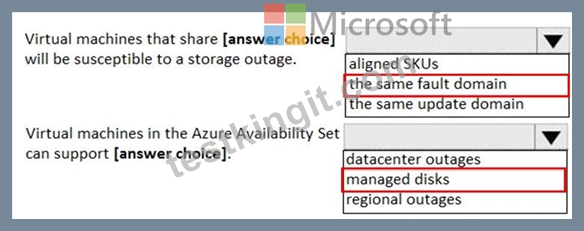
Explanation:
Box 1: the same fault domain
Fault domains define the group of virtual machines that share a common power source and network switch. If a storage fault domain fails due to hardware or software failure, only the VM instance with disks on the storage fault domain fails.
Box 2: managed disks
Managed disks provide better reliability for Availability Sets by ensuring that the disks of VMs in an Availability Set are sufficiently isolated from each other to avoid single points of failure. It does this by automatically placing the disks in different storage fault domains (storage clusters) and aligning them with the VM fault domain.
References:
https://docs.microsoft.com/en-us/azure/virtual-machines/windows/manage-availability
NEW QUESTION # 43
Note: This question is part of a series of questions that present the same scenario. Each question in the series contains a unique solution that might meet the stated goals. Some question sets might have more than one correct solution, while others might not have a correct solution.
After you answer a question in this section, you will NOT be able to return to it. As a result, these questions will not appear in the review screen.
You have a complex SAP environment that has both ABAP- and Java-based systems. The current on-premises landscapes are based on SAP NetWeaver 7.0 (Unicode and Non-Unicode) running on Windows Server and Microsoft SQL Server.
You need to migrate the SAP environment to a HANA-certified Azure environment.
Solution: You upgrade to SAP NetWeaver 7.4, and then you migrate SAP to Azure by using Azure Site Recovery.
Does this meet the goal?
- A. Yes
- B. No
Answer: A
Explanation:
Explanation
We need upgrade to SAP NetWeaver 7.4 before the migration. Then Azure Site Recovery is used for the migration to Azure.
Reference:
https://docs.microsoft.com/en-us/azure/site-recovery/vmware-azure-architecture
NEW QUESTION # 44
You are validating an SAP HANA on Azure (Large Instances) deployment.
You need to ensure that sapconf is installed and the kernel parameters are set appropriately for the active profile.
How should you complete the commands? To answer, drag the appropriate values to the correct targets. Each value may be used once, more than once, or not at all. You may need to drag the split bar between panes or scroll to view content.
NOTE:Each correct selection is worth one point.
Answer:
Explanation:
Explanation
Box 1: sapconf
The configuration is split into two parts:
/etc/sysconfig/sapconf
/usr/lib/tuned//tuned.conf
Box 2: sap-hana
References:
https://blogs.sap.com/2017/12/22/prepare-your-linux-for-your-sap-solution-with-saptune/
NEW QUESTION # 45
You are migrating SAP to Azure. The ASCS application servers are in one Azure zone, and the SAP database server in in a different Azure zone. ASCS/ERS is configured for high availability.
During performance testing, you discover increased response times in Azure, even though the Azure environment has better computer and memory configurations than the on-premises environment.
During the initial analysis, you discover an increased wait time for Enqueue.
What are three possible causes of the increased wait time? Each correct answer presents a complete solution.
NOTE: Each correct selection is worth one point.
- A. misconfigured load balancer rules and health check probes for Enqueue and ASCS
- B. network latency between the database server and the SAP application servers
- C. a missing Enqueue profile
- D. disk I/O during Enqueue backup operations
- E. active Enqueue replication
Answer: A,B,E
Explanation:
Explanation
E: The network latency across Availability Zones is not the same in all Azure regions. In some cases, you can deploy and run the SAP application layer across different zones because the network latency from one zone to the active DBMS VM is acceptable. But in some Azure regions, the latency between the active DBMS VM and the SAP application instance, when deployed in different zones, might not be acceptable for SAP business processes.
References:
https://docs.microsoft.com/en-us/azure/virtual-machines/workloads/sap/sap-ha-availability-zones
NEW QUESTION # 46
You are integrating SAP HANA and Azure Active Directory (Azure AD).
For each of the following statements, select Yes if the statement is true. Otherwise, select No.
NOTE: Each correct selection is worth one point.
Answer:
Explanation:
Explanation
Box 1: Yes
To configure Azure AD single sign-on with SAP HANA, perform the following steps:
1. In the Azure portal, on the SAP HANA application integration page, select Single sign-on.
2. On the Select a Single sign-on method dialog, select SAML/WS-Fed mode to enable single sign-on.
Box 2: No
Box 3: No
Key security considerations for deploying SAP on Azure
References:
https://docs.microsoft.com/en-us/azure/active-directory/saas-apps/saphana-tutorial
https://docs.microsoft.com/en-us/azure/active-directory/saas-apps/saphana-tutorial
NEW QUESTION # 47
You have an Azure Active Directory (Azure AD) tenant and an SAP Cloud Platform Identity Authentication Service tenant.
You need to ensure that users can use their Azure AD credentials to authenticate to SAP applications and services that trust the SAP Cloud Platform Identity Authentication Service tenant.
In which order should you perform the actions? To answer, move all actions from the list of actions to the answer area and arrange them in the correct order.
Answer:
Explanation:
Explanation
Table Description automatically generated
Step 1: Create and configure an enterprise application in the Azure AD tentant To configure the integration of SAP Cloud Platform Identity Authentication into Azure AD, you need to add SAP Cloud Platform Identity Authentication from the gallery to your list of managed SaaS apps.
Sign in to the Azure portal using either a work or school account, or a personal Microsoft account.
On the left navigation pane, select the Azure Active Directory service.
Navigate to Enterprise Applications and then select All Applications.
To add new application, select New application.
In the Add from the gallery section, type SAP Cloud Platform Identity Authentication in the search box.
Select SAP Cloud Platform Identity Authentication from results panel and then add the app. Wait a few seconds while the app is added to your tenant.
Graphical user interface, text, application Description automatically generated
Step 2: Download the single sign-on (SSO) metadata from the Azure AD tenant.
Download single sign-on metadata from Azure Active Directory.
Step 3: Create and configure a corporate identity provider.
Create corporate identity provider.
Step 4: Download the SAP Cloud Platform Identity Authentication Service tenant metadata.
Download Identity Authentication service tenant metadata.
Step 5: Upload the SAP Cloud Platform Identity Authentication Service tenant metadata to Azure AD tenant.
Upload Identity Authentication service tenant metadata to Azure Active Directory.
You have already uploaded the metadata file from Azure Active Directory to Identity Authentication service.
It's time to do it the other way round now and upload the metadata of Identity Authentication service to Azure Active Directory.
Reference:
https://developers.sap.com/tutorials/cp-ias-azure-ad.html
NEW QUESTION # 48
You have an on-premises SAP environment. Application servers run on SUSE Linux Enterprise Server (SLES) servers. Databases run on SLES servers that have Oracle installed.
You need to recommend a solution to migrate the environment to Azure. The solution must use currently deployed technologies whenever possible and support high availability.
What should you include in the recommendation? To answer, select the appropriate options in the answer area.
NOTE: Each correct selection is worth one point.
Answer:
Explanation:
NEW QUESTION # 49
You are evaluating which migration method Litware can implement based on the current environment and the business goals.
Which migration method will cause the least amount of downtime?
- A. Migrate SAP ECC to SAP Business Suite in HANA, and then migrate SAP to Azure.
- B. Migrate SAP to Azure, and then migrate SAP ECC to SAP Business Suite on HANA.
- C. Use Near-Zero Downtime (NZDT) to migrate to SAP HANA and Azure during the same maintenance window.
- D. Use the Database Migration Option (DMO) to migrate to SAP HANA and Azure during the same maintenance window.
Answer: D
Explanation:
The SAP Database Migration Option (DMO) with System Move option of SUM, used as part of the migration allows customer the options to perform the migration in a single step, from source system on-premises, or to the target system residing in Microsoft Azure, minimizing overall downtime.
Reference:
https://blogs.sap.com/2017/10/05/your-sap-on-azure-part-2-dmo-with-system-move/ Migrate SAP Workloads to Azure Testlet 2 Case Study This is a case study. Case studies are not timed separately. You can use as much exam time as you would like to complete each case. However, there may be additional case studies and sections on this exam. You must manage your time to ensure that you are able to complete all questions included on this exam in the time provided.
To answer the questions included in a case study, you will need to reference information that is provided in the case study. Case studies might contain exhibits and other resources that provide more information about the scenario that is described in the case study. Each question is independent of the other questions in this case study.
At the end of this case study, a review screen will appear. This screen allows you to review your answers and to make changes before you move to the next section of the exam. After you begin a new section, you cannot return to this section.
To start the case study
To display the first question in this case study, click the Next button. Use the buttons in the left pane to explore the content of the case study before you answer the questions. Clicking these buttons displays information such as business requirements, existing environment, and problem statements. If the case study has an All Information tab, note that the information displayed is identical to the information displayed on the subsequent tabs. When you are ready to answer a question, click the Question button to return to the question.
Overview
Contoso, Ltd. is a manufacturing company that has 15,000 employees.
The company uses SAP for sales and manufacturing.
Contoso has sales offices in New York and London and manufacturing facilities in Boston and Seattle.
Existing Environment
Active Directory
The network contains an on-premises Active Directory domain named ad.contoso.com. User email addresses use a domain name of contoso.com.
SAP Environment
The current SAP environment contains the following components:
* SAP Solution Manager
* SAP ERP Central Component (SAP ECC)
* SAP Supply Chain Management (SAP SCM)
* SAP application servers that run Windows Server 2008 R2
* SAP HANA database servers that run SUSE Linux Enterprise Server 12 (SLES 12) Problem Statements Contoso identifies the following issues in its current environment:
* The SAP HANA environment lacks adequate resources.
* The Windows servers are nearing the end of support.
* The datacenters are at maximum capacity.
Requirements
Planned Changes
Contoso identifies the following planned changes:
* Deploy Azure Virtual WAN.
* Migrate the application servers to Windows Server 2016.
* Deploy ExpressRoute connections to all of the offices and manufacturing facilities.
* Deploy SAP landscapes to Azure for development, quality assurance, and production.
All resources for the production landscape will be in a resource group named SAPProduction.
Business goals
Contoso identifies the following business goals:
* Minimize costs whenever possible.
* Migrate SAP to Azure without causing downtime.
* Ensure that all SAP deployments to Azure are supported by SAP.
* Ensure that all the production databases can withstand the failure of an Azure region.
* Ensure that all the production application servers can restore daily backups from the last 21 days.
Technical Requirements
Contoso identifies the following technical requirements:
* Inspect all web queries.
* Deploy an SAP HANA cluster to two datacenters.
* Minimize the bandwidth used for database synchronization.
* Use Active Directory accounts to administer Azure resources.
* Ensure that each production application server has four 1-TB data disks.
* Ensure that an application server can be restored from a backup created during the last five days within 15 minutes.
* Implement an approval process to ensure that an SAP administrator is notified before another administrator attempts to make changes to the Azure virtual machines that host SAP.
It is estimated that during the migration, the bandwidth required between Azure and the New York office will be
1 Gbps. After the migration, a traffic burst of up to 3 Gbps will occur.
Proposed Backup Policy
An Azure administrator proposes the backup policy shown in the following exhibit.
Azure Resource Manager Template
An Azure administrator provides you with the Azure Resource Manager template that will be used to provision the production application servers.

Migrate SAP Workloads to Azure
Question Set 3
NEW QUESTION # 50
For each of the following statements, select Yes if the statement is true. Otherwise, select No.
NOTE: Each correct selection is worth one point.
Answer:
Explanation:
Explanation
Box 1: Yes
By moving much of Azure's software-defined networking stack off the CPUs and into FPGA-based SmartNICs, compute cycles are reclaimed by end user applications, putting less load on the VM, decreasing jitter and inconsistency in latency.
Box 2: Yes
Box 3: No
Accelerated Networking (AN) is generally available (GA) and widely available for Windows and the latest distributions of Linux References:
https://azure.microsoft.com/en-us/blog/maximize-your-vm-s-performance-with-accelerated-networking-now-gen
https://azure.microsoft.com/en-gb/blog/maximize-your-vm-s-performance-with-accelerated-networking-now-gen
NEW QUESTION # 51
This question requires that you evaluate the underlined text to determine if it is correct.
When deploying SAP HANA to an Azure virtual machine, you can enable Write Accelerator to reduce the latency between the SAP application servers and the database layer.
Instructions: Review the underlined text. If it makes the statement correct, select "No change is needed". If the statement is incorrect, select the answer choice that makes the statement correct.
- A. start the NIPING service
- B. enable Accelerated Networking
- C. install the Mellanox driver
- D. No change is needed
Answer: B
Explanation:
Explanation
To further reduce network latency between Azure VMs, we [Microsoft] recommend that you choose Azure Accelerated Networking. Use it when you deploy Azure VMs for an SAP workload, especially for the SAP application layer and the SAP DBMS layer.
Topic 2, Contoso Ltd Case Study
Case Study
This is a case study. Case studies are not timed separately. You can use as much exam time as you would like to complete each case. However, there may be additional case studies and sections on this exam. You must manage your time to ensure that you are able to complete all questions included on this exam in the time provided.
To answer the questions included in a case study, you will need to reference information that is provided in the case study. Case studies might contain exhibits and other resources that provide more information about the scenario that is described in the case study. Each question is independent of the other questions in this case study.
At the end of this case study, a review screen will appear. This screen allows you to review your answers and to make changes before you move to the next section of the exam. After you begin a new section, you cannot return to this section.
To start the case study
To display the first question in this case study, click the Next button. Use the buttons in the left pane to explore the content of the case study before you answer the questions. Clicking these buttons displays information such as business requirements, existing environment, and problem statements. If the case study has an All Information tab, note that the information displayed is identical to the information displayed on the subsequent tabs. When you are ready to answer a question, click the Question button to return to the question.
Overview
Contoso, Ltd. is a manufacturing company that has 15,000 employees.
The company uses SAP for sales and manufacturing.
Contoso has sales offices in New York and London and manufacturing facilities in Boston and Seattle.
Existing Environment
Active Directory
The network contains an on-premises Active Directory domain named ad.contoso.com. User email addresses use a domain name of contoso.com.
SAP Environment
The current SAP environment contains the following components:
SAP Solution Manager
SAP ERP Central Component (SAP ECC)
SAP Supply Chain Management (SAP SCM)
SAP application servers that run Windows Server 2008 R2
SAP HANA database servers that run SUSE Linux Enterprise Server 12 (SLES 12) Problem Statements Contoso identifies the following issues in its current environment:
The SAP HANA environment lacks adequate resources.
The Windows servers are nearing the end of support.
The datacenters are at maximum capacity.
Requirements
Planned Changes
Contoso identifies the following planned changes:
Deploy Azure Virtual WAN.
Migrate the application servers to Windows Server 2016.
Deploy ExpressRoute connections to all of the offices and manufacturing facilities.
Deploy SAP landscapes to Azure for development, quality assurance, and production.
All resources for the production landscape will be in a resource group named SAPProduction.
Business goals
Contoso identifies the following business goals:
Minimize costs whenever possible.
Migrate SAP to Azure without causing downtime.
Ensure that all SAP deployments to Azure are supported by SAP.
Ensure that all the production databases can withstand the failure of an Azure region.
Ensure that all the production application servers can restore daily backups from the last 21 days.
Technical Requirements
Contoso identifies the following technical requirements:
Inspect all web queries.
Deploy an SAP HANA cluster to two datacenters.
Minimize the bandwidth used for database synchronization.
Use Active Directory accounts to administer Azure resources.
Ensure that each production application server has four 1-TB data disks.
Ensure that an application server can be restored from a backup created during the last five days within
15 minutes.
Implement an approval process to ensure that an SAP administrator is notified before another administrator attempts to make changes to the Azure virtual machines that host SAP.
It is estimated that during the migration, the bandwidth required between Azure and the New York office will be 1 Gbps. After the migration, a traffic burst of up to 3 Gbps will occur.
Proposed Backup Policy
An Azure administrator proposes the backup policy shown in the following exhibit.
Azure Resource Manager Template
An Azure administrator provides you with the Azure Resource Manager template that will be used to provision the production application servers.

NEW QUESTION # 52
You are deploying SAP Fiori lo an SAP environment on Azure.
You are configuring SAML 2.0 for an SAP Fiori instance named FPP that uses client 100 to authenticate to an Azure Active Directory (Azure AD) tenant.
Which provider name should you use to ensure that the Azure AD tenant recognizes the SAP fiori instance?
- A. ldap://FPP
- B. https://FPP100
- C. ldap://FPP-100
- D. https://FPP
Answer: B
Explanation:
By default, the provider name is in the format <sid><client>. Azure AD expects the name in the format <protocol>://<name>. We recommend that you maintain the provider name as Error! Hyperlink reference not valid. so you can configure multiple SAP Fiori ABAP engines in Azure AD.
Example:
Reference:
https://docs.microsoft.com/en-us/azure/active-directory/saas-apps/sap-fiori-tutorial
NEW QUESTION # 53
......
AZ-120 EXAM DUMPS WITH GUARANTEED SUCCESS: https://www.testkingit.com/Microsoft/latest-AZ-120-exam-dumps.html
Best Quality Microsoft AZ-120 Exam Questions: https://drive.google.com/open?id=1oh_im04_K8sOD9vhjp7qU2Mrui7oS3nv