

[Jan 09, 2026] Get Up-To-Date Real Exam Questions for TM3 with New Materials
Updated TM3 Certification Exam Sample Questions
NEW QUESTION # 17
Which one of the following metrics is primarily used to measure the achievement of a test objective and reported in a test completion report?
- A. Accumulated number of resolved defects versus accumulated number of defects
- B. Code coverage
- C. Actual versus planned estimation (in hours) for testing activities
- D. Number of automated test cases versus planned automated test cases
Answer: D
Explanation:
Comprehensive and Detailed Explanation From Exact Extract of ISTQB Certified Tester Advanced Level - Test Manager v3.0 syllabus:
The syllabus explains thattest objectivesare agreed during planning andachievement against these objectivesis assessed and reported intest completion. A common objective is toautomate a defined proportion of tests; the metric "number of automated test cases versus planned automated test cases" directly measures the degree to which thatobjectivewas achieved and is reported in completion.
A (code coverage)andC (defect trends)are valuable but are not inherently tied to a specificstated objectiveunless such a target was set (e.g., 80% branch coverage).
Bis amonitoringmetric (variance to plan) rather than a direct measure ofobjective achievement.(Reference:
CTAL-TM v3.0 -Test Planning, Monitoring, and ControlandTesting Process (Test Completion): defining measurable test objectives; reporting objective achievement in the test summary/completion report.)
NEW QUESTION # 18
You have been contracted to manage the user acceptance testing of a new reservation system for a travel agency. The reservation system is being developed by a third party. Detailed specifications are available, and an estimate of the total development effort exists. The system will be delivered in four agreed increments.
Which of the following estimation techniques would be most appropriate to use in this context?
- A. Wide-band Delphi
- B. Estimation based on ratios
- C. Extrapolation
- D. Planning poker
Answer: B
Explanation:
Comprehensive and Detailed Explanation From Exact Extract of ISTQB Certified Tester Advanced Level - Test Manager v3.0 syllabus:
The syllabus describesratio-based estimation(e.g., estimating test effort as a proportion of known or estimated development effort) as appropriate when reliable development-effort data or estimates and clear scope are available. Here, detailed specifications exist, overall development effort is estimated, and increments are defined-conditions well-suited to ratio-based estimation.
Extrapolationrequires comparable historical test data for this context.
Wide-band Delphiis useful when data is scarce and expert consensus is needed.
Planning pokeris typically used by Agile development teams to size user stories, not for contracting UAT with a third party.
NEW QUESTION # 19
You have been contracted to manage the user acceptance testing of a new reservation system for a travel agency. The reservation system is being developed by a third party. Detailed specifications are available, and an estimate of the total development effort exists. The system will be delivered in four agreed increments.
Which of the following estimation techniques would be most appropriate to use in this context?
- A. Wide-band Delphi
- B. Estimation based on ratios
- C. Extrapolation
- D. Planning poker
Answer: B
Explanation:
Comprehensive and Detailed Explanation From Exact Extract of ISTQB Certified Tester Advanced Level - Test Manager v3.0 syllabus:
The syllabus describesratio-based estimation(e.g., estimating test effort as a proportion of known or estimated development effort) as appropriate when reliable development-effort data or estimates and clear scope are available. Here, detailed specifications exist, overall development effort is estimated, and increments are defined-conditions well-suited to ratio-based estimation.
Extrapolationrequires comparable historical test data for this context.
Wide-band Delphiis useful when data is scarce and expert consensus is needed.
Planning pokeris typically used by Agile development teams to size user stories, not for contracting UAT with a third party.
NEW QUESTION # 20
Which of the following is not true regarding applying a model-based approach, e.g., TMMi, for improvements at project level?
- A. The assessment should include test management processes such as test planning and test monitoring and control
- B. Practices at organisational level should be tailored appropriate to the project's context
- C. The assessment should include areas such as test policy and test organisation
- D. The assessment should include test engineering processes such as test design, test implementation and test execution
Answer: C
Explanation:
Comprehensive and Detailed Explanation From Exact Extract of ISTQB Certified Tester Advanced Level - Test Manager v3.0 syllabus:
The syllabus distinguishesorganizational-levelprocess areas (e.g.,test policy, test organization) fromproject- levelprocess areas (e.g.,test planning, monitoring/control; test design, implementation, execution) when applyingmodel-based improvementssuch as TMMi at different scopes.
Atproject level, assessments focus onproject processes and practices;test policyandtest organizationareorganizationalconcerns, not a correct inclusion for a project-level assessment.
Therefore,C is not truefor a project-level model-based improvement focus.A and Bare correct inclusions at project scope, andDis consistent with the syllabus guidance totailor organizational practices to the project context.
(References: CTAL-TM v3.0 Syllabus - Chapter 2 "Test Management in the Organization" - improvement approaches and scopes; descriptions contrasting organizational vs. project-level process areas and the use of model-based frameworks such as TMMi.)
NEW QUESTION # 21
Your company is considering purchasing a test tool suite from a respectable vendor. Your manager has searched the internet for comparable products, but none of them meet his specific requirements. A tool demonstration has been arranged for next week and your team has been invited to attend. The tool suite consists of a test management tool, test execution tool, and a requirements management tool. There is a possibility of adding a performance testing tool at a later stage.
You have decided to attend the demo but raise some issues beforehand regarding expectations.
Which two issues from the options provided below should at least be raised?
- A. What are the problems we are trying to address?
- B. Is customized training available?
- C. Which project will be selected to perform the tool pilot?
- D. Do we have a set of tool requirements to validate the tool against?
- E. How will the implementation be organised?
Answer: A,D
Explanation:
Comprehensive and Detailed Explanation From Exact Extract of ISTQB Certified Tester Advanced Level - Test Manager v3.0 syllabus:
The syllabus reminds test managers thattool introduction must be problem-drivenandrequirements-based.
Before (or alongside) demos, teams should clarify:
Athebusiness/testing problemsand improvement goals the tool is meant to address (e.g., traceability, automation scale, reporting).
Baclear set of tool requirements/selection criteriato objectivelyassess the toolduring a demo or evaluation.
These two are theminimum critical questionsto ground any evaluation. WhileC,D, andEare important for later stages (rollout planning, piloting, and training), ISTQB stresses thatsuccessful adoption starts with defined needs and evaluation criteria, ensuring the demo and subsequent selection are aligned to real objectives.
Relevant syllabus areas:Test Tool and Automation-Tool selection and introduction(identify problems
/opportunities, define requirements and success criteria, evaluate, then plan pilot/rollout/training).
NEW QUESTION # 22
Which of the following is not something you should do when performing a Belbin assessment with an Agile team?
- A. Team members use a self-assessment questionnaire to identify their own strengths and weaknesses in relation to nine Belbin roles.
- B. The team should not align the team's roles with the team's goals and expectations. These should be kept independent.
- C. Feedback is provided to the individual team members by another team member using the observer assessment questionnaire.
- D. The team member roles should be balanced with the Belbin team roles model to identify any missing or overrepresented roles and adjust accordingly.
Answer: B
Explanation:
Comprehensive and Detailed Explanation From Exact Extract of ISTQB Certified Tester Advanced Level - Test Manager v3.0 syllabus:
The syllabus introducesBelbin team rolesas a tool tobalance rolesin a team and improve collaboration. It notes the use ofself-assessmentandobserver feedbackand stresses aligning team composition and role usage withthe team's goals and context. Therefore, statementDis incorrect: teamsshouldalign roles withteam goals and expectations; keeping them "independent" runs counter to the intended use of Belbin roles in Agile teams.
(ISTQB CTAL-TM v3.0 - Chapter "People Skills - Team Composition": Belbin roles, use of self/observer assessments, and aligning role mix with team goals.)
NEW QUESTION # 23
In multi-team environments with hybrid software development approaches, there are various challenges in the context of defect management, such as:
i. Alignment of defect attributes to be used
ii. Prioritisation of defects
iii. Alignment of the approach for defect fixes
Solutions to the above-mentioned challenges include:
- A. A = ii, B = i, C = iii
- B. A = i, B = ii, C = iii
- C. A = i, B = ii, C = i
- D. Transparency of plans by sharing them between teams via dashboardsWhich solution is related to which challenge?
- E. The product owner should be involved in the defect management meetings
- F. Synchronisation between the defect management tools
- G. A = i, B = iii, C = ii
Answer: D
Explanation:
Comprehensive and Detailed Explanation From Exact Extract of ISTQB Certified Tester Advanced Level - Test Manager v3.0 syllabus:
ii. Prioritisation of defects # A. Product owner involvement: The PO (or equivalent business authority) ensuresbusiness-value/risk-based prioritizationis consistent across teams.
i. Alignment of defect attributes # B. Tool synchronization: Toalign fields/attributes/statuses, teams synchronize or harmonize defect management tools and schemas.
iii. Alignment of approach for fixes # C. Transparent shared dashboards:Shared plans/dashboardssupport coordination onhow/whenfixes are implemented across teams, improving consistency and visibility.This mapping reflects the syllabus coverage oforganization-level test management, multi-team governance, tool alignment, and cross-team transparency practices in hybrid/Agile environments (CTAL-TM v3.0, Chapter 2:
Test Management in the Organization; Chapter 5: defect management coordination and reporting).
NEW QUESTION # 24
Management is sceptical regarding the budget request (€25,000) for the next testing project. You are asked for a cost-benefit calculation. Based on historical data from several projects, you have come up with the following numbers:
Average prevention cost per defect: €200
Average cost of detection per defect: €400
Average cost of internal failure: €150
Average cost of external failure: €2,500
Expected number of defects to be found in this project during testing: 50 What is the result for the expected cost-benefit calculation for the upcoming project?
- A. €87,500
- B. €92,500
- C. €72,500
- D. €62,500
Answer: A
Explanation:
Comprehensive and Detailed Explanation From Exact Extract of ISTQB Certified Tester Advanced Level - Test Manager v3.0 syllabus:
Per the syllabus, when building abusiness caseusing thecost of qualitymodel, compare theavoided external failure costswith thesum of relevant pre-release costs(prevention, detection/appraisal, and internal failure). For
50 expected defects found in testing:
Avoided external failure cost= 50 × €2,500 =€125,000
Pre-release costsper defect = €200 (prevention) + €400 (detection) + €150 (internal failure) =€750 Total pre-release costs= 50 × €750 =€37,500 Net benefit (cost-benefit)= €125,000 # €37,500 =€87,500 This computation follows the syllabus' guidance to quantify bothcosts(prevention, detection, internal failure) andbenefits(external failures avoided) to demonstrate the economic value of testing.
NEW QUESTION # 25
You are a test manager managing a test team and working at a government agency. The test team is responsible for performing the system test. Senior management has been provided with the following test objective for a new project:
"The system should be of high quality."
Using the SMART goal methodology, which of the following statements would be appropriate as a revision to the defined test objective by management?
- A. The number of user issues reported in the first 3 months after going live shall be less than an average of
1 per week - B. All defined requirements shall be implemented and function without problems
- C. At least three weeks of system testing shall be performed and no major defects will be outstanding before going live
- D. During component testing a statement coverage of 90% shall be achieved
Answer: A
Explanation:
Comprehensive and Detailed Explanation From Exact Extract of ISTQB Certified Tester Advanced Level - Test Manager v3.0 syllabus:
The syllabus requires that test objectives beSMART:Specific, Measurable, Achievable, Relevant, and Time- bound. OptionCis specific ("user issues"), measurable ("< 1 per week"), achievable (depending on context), relevant to system quality in production, and time-bound ("first 3 months after going live").
Ais not measurable ("...without problems" is vague).
Bis partially SMART but uses ambiguous terms ("major defects") and focuses on elapsed time rather than quality outcomes.
References: ISTQB CTAL-TM v3.0 Syllabus-Chapter 3 (Test Planning: defining measurable test objectives and SMART criteria; aligning objectives to levels and stakeholders).
NEW QUESTION # 26
Management is sceptical regarding the budget request (€25,000) for the next testing project. You are asked for a cost-benefit calculation. Based on historical data from several projects, you have the following numbers:
Average prevention cost per defect: €200
Average cost of detection per defect: €400
Average cost of internal failure: €150
Average cost of external failure: €2,500
Expected number of defects to be found in this project during testing: 50 What is the result for the expected cost-benefit calculation for the upcoming project?
- A. €87,500
- B. €92,500
- C. €72,500
- D. €62,500
Answer: A
Explanation:
Comprehensive and Detailed Explanation From Exact Extract of ISTQB Certified Tester Advanced Level - Test Manager v3.0 syllabus:
Using thecost of qualityperspective in the syllabus, compute the savings from moving defects fromexternal failuretointernal discovery(prevention + appraisal + internal failure).
Internal discovery cost per defect:€200 + €400 + €150 = €750.
External failure cost per defect:€2,500.
Net saving per defect moved inside:€2,500 # €750 = €1,750.
For50defects:€1,750 × 50 = €87,500#answer: €87,500.The syllabus directs test managers to articulate testing' s value by quantifyingavoided external failure costsagainstprevention, detection, and internal failure costs, supporting investment decisions and demonstrating ROI for testing initiatives (Chapter: Test Management in the Organization - economics/cost of quality; business case and benefit evaluation).
NEW QUESTION # 27
To which category of cost of quality does "fixing a defect found during testing" belong?
- A. Internal failure costs
- B. External failure costs
- C. Defect prevention costs
- D. Appraisal costs
Answer: A
Explanation:
Comprehensive and Detailed Explanation From Exact Extract of ISTQB Certified Tester Advanced Level - Test Manager v3.0 syllabus:
The syllabus differentiatescost of qualityinto:
Prevention(to avoid defects),
Appraisal(to evaluate products, e.g., reviews, testing),
Internal failure(defectsfound before release, including the cost to fix during testing), and External failure(defects foundafter release)."Fixing a defect found during testing" is aninternal failure cost, because the failure is detected and corrected prior to delivery (CTAL-TM v3.0, Organizational Test Management - economics of testing and cost of quality categories).
NEW QUESTION # 28
You are a test manager in charge of integration, system, and acceptance testing for a bank. You are working on a project to upgrade an existing ATM to allow customers to obtain cash advances from supported credit cards. The system should allow cash advances from €20 to €500 (both inclusive) for all supported credit cards. The supported credit cards are American Express, VISA, Eurocard, and Mastercard. The system should be easy to use for all users, including new users.
In the master test plan, the following items are listed in the section named "items and/or features to be tested":
I. All supported credit cards
II. Language localisation
III. Valid and invalid advances
IV. Usability
Assume that the project has now been completed, and the ATM system has been in use for just over two months. You are planning a retrospective meeting for the testing work performed.
Which of the following areas is most likely to be considered in this retrospective?
- A. Comparing actual tests completed versus estimated number of tests
- B. Operational defects occurred during the first two months of production
- C. The requirements engineering process
- D. Documenting the final and open defect list
Answer: B
Explanation:
Comprehensive and Detailed Explanation From Exact Extract of ISTQB Certified Tester Advanced Level - Test Manager v3.0 syllabus:
In theTesting Process(Test Completion and improvement), the syllabus directs the test manager to useproduction and operational feedback(includingdefects found in live operation) as key inputs tolessons learnedandtest process improvement. A retrospective held after two months in production wouldspecifically examine operational defect datato evaluate test effectiveness, coverage, and the adequacy of acceptance criteria and non-functional aspects (e.g., usability, localization).
OptionB(final/open defect list) is part oftest completiondeliverables at project close, not the primary new focus of apost-deployment retrospective.
OptionC(requirements engineering process) may be discussed, but themost directly relevant and new evidencefor improvement after release isoperational defects.
OptionD(planned vs. executed tests) is amonitoring/controlactivity during the project; it can inform improvement, butlive defect trendsare the principal post-release focus.Relevant syllabus areas:Testing Process-Test Completion(lessons learned; inputs from production and operations to improve future test planning and approach).
NEW QUESTION # 29
Assume you are a test manager of a project that develops software in the medical domain. You are responsible for analysing the organisational test strategy and the project context to choose the appropriate test approach.
You consider the following factors:
Detailed requirements of high quality are available
Parts of the software to be developed are expected to be safety critical Internal audits and an external audit by a government agency are expected to take place, as such traceability and evidence are important elements for the test approach A release date has been defined, and a marketing campaign has already been scheduled The project works according to the sequential V-model lifecycle The independent test team has a lot of domain knowledge but has also been trained and has experience in using test design techniques Which of the following test approaches would be most appropriate for this project?
- A. Define acceptance criteria for each of the requirements and implement definition-of-done criteria to drive testing
- B. Experience-based testing, e.g., exploratory testing, to make maximum use of the domain knowledge of the testers
- C. Use Acceptance Test-Driven Development (ATDD) as a way to implement shift-left, and use test automation in addition to enhance product quality
- D. Risk-based testing to identify the most critical features and use a methodical approach to testing, e.g., more formal test design techniques to drive testing and ensure traceability
Answer: D
Explanation:
Comprehensive and Detailed Explanation From Exact Extract of ISTQB Certified Tester Advanced Level - Test Manager v3.0 syllabus:
In regulated, safety-critical domains with audits and strong traceability requirements, the syllabus emphasizes defining amethodical, documented test approachwithin test planning, includingselection of formal test design techniquesandrisk-based testingto focus effort on the most critical features. These elements are explicitly tied toV-modelcontexts, where traceability from requirements through test conditions and cases is expected, and evidence is essential for internal and external audits (CTAL-TM v3.0 Syllabus - Chapter 3, Test Planning; and Chapter 4, Risk-Based Testing and effort allocation).
Option B aligns with these needs: applyingrisk-based testingto prioritize safety-critical functions and usingformal techniquesto producetraceable, auditabletest assets.
Options A and D are practices typically associated with agile/ATDD and "definition of done," which do not best fit asequential V-modelcontext. Option C (experience-based) may complement but isinsufficientas the primary approach wheretraceability and auditabilityare key.
(References: CTAL-TM v3.0 Syllabus - Chapter 3 "Test Planning, Monitoring, and Control" - defining the test approach and selecting test design techniques; Chapter 4 "Risk-Based Testing and Other Approaches for Test Prioritization and Effort Allocation" - prioritizing safety-critical areas; material on traceability/audit expectations in regulated contexts.)
NEW QUESTION # 30
You are the only tester in an Agile team. The test policy states that only defects that need to be solved outside the team are documented. You are receiving complaints from developers from other teams that they do not receive sufficient defect information to be able to efficiently and effectively solve the defects. You have used the ISO 29119 standard to identify which attributes could be added to the current defect report template.
Which two of the following options would be best to add to the current defect report template to solve the current issue?
- A. Test level where the defect was found
- B. Severity of the defect
- C. Configuration in which the defect was found
- D. The name of the tester that found the defect
- E. How to reproduce the defect
Answer: C,E
Explanation:
Comprehensive and Detailed Explanation From Exact Extract of ISTQB Certified Tester Advanced Level - Test Manager v3.0 syllabus:
In theTesting Process(defect management and reporting), the syllabus emphasizes that defect reports must containsufficient information to allow effective reproduction and diagnosisand that they should includeenvironment/configuration detailsrelevant to reproducing the failure and isolating the underlying defect. Concretely, the syllabus highlights information such assteps to reproduce,observed and expected results, andtest environment/configurationas essential elements to enable teams (especially external teams) to analyze and fix defects efficiently. Therefore, addingHow to reproduce the defect (B)and theConfiguration in which the defect was found (E)most directly addresses the complaint of insufficient information for external developers.
(ISTQB CTAL-TM v3.0 - Chapter "Testing Process": defect reporting content and quality; importance of reproducibility and environment details in defect reports.)
NEW QUESTION # 31
When reading books and watching recorded videos are used as a way to acquire skills and knowledge, which approach to competence development is typically being used?
- A. Self-study
- B. Peer learning
- C. Training and education
- D. Training on-the-job
Answer: A
Explanation:
Comprehensive and Detailed Explanation From Exact Extract of ISTQB Certified Tester Advanced Level - Test Manager v3.0 syllabus:
The syllabus lists multiple competence development approaches (training/education, coaching/mentoring, on- the-job learning, peer learning, andself-study) and explicitly characterizesself-studyas learning through materials such as books and recorded content. This aligns directly with the scenario of "reading books and watching recorded videos," which isself-study(CTAL-TM v3.0, People Skills - competence development options).
NEW QUESTION # 32
Which of the following is a generic good practice in adopting and rolling out of a new test tool?
- A. Understand how the tool can technically and organisationally be integrated into the software development lifecycle
- B. Define guidelines for the use of the tool
- C. Identify opportunities for process improvement supported by the tool
- D. Consider the pros and cons of the various licensing models
Answer: B
Explanation:
Comprehensive and Detailed Explanation From Exact Extract of ISTQB Certified Tester Advanced Level - Test Manager v3.0 syllabus:
The syllabus onTest Tool and Automationlistsgood practices for tool adoption and rollout, including establishingusage guidelines/standardsso teams apply the tool consistently, effectively, and in alignment with the defined process and objectives. WhileBandCare also sensible activities in a broader adoption plan, thegeneric, universally applicable good practiceemphasized in ISTQB materials is todefine and communicate clear guidelines for tool use(roles, workflows, conventions, quality gates), backed by training and a measured rollout.D(licensing considerations) is a procurement detail and not a core "generic" practice highlighted for successful rollout.
Relevant syllabus areas:Test Tool and Automation-Tool selection, introduction, and successful deployment practices(guidelines, training, pilot, measured rollout, integration with process).
NEW QUESTION # 33
Assume that you are using traceability to manage test case coverage against test conditions. During test analysis, three test conditions were identified. Test design for system testing has been completed and 10 test cases (TC1 to TC10) have been designed, as described by the following traceability matrix ("C" indicates a critical test case, while "NC" indicates a non-critical test case):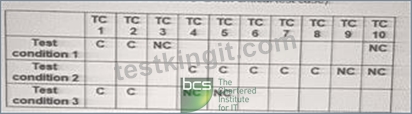
[traceability matrix not visible in the prompt]
The exit criterion for system testing states that each test condition must have all the associated critical test cases successfully executed (passed) AND all associated non-critical test cases at least executed.
The following is the situation after three days of system testing:
TC1, TC2, TC4, TC5, TC7, TC9: passed
TC3, TC10: failed (with an associated open defect report)
TC6, TC8: not run
Management wants to decide whether to release the system. You advise them that the system does not yet meet the defined exit criteria.
Based only on the given information, which test condition does not yet meet the stated exit criterion?
- A. Test condition 2
- B. Test condition 3
- C. None, all meet the stated exit criteria
- D. Test condition 1
Answer: A
Explanation:
The syllabus explicitly states thatexit criteriamust be met before considering completion of a test level:
"Exit criteria are the conditions that must be achieved to declare completion of a given test level... including coverage criteria and status of required tests (e.g., passed)."
- ISTQB CTAL-TM v3.0 Syllabus, Chapter 5Test Monitoring and Test Control And test control must act when exit criteria are not met:
"If the exit criteria are not satisfied, appropriate actions must be taken to address the situation."
- ISTQB CTAL-TM v3.0 Syllabus, Chapter 5
Sincetest condition 2 still has critical tests not yet executed, thedefined exit criteria are not fulfilled, and therefore a release decision should not be approved.
NEW QUESTION # 34
You are working as a test manager at a company that develops software applications for the mobile domain.
The organisation has recently been assessed against TMMi. This assessment showed that the company is a TMMi level 1 organisation. The projects use the V-model lifecycle and an independent test team exists. The test team consists of both experienced and novice testers. The team has not yet been formally trained in testing, but an ISTQB Foundation course is scheduled to take place in two months.
In your role as a test manager working in the independent test team, you have recently performed a risk assessment for a mobile software application to be developed. You want the features that have been identified as major risks to be tested more thoroughly.
Which test practice would you propose to mitigate the identified major product risks?
- A. Use test design techniques such as equivalence partitioning and decision table testing
- B. Start a test improvement project to achieve TMMi level 2
- C. Assign the most experienced testers to test the features with the highest risk levels
- D. Create pairs of developers and testers to test the features with the highest risk levels together
Answer: C
Explanation:
Comprehensive and Detailed Explanation From Exact Extract of ISTQB Certified Tester Advanced Level - Test Manager v3.0 syllabus:
The syllabus advises thatrisk mitigationincludes allocatingstronger capability and more efforttohigh-riskareas (e.g., by assigningmore experienced testersand more intensive testing to those features). In alow-maturity (TMMi level 1)context withnovice testers not yet trained, immediately deployingexperienced testersto high- risk items is the most practical and effective step to achievedeeper, more reliable testing.
Option B would be beneficial, but without formal training yet, immediate effectiveness is uncertain.
Option C is a longer-term improvement initiative, not a direct immediate mitigation for the current project risks.
Reference: ISTQB CTAL-TM v3.0 Syllabus, Chapter 4 (Risk-Based Testing) onallocating test effort and expertise according to product risk; Chapter 3 (Test Planning) onresourcing high-risk areasfirst.
NEW QUESTION # 35
The stakeholders matrix is a strategic tool to be used by test managers and is composed of four quadrants.
Which quadrant is described by the following statements?
Typically do not have a strong interest in day-to-day tasks
Their decisions are critical for resource allocation and high-level project direction
- A. Apathetics
- B. Defenders
- C. Promoters
- D. Latents
Answer: D
Explanation:
Comprehensive and Detailed Explanation From Exact Extract of ISTQB Certified Tester Advanced Level - Test Manager v3.0 syllabus:
In the stakeholder power-interest matrix used by test managers, stakeholders withhigh power but low interestare categorized asLatents. They generally "do not have a strong interest in day-to-day tasks," yet theirdecisions are critical for resources and strategic direction. Promoters are high power/high interest; Defenders are low power/high interest; Apathetics are low power/low interest. This mapping guides how test managers engage and communicate with each stakeholder group (CTAL-TM v3.0 Syllabus, chapter on organizational aspects of test management and stakeholder engagement).
NEW QUESTION # 36
Three exit criteria have been defined for a project:
- A. Criteria A = OK, criteria B = NOT OK, criteria C = NOT OK
- B. Criteria A = NOT OK, criteria B = NOT OK, criteria C = OK
- C. Criteria A = OK, criteria B = OK, criteria C = OK
- D. Test cases passed is more than 70%
- E. Number of defects per test case is less than 0.5 The first week of the testing has shown the following results (Mon-Fri):Defects Found = 21 (3+4+2+5+7)Defects Fixed = 8 (0+2+2+3+1)Tests Run = 43 (10+3+20+5+5)Tests Passed = 24 (5+3+15+0+1)
- F. Criteria A = NOT OK, criteria B = NOT OK, criteria C = NOT OK
- G. Number of outstanding defects is less than 5
Answer: G
Explanation:
Comprehensive and Detailed Explanation From Exact Extract of ISTQB Certified Tester Advanced Level - Test Manager v3.0 syllabus:
Pass rate = 24/43 = 55.8% #less than 70%#A =NOT OK.
Outstanding defects = 21 # 8 =13#not less than 5#B =NOT OK.
Defects per test case = 21/43 #0.49#less than 0.5#C =OK.The syllabus (Test Monitoring and Reporting) specifies using quantitative measures such as pass/fail rates, defect status (open vs. fixed), and defect detection metrics against exit criteria to evaluate test completion and readiness for release. These measures are used to decide whether exit criteria are met and to trigger control actions where they are not.
NEW QUESTION # 37
......
TM3 Study Guide Cover to Cover as Literally: https://www.testkingit.com/BCS/latest-TM3-exam-dumps.html
Get Unlimited Access to TM3 Certification Exam Cert Guide: https://drive.google.com/open?id=1YvyrXldEOdECyYxObEwTX3KjlXg6wD9D