

Jan 01, 2025 Step by Step Guide to Prepare for AZ-104 Exam BrainDumps
Microsoft Azure Administrator Associate AZ-104 Real Exam Questions and Answers FREE Updated on 2025
NEW QUESTION # 105
You have an Azure subscription that contains a virtual network named VNET in the East Us 2 region. A network interface named VM1-NI is connected to VNET1.
You successfully deploy the following Azure Resource Manager template.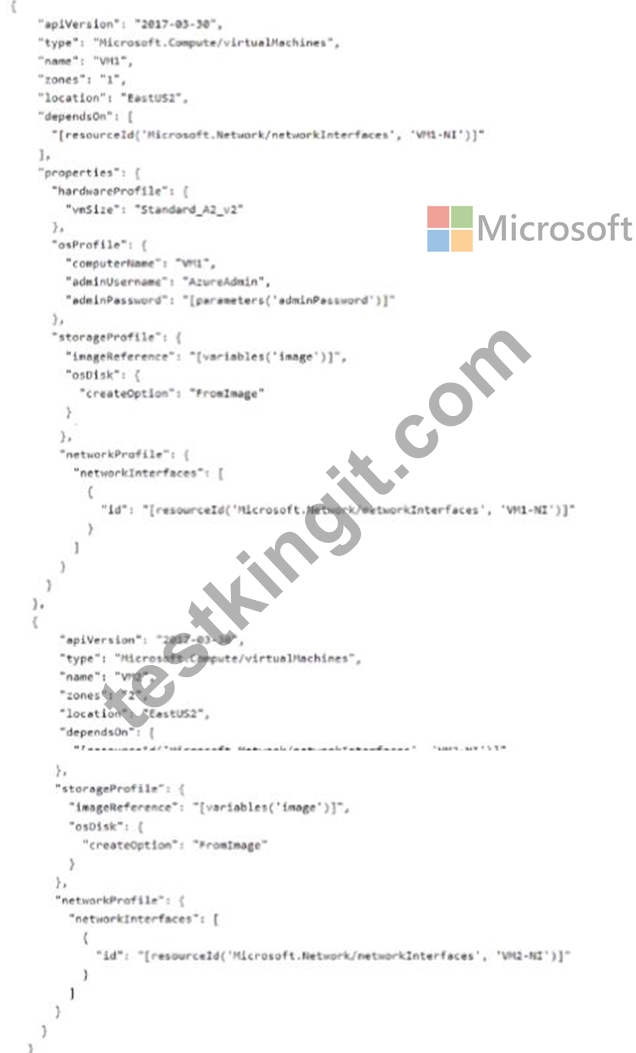

Answer:
Explanation:
NEW QUESTION # 106
You need to implement Role1.
Which command should you run before you create Role1? To answer, select the appropriate options in the answer area.
NOTE: Each correct selection is worth one point.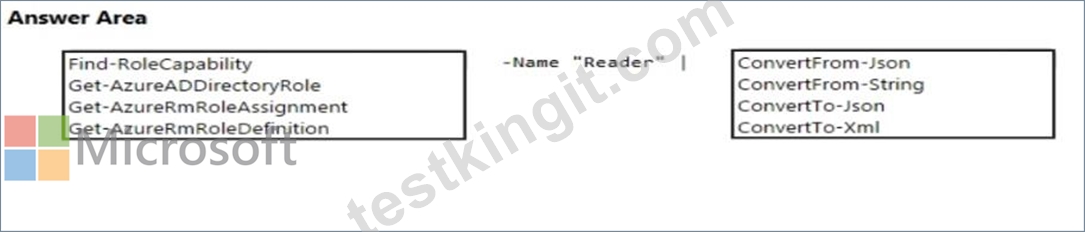
Answer:
Explanation: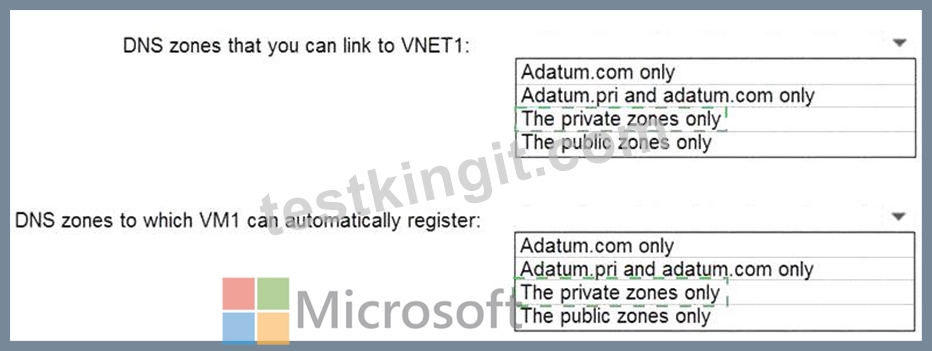
Explanation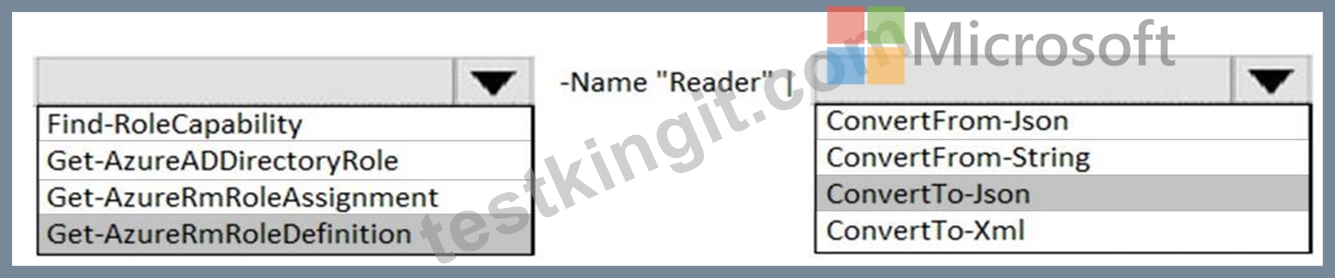
NEW QUESTION # 107
You have an Azure subscription that contains a storage account.
You have an on-premises server named Server1 that runs Window Server 2016. Server1 has 2 TB of data.
You need to transfer the data to the storage account by using the Azure Import/Export service.
In which order should you perform the actions? To answer, move all actions from the list of actions to the answer area and arrange them in the correct order.
NOTE: More than one order of answer choices is correct. You will receive credit for any of the correct orders you select.
Answer:
Explanation:
References:
https://docs.microsoft.com/en-us/azure/storage/common/storage-import-export-service
NEW QUESTION # 108
You have an Azure subscription.
You plan to use Azure Resource Manager templates to deploy 50 Azure virtual machines that will be part of the same availability set.
You need to ensure that as many virtual machines as possible are available if the fabric fails or during servicing.
How should you configure the template? To answer, select the appropriate options in the answer area.
NOTE: Each correct selection is worth one point.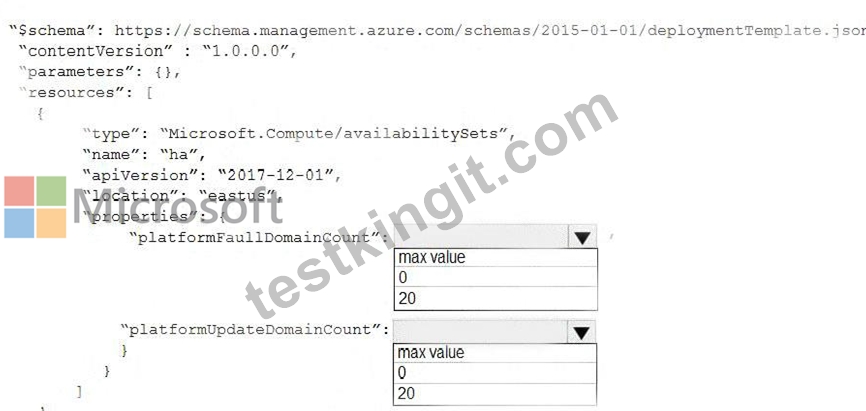
Answer:
Explanation: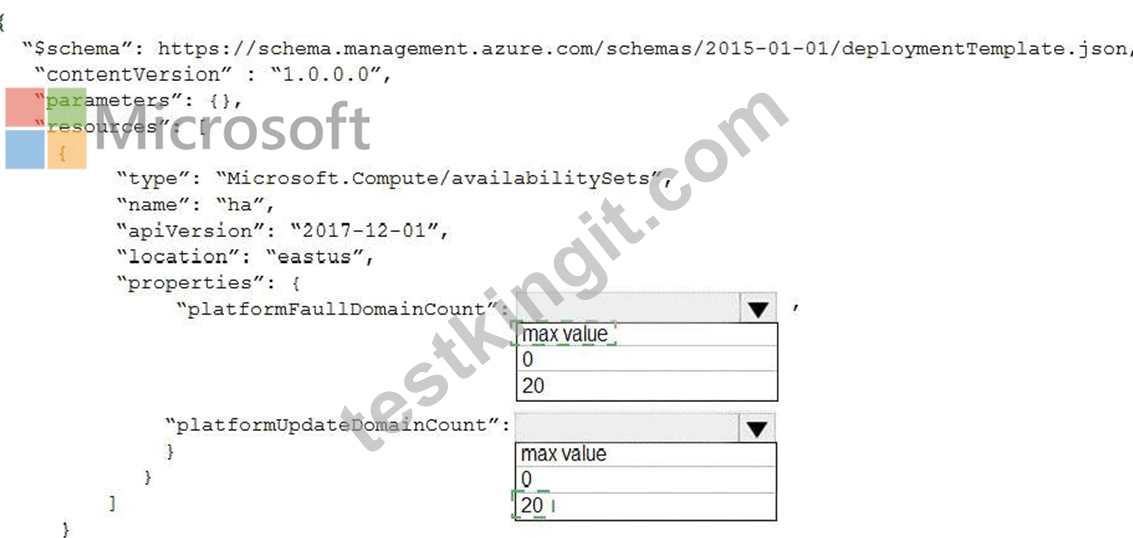
Explanation
Box 1 = max value
Box 2 = 20
Explanation
Use max for platformFaultDomainCount
2 or 3 is max value, depending on which region you are in.
Use 20 for platformUpdateDomainCount
Increasing the update domain (platformUpdateDomainCount) helps with capacity and availability planning when the platform reboots nodes. A higher number for the pool (20 is max) means that fewer of their nodes in any given availability set would be rebooted at once.
References:
https://www.itprotoday.com/microsoft-azure/check-if-azure-region-supports-2-or-3-fault-domains-managed-disk
https://github.com/Azure/acs-engine/issues/1030
NEW QUESTION # 109
You need to meet the connection requirements for the New York office.
What should you do? To answer, select the appropriate options in the answer area.
NOTE: Each correct selection is worth one point.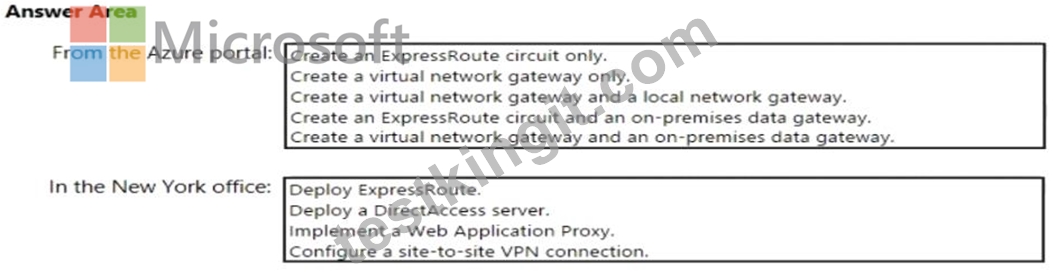
Answer:
Explanation: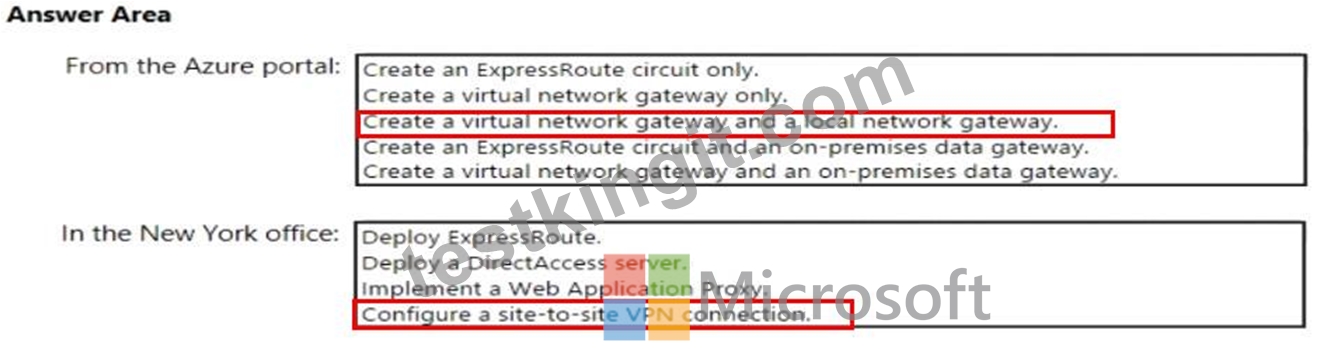
Reference:
https://docs.microsoft.com/en-us/azure/architecture/reference-architectures/hybrid-networking/vpn
NEW QUESTION # 110
You have an Azure subscription that contains the hierarchy shown in the following exhibit.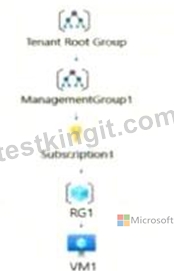
You create an Azure Policy definition named Policy1.
To which Azure resources can you assign Policy and which Azure resources can you specify as exclusions from Policy1? To answer, select the appropriate options in the answer NOTE Each correct selection is worth one point.
Answer:
Explanation:
Explanation
NEW QUESTION # 111
You have an on-premises network that contains a Hyper-V host named Host1. Host1 runs Windows Server 2016 and hosts 10 virtual machines that run Windows Server 2016.
You plan to replicate the virtual machines to Azure by using Azure Site Recovery.
You create a Recovery Services vault named ASR1 and a Hyper-V site named Site1.
You need to add Host1 to ASR1.
What should you do?
- A. Download the installation file for the Azure Site Recovery Provider.
Download the vault registration key.
Install the Azure Site Recovery Provider on Host1 and register the server. - B. Download the installation file for the Azure Site Recovery Provider.
Download the vault registration key.
Install the Azure Site Recovery Provider on each virtual machine and register the virtual machines. - C. Download the installation file for the Azure Site Recovery Provider.
Download the storage account key.
Install the Azure Site Recovery Provider on each virtual machine and register the virtual machines. - D. Download the installation file for the Azure Site Recovery Provider.
Download the storage account key.
Install the Azure Site Recovery Provider on Host1 and register the server.
Answer: A
Explanation:
Below are the steps you need to perform in this scenario. Refer the link mentioned in the reference section.
Download the installation file for the Azure Site Recovery Provider
To set up the source environment, you create a Hyper-V site and add to that site the Hyper-V hosts containing VMs that you want to replicate. Then, you download and install the Azure Site Recovery Provider and the Azure Recovery Services agent on each host, and register the Hyper-V site in the vault.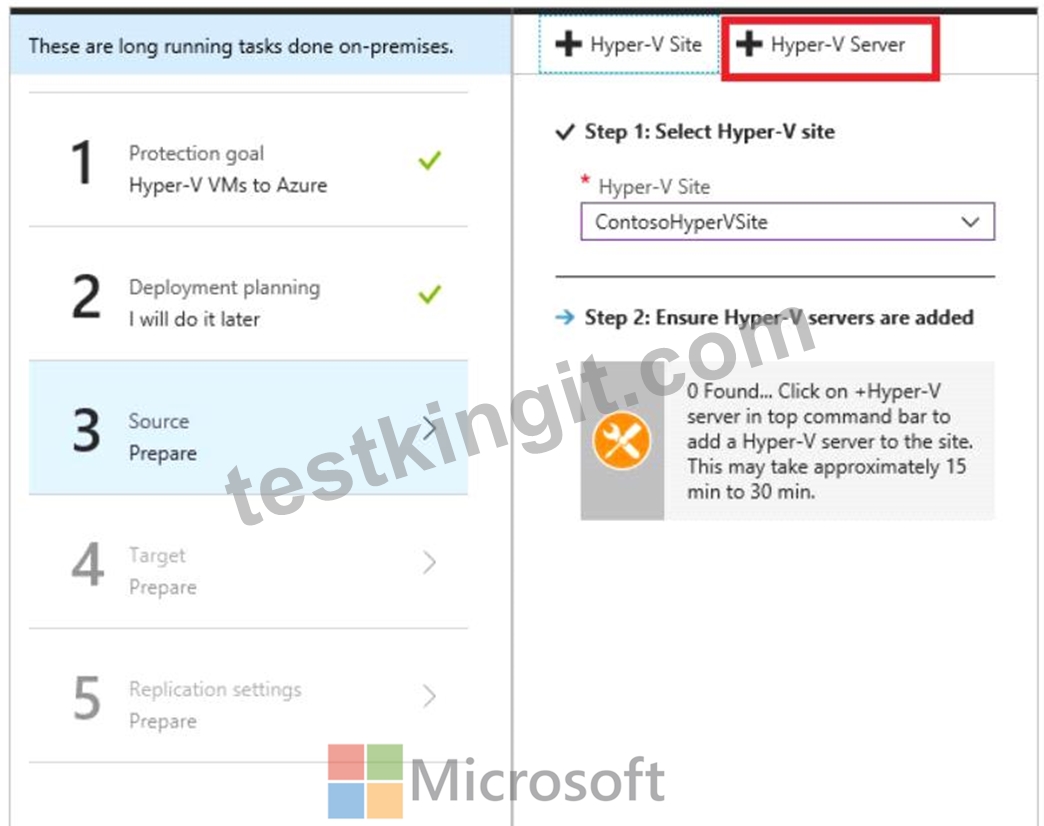
Download the vault registration key
Download the Vault registration key. You need this when you install the Provider. The key is valid for five days after you generate it.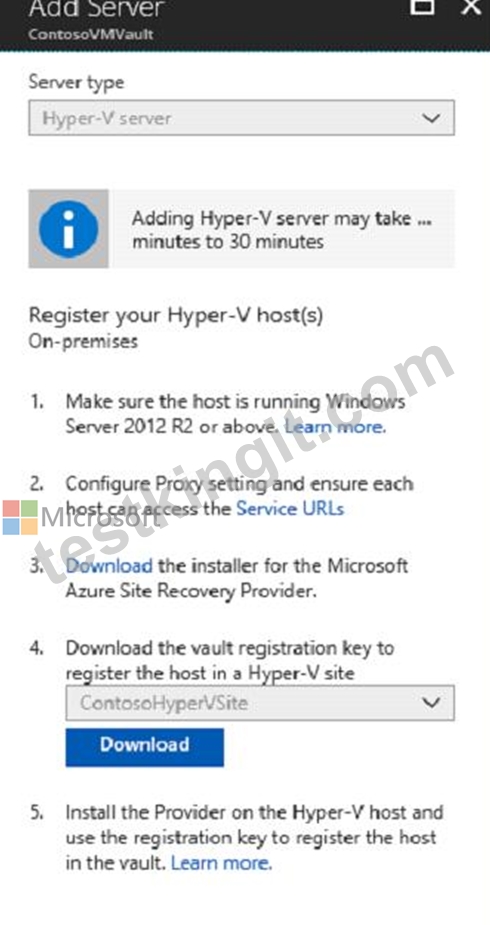
Install the Azure Site Recovery Provider on Host1.
Install the downloaded setup file (AzureSiteRecoveryProvider.exe) on each Hyper-V host that you want to add to the Hyper-V site. Setup installs the Azure Site Recovery Provider and Recovery Services agent on each Hyper-V host.
Register the server
In Registration, after the server is registered in the vault, select Finish.
References:
https://docs.microsoft.com/en-us/azure/site-recovery/hyper-v-azure-tutorial
NEW QUESTION # 112
You need to prepare the environment to meet the authentication requirements.
Which two actions should you perform? Each correct answer presents part of the solution.
NOTEEach correct selection is worth one point.
- A. a Recovery Services vault and a backup policy
- B. an Azure Key Vault and an access policy
- C. an Azure Storage account and an access policy
- D. Azure Active Directory (AD) Identity Protection and an Azure policy
Answer: A,C
Explanation:
Explanation
D: Seamless SSO works with any method of cloud authentication - Password Hash Synchronization or Pass-through Authentication, and can be enabled via Azure AD Connect.
B: You can gradually roll out Seamless SSO to your users. You start by adding the following Azure AD URL to all or selected users' Intranet zone settings by using Group Policy in Active Directory:
https://autologon.microsoftazuread-sso.com
NEW QUESTION # 113
You have an Azure subscription that contains the Azure virtual machines shown in the following table.
You configure the network interfaces of the virtual machines to use the settings shown in the following table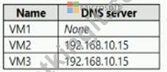
From the settings of VNET1, you configure the DNS servers shown in the following exhibit.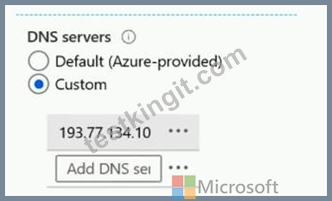
The virtual machines can successfully connect to the DNS server that has an IP address of 192.168.10.15 and the DNS server that has an IP address of 193.77.134.10.
For each of the following statements, select Yes if the statement is true. Otherwise, select No.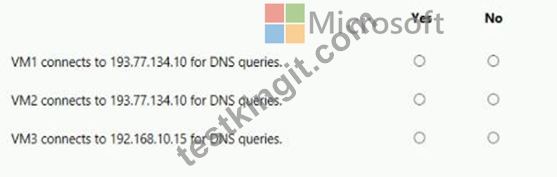
Answer:
Explanation: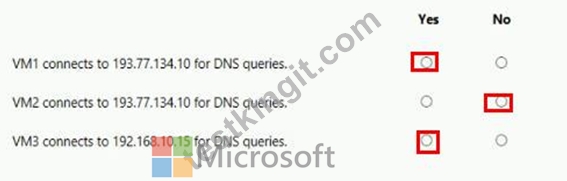
Reference:
https://docs.microsoft.com/en-us/azure/virtual-network/virtual-networks-faq#name-resolution-dns
NEW QUESTION # 114
You have an Azure subscription named Subscription1. Subscription1 contains the resource groups in the following table.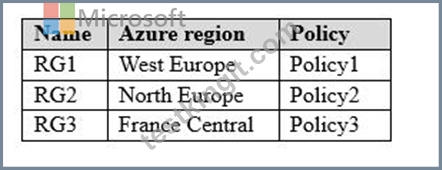
RG1 has a web app named WebApp1. WebApp1 is located in West Europe.
You move WebApp1 to RG2. What is the effect of the move?
- A. The App Service plan to WebApp1 remains to West Europe. Policy1 applies to WebApp1.
- B. The App Service plan to WebApp1 remains to West Europe. Policy2 applies to WebApp1.
- C. The App Service plan to WebApp1 moves to North Europe. Policy1 applies to WebApp1.
- D. The App Service plan to WebApp1 moves to North Europe. Policy2 applies to WebApp1.
Answer: B
Explanation:
You can move an app to another App Service plan, as long as the source plan and the target plan are in the same resource group and geographical region.
The region in which your app runs is the region of the App Service plan it's in. However, you cannot change an App Service plan's region.
References:
https://docs.microsoft.com/en-us/azure/app-service/app-service-plan-manage
NEW QUESTION # 115
You have an Azure subscription that contains the resources shown in the following table.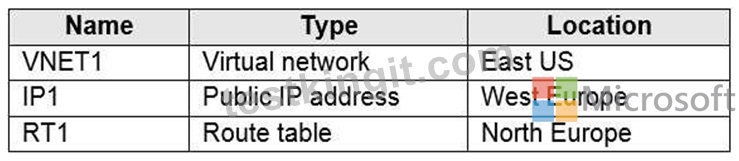
You need to create a network interface named NIC1.
In which location can you create NIC1?
- A. East US, West Europe, and North Europe
- B. East US only
- C. East US and West Europe only
- D. East US and North Europe only
Answer: B
Explanation:
Section: [none]
Explanation:
Before creating a network interface, you must have an existing virtual network in the same location and subscription you create a network interface in.
Reference:
https://docs.microsoft.com/en-us/azure/virtual-network/virtual-network-network-interface
NEW QUESTION # 116
You have an app named App1 that runs on an Azure web app named webapp1.
The developers at your company upload an update of App1 to a Git repository named GUI.
Webapp1 has the deployment slots shown in the following table.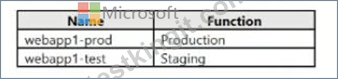
You need to ensure that the App1 update is tested before the update is made available to users.
Which two actions should you perform? Each correct answer presents part of the solution.
NOTE: Each correct selection is worth one point.
- A. Deploy the App1 update to webapp1-test, and then test the update
- B. Stop webapp1-prod
- C. Swap the slots
- D. Deploy the App1 update to webapp1-prod, and then test the update
- E. Stop webapp1-test
Answer: A,C
Explanation:
https://docs.microsoft.com/en-us/azure/app-service/deploy-staging-slots
NEW QUESTION # 117
HOTSPOT
You have a hybrid deployment of Azure Active Directory (Azure AD) that contains the users shown in the following table.
You need to modify the JobTitle and UsageLocation attributes for the users.
For which users can you modify the attributes from Azure AD? To answer, select the appropriate options in the answer area.
NOTE: Each correct selection is worth one point.
Hot Area: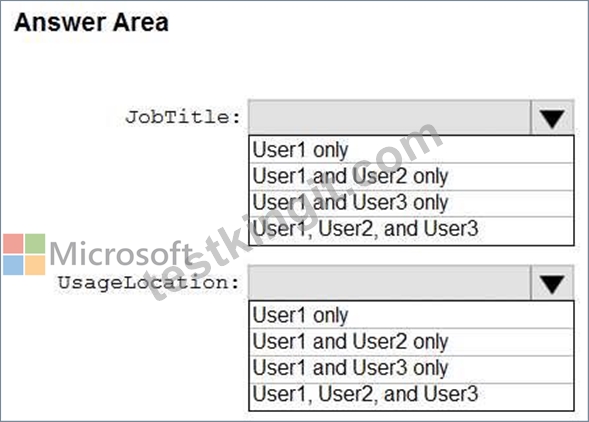
Answer:
Explanation: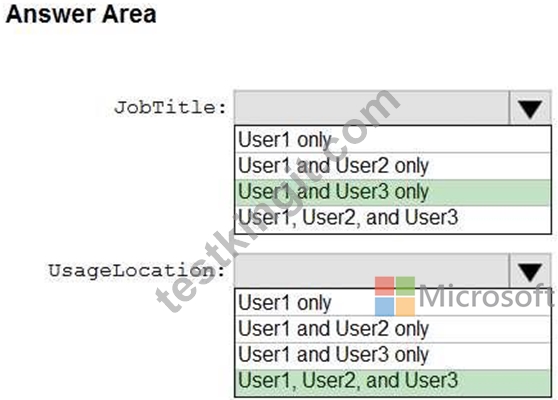
Section: [none]
Explanation:
Box 1: User1 and User3 only
You must use Windows Server Active Directory to update the identity, contact info, or job info for users whose source of authority is Windows Server Active Directory.
Box 2: User1, User2, and User3
Reference:
https://docs.microsoft.com/en-us/azure/active-directory/fundamentals/active-directory-users-profile-azure-portal
NEW QUESTION # 118
You have an Azure subscription that contains the resource groups shown in the following table.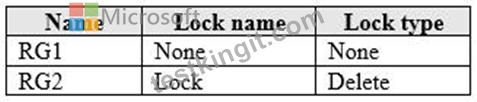
RG1 contains the resources shown in the following table.
RG2 contains the resources shown in the following table.
You need to identify which resources you can move from RG1 to RG2, and which resources you can move from RG2 to RG1.
Which resources should you identify? To answer, select the appropriate options in the answer area.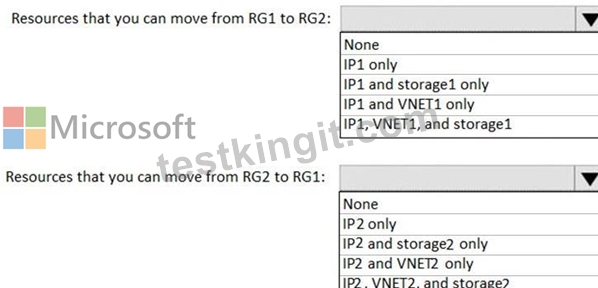
Answer:
Explanation:
Explanation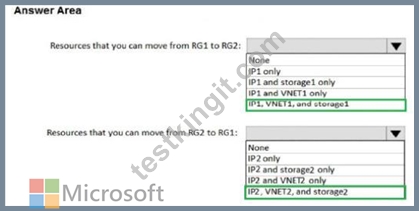
Read only and Delete lock won't prevent you from moving resources in different resource groups. It will prevent you to do the operations in the resource group where the resources are there.
So the correct answer should be
RG1 --> RG2 = IP1, vnet1 and storage1
RG2 --> RG1 = IP2, vnet2 and storage2
Reference:
https://docs.microsoft.com/en-us/azure/governance/blueprints/concepts/resource-locking
NEW QUESTION # 119
You have a sync group named Sync1 that has a cloud endpoint. The cloud endpoint includes a file named File1.txt.
You on-premises network contains servers that run Windows Server 2016. The servers are configured as shown in the following table.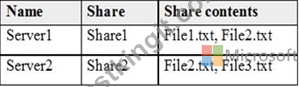
You add Share1 as an endpoint for Sync1. One hour later, you add Share2 as an endpoint for Sync1.
For each of the following statements, select Yes if the statement is true. Otherwise, select No.
NOTE: Each correct selection is worth one point.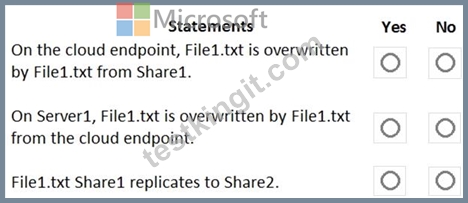
Answer:
Explanation: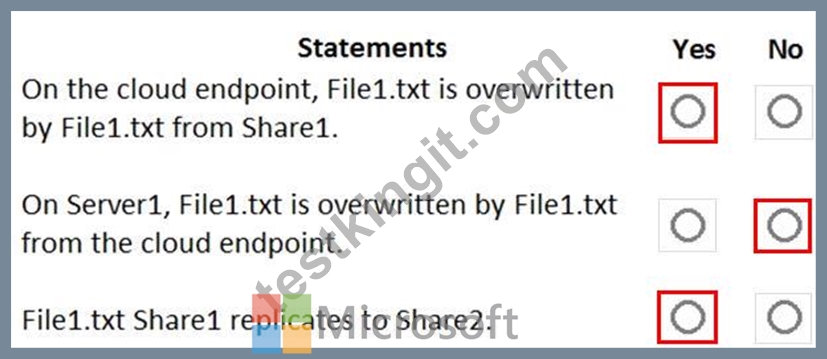
Reference:
https://docs.microsoft.com/en-us/azure/storage/files/storage-sync-files-planning
http://techgenix.com/azure-file-sync-replicating-data/
NEW QUESTION # 120
You need to prepare the environment to meet the authentication requirements.
Which two actions should you perform? Each correct answer presents part of the solution.
NOTE Each correct selection is worth one point.
- A. a Recovery Services vault and a backup policy
- B. an Azure Key Vault and an access policy
- C. Azure Active Directory (AD) Identity Protection and an Azure policy
- D. an Azure Storage account and an access policy
Answer: B
Explanation:
D: Seamless SSO works with any method of cloud authentication - Password Hash Synchronization or Pass-through Authentication, and can be enabled via Azure AD Connect.
B: You can gradually roll out Seamless SSO to your users. You start by adding the following Azure AD URL to all or selected users' Intranet zone settings by using Group Policy in Active Directory: https://autologon.microsoftazuread-sso.com Incorrect Answers:
A: Seamless SSO needs the user's device to be domain-joined, but doesn't need for the device to be Azure AD Joined.
C: Azure AD connect does not port 8080. It uses port 443.
E: Seamless SSO is not applicable to Active Directory Federation Services (ADFS).
Scenario: Users in the Miami office must use Azure Active Directory Seamless Single Sign-on (Azure AD Seamless SSO) when accessing resources in Azure.
Planned Azure AD Infrastructure include: The on-premises Active Directory domain will be synchronized to Azure AD.
Topic 3, Contoso Ltd
Existing Environment
Currently, Contoso uses multiple types of servers for business operations, including the following:
File servers
Domain controllers
Microsoft SQL Server servers
Your network contains an Active Directory forest named contoso.com. All servers and client computers are joined to Active Directory.
You have a public-facing application named App1. App1 is comprised of the following three tiers:
A SQL database
A web front end
A processing middle tier
Each tier is comprised of five virtual machines. Users access the web front end by using HTTPS only.
Requirements
Planned Changes
Contoso plans to implement the following changes to the infrastructure:
Move all the tiers of App1 to Azure.
Move the existing product blueprint files to Azure Blob storage.
Create a hybrid directory to support an upcoming Microsoft Office 365 migration project.
Technical Requirements
Contoso must meet the following technical requirements:
Move all the virtual machines for App1 to Azure.
Minimize the number of open ports between the App1 tiers.
Ensure that all the virtual machines for App1 are protected by backups.
Copy the blueprint files to Azure over the Internet.
Ensure that the blueprint files are stored in the archive storage tier.
Ensure that partner access to the blueprint files is secured and temporary.
Prevent user passwords or hashes of passwords from being stored in Azure.
Use unmanaged standard storage for the hard disks of the virtual machines.
Ensure that when users join devices to Azure Active Directory (Azure AD), the users use a mobile phone to verify their identity.
Minimize administrative effort whenever possible.
User Requirements
Contoso identifies the following requirements for users:
Ensure that only users who are part of a group named Pilot can join devices to Azure AD.
Designate a new user named Admin1 as the service administrator of the Azure subscription.
Admin1 must receive email alerts regarding service outages.
Ensure that a new user named User3 can create network objects for the Azure subscription.
NEW QUESTION # 121
You need to move the blueprint files to Azure.
What should you do?
- A. Generate a shared access signature (SAS). Map a drive, and then copy the files by using File Explorer.
- B. Use the Azure Import/Export service.
- C. Generate an access key. Map a drive, and then copy the files by using File Explorer.
- D. Use Azure Storage Explorer to copy the files.
Answer: D
Explanation:
Azure Storage Explorer is a free tool from Microsoft that allows you to work with Azure Storage data on Windows, macOS, and Linux. You can use it to upload and download data from Azure blob storage.
Scenario:
Planned Changes include: move the existing product blueprint files to Azure Blob storage.
Technical Requirements include: Copy the blueprint files to Azure over the Internet.
Topic 4, Contoso Ltd (Consulting Company)
To start the case study
To display the first question in this case study, click the Next button. Use the buttons in the left pane to explore the content of the case study before you answer the questions. Clicking these buttons displays information such as business requirements, existing environment, and problem statements. If the case study has an All Information tab, note that the information displayed is identical to the information displayed on the subsequent tabs. When you are ready to answer a question, click the question button to return to the question.
Overview
General Overview
Contoso, Ltd. is a consulting company that has a main office in Montreal and branch offices in Seattle and New York.
Environment
Existing Environment
Contoso has an Azure subscription named Sub1 that is linked to an Azure Active Directory (Azure AD) tenant. The network contains an on-premises Active Directory domain that syncs to the Azure AD tenant.
The Azure AD tenant contains the users shown in the following table.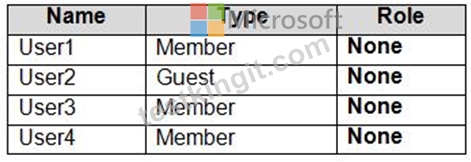
Sub1 contains two resource groups named RG1 and RG2 and the virtual networks shown in the following table.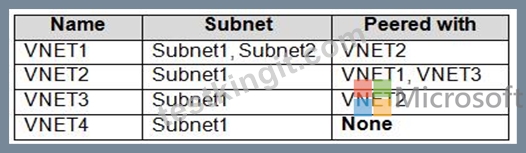
User1 manages the resources in RG1. User4 manages the resources in RG2.
Sub1 contains virtual machines that run Windows Server 2019 as shown in the following table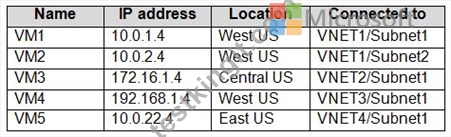
No network security groups (NSGs) are associated to the network interfaces or the subnets.
Sub1 contains the storage accounts shown in the following table.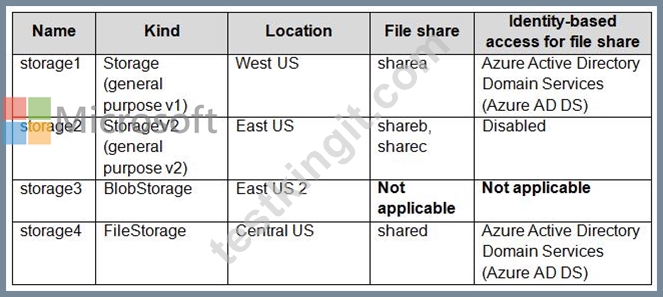
Requirements
Planned Changes
Contoso plans to implement the following changes:
Create a blob container named container1 and a file share named share1 that will use the Cool storage tier.
Create a storage account named storage5 and configure storage replication for the Blob service.
Create an NSG named NSG1 that will have the custom inbound security rules shown in the following table.
Associate NSG1 to the network interface of VM1.
Create an NSG named NSG2 that will have the custom outbound security rules shown in the following table.
Associate NSG2 to VNET1/Subnet2.
Technical Requirements
Contoso must meet the following technical requirements:
Create container1 and share1.
Use the principle of least privilege.
Create an Azure AD security group named Group4.
Back up the Azure file shares and virtual machines by using Azure Backup.
Trigger an alert if VM1 or VM2 has less than 20 GB of free space on volume C.
Enable User1 to create Azure policy definitions and User2 to assign Azure policies to RG1.
Create an internal Basic Azure Load Balancer named LB1 and connect the load balancer to VNET1/Subnet1 Enable flow logging for IP traffic from VM5 and retain the flow logs for a period of eight months.
Whenever possible, grant Group4 Azure role-based access control (Azure RBAC) read-only permissions to the Azure file shares.
NEW QUESTION # 122
You have an Azure App Service app named WebApp1 that contains two folders named Folder1 and Folder2.
You need to configure a daily backup of WebApp1. The solution must ensure that Folder2 is excluded from the backup.
What should you create first and what should you use to exclude Fokier2? To answer, select the appropriate options in the answer area.
NOTE: Each correct selection is worth one point.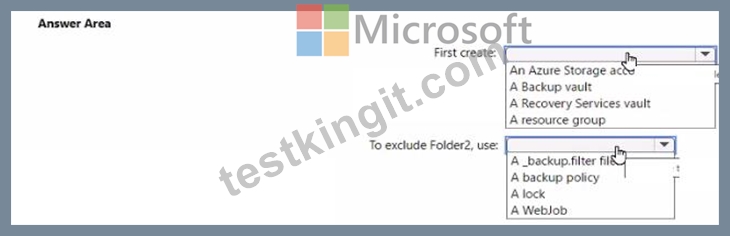
Answer:
Explanation: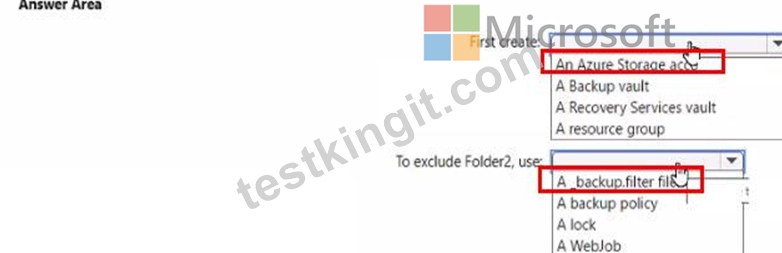
NEW QUESTION # 123
You have an Azure policy as shown in the following exhibit: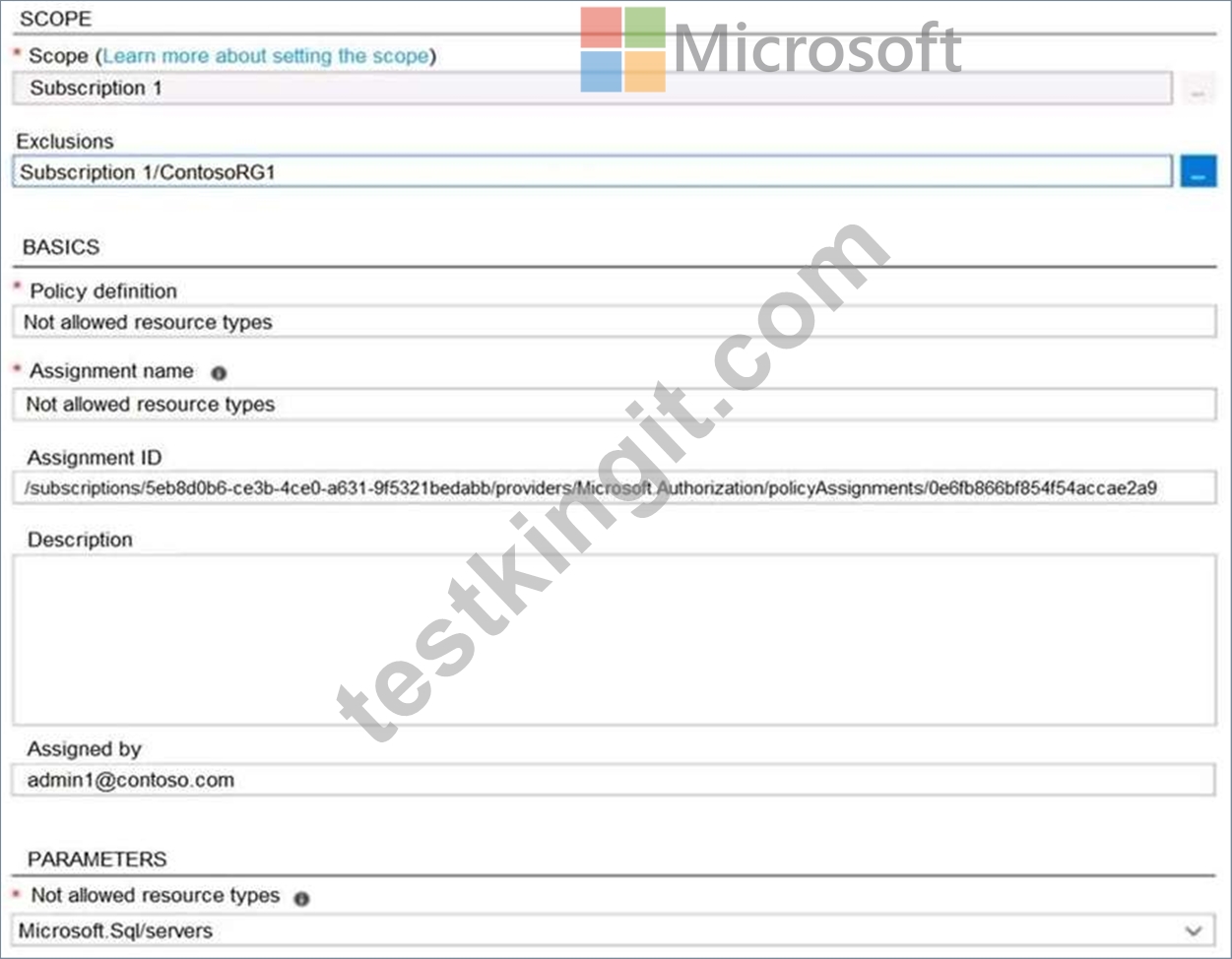
What is the effect of the policy?
- A. You can create Azure SQL servers in ContosoRG1 only.
- B. You are prevented from creating Azure SQL servers anywhere in Subscription 1.
- C. You can create Azure SQL servers in any resource group within Subscription 1.
- D. You are prevented from creating Azure SQL Servers in ContosoRG1 only.
Answer: A
Explanation:
You are prevented from creating Azure SQL servers anywhere in Subscription 1 with the exception of ContosoRG1
NEW QUESTION # 124
You have an Azure subscription that contains the resources shown in the following table:
You assign a policy to RG6 as shown in the following table: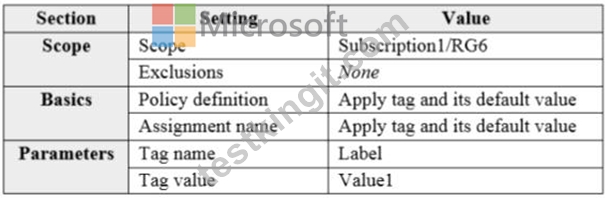
To RG6, you apply the tag: RGroup: RG6.
You deploy a virtual network named VNET2 to RG6.
Which tags apply to VNET1 and VNET2? To answer, select the appropriate options in the answer area.
NOTE: Each correct selection is worth one point.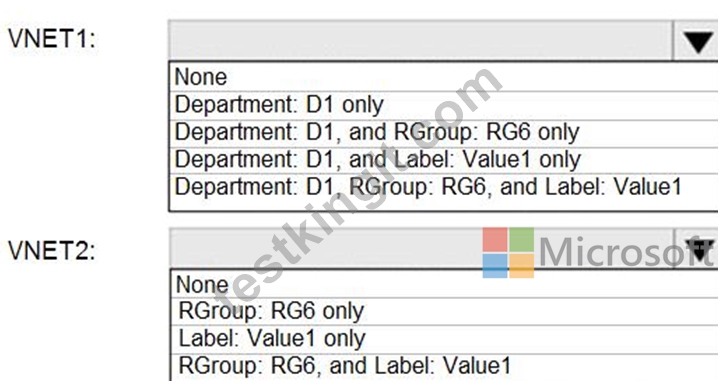
Answer:
Explanation: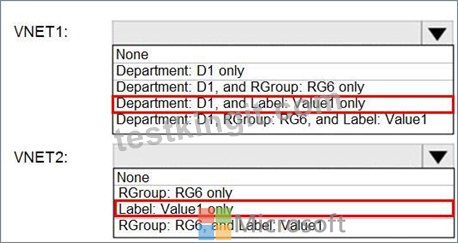
Reference:
https://docs.microsoft.com/en-us/azure/azure-resource-manager/management/tag-policies
NEW QUESTION # 125
Note: This question is part of a series of questions that present the same scenario. Each question in the series contains a unique solution that might meet the stated goals. Some question sets might have more than one correct solution, while others might not have a correct solution.
After you answer a question in this section, you will NOT be able to return to it. As a result, these questions will not appear in the review screen.
You have an Azure subscription named Subscription1. Subscription1 contains a resource group named RG1.
RG1 contains resources that were deployed by using templates.
You need to view the date and time when the resources were created in RG1.
Solution: From the RG1 blade, you click Deployments.
Does this meet the goal?
- A. Yes
- B. No
Answer: A
Explanation:
Explanation
1. Select the resource group (Here RG1) you want to examine.
2. Select the link under Deployments.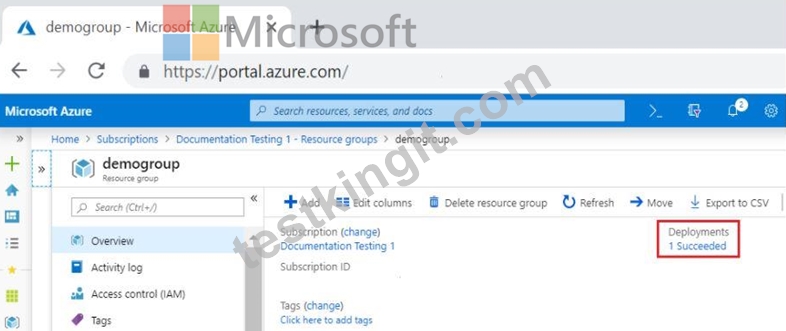
3. Select one of the deployments from the deployment history.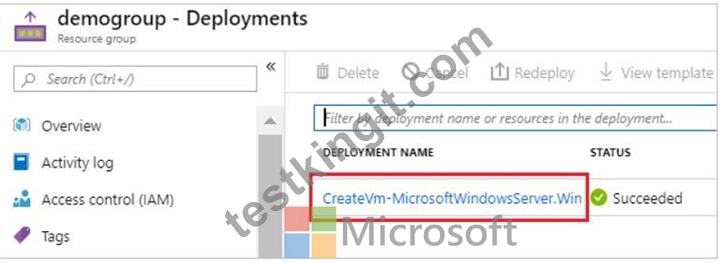
4. You will see a history of deployment for the resource group, including the correlation ID.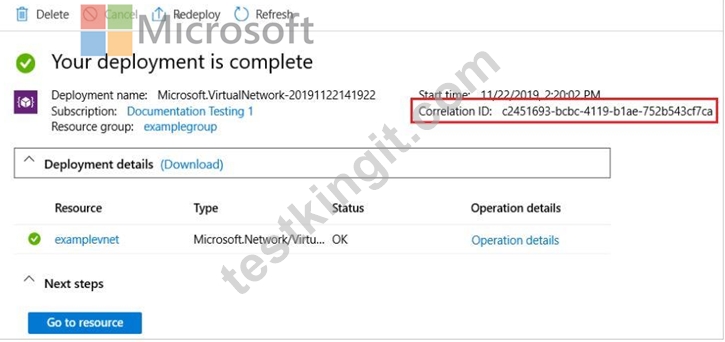
Reference:
https://docs.microsoft.com/en-us/azure/azure-resource-manager/templates/deployment-history?tabs=azure-portal
NEW QUESTION # 126
......
Microsoft AZ-104 exam is a comprehensive certification assessment that covers a broad range of topics related to Azure administration. By passing AZ-104 exam, candidates can demonstrate their expertise in managing Azure resources and services, and they can enhance their career prospects in the field of cloud computing.
Ultimate Guide to Prepare AZ-104 Certification Exam for Microsoft Azure Administrator Associate: https://www.testkingit.com/Microsoft/latest-AZ-104-exam-dumps.html
AZ-104 Ultimate Study Guide: https://drive.google.com/open?id=1o64pcOT83FBa17-Gg-el3ttVInK0Z3JC