

Feb 24, 2025 PASS API API-577 EXAM WITH UPDATED DUMPS
API-577 Questions PDF [2025] Use Valid New dump to Clear Exam
API API-577 Exam Syllabus Topics:
| Topic | Details |
|---|---|
| Topic 1 |
|
| Topic 2 |
|
| Topic 3 |
|
| Topic 4 |
|
| Topic 5 |
|
| Topic 6 |
|
| Topic 7 |
|
NEW QUESTION # 19
Stud arc welding is a specialized process predominantly limited to welding:
- A. Non-load-bearing welds.
- B. Non-pressure-containing welds.
- C. Flat position welds.
- D. Insulation and refractory pins.
Answer: D
NEW QUESTION # 20
For SMAW welding, the last number of the electrode identification identifies:
- A. Electrode operating characteristics.
- B. Coating operating characteristics.
- C. Welding position.
- D. Chemical composition.
Answer: B
NEW QUESTION # 21
The weld symbol represents which type of weld groove?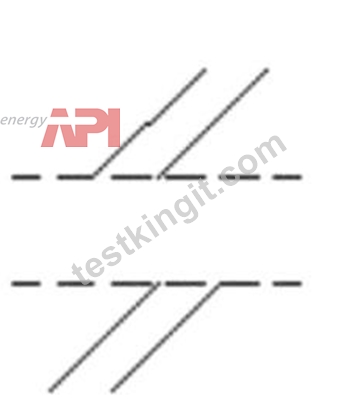
- A. Bevel
- B. Flare
- C. Scarf
- D. Parallel
Answer: A
NEW QUESTION # 22
Which of the following determines the necessity for preheat and postweld heat treatment?
- A. The percentage of carbon that will be in the completed weld
- B. The carbon equivalent of the steel
- C. The rate of cooling after the welding is completed
- D. The as-rolled hardness of the welding components
Answer: B
NEW QUESTION # 23
Which of the following transfer methods associated with GMAW is characterized by a highly directed stream of discrete drops that are accelerated by arc forces, and negligible spatter?
- A. Pulsed droplet transfer
- B. Spray transfer
- C. Globular transfer
- D. Short circuiting transfer
Answer: B
NEW QUESTION # 24
Refer to the following diagram: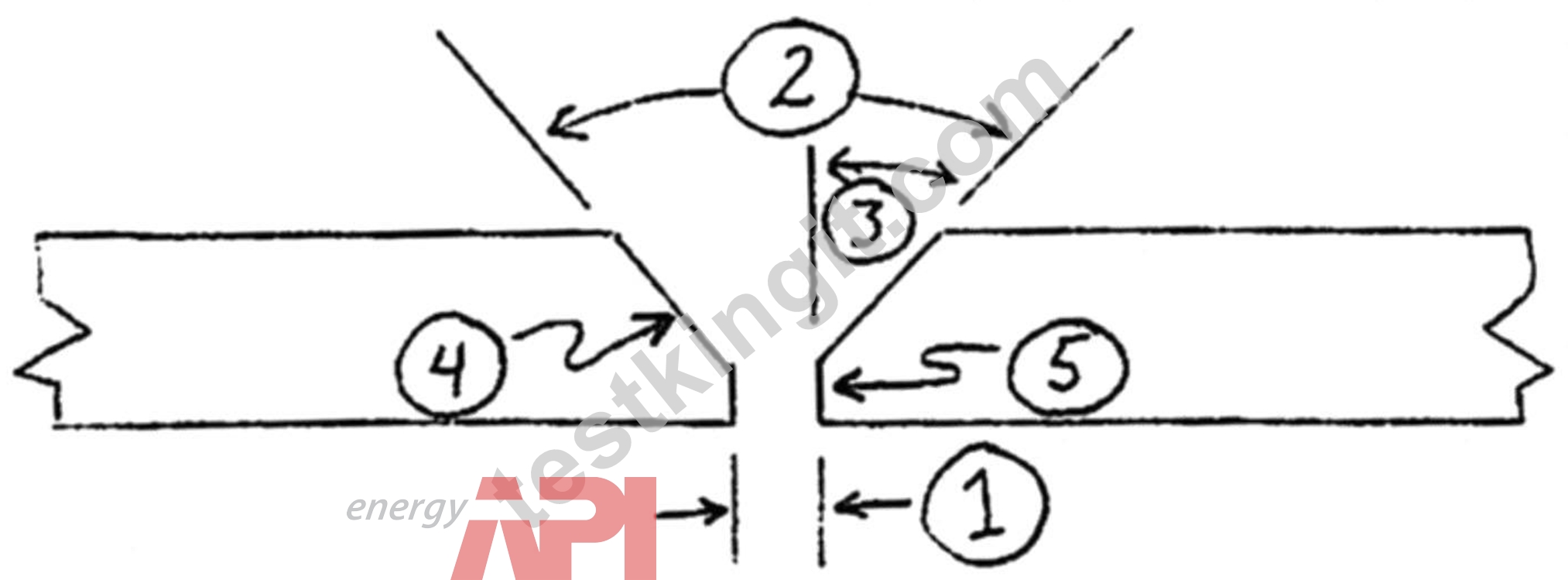
Item#1 represents:
- A. root opening.
- B. root face.
- C. root weld size.
- D. groove weld size.
Answer: A
NEW QUESTION # 25
Base metals are assigned P-numbers by the ASME Code, Section IX to reduce the number of:
- A. Required welding procedure specifications.
- B. Required welding procedure qualifications.
- C. Required mechanical tests.
- D. Required procedure and performance qualifications.
Answer: D
NEW QUESTION # 26
A root opening of a groove weld is:
- A. The beveled surface of the joint members.
- B. The surface of a joint member included in the groove.
- C. That portion of the groove face adjacent to the joint root.
- D. A separation at the joint root between the work pieces.
Answer: D
NEW QUESTION # 27
Steels usually require both preheat and PWHT if they have a carbon equivalent higher than:
- A. 0.45
- B. 0.35
- C. 0.55
- D. 0.50
Answer: A
NEW QUESTION # 28
The change in shape (deformation) that a test specimen experiences when it is stressed or loaded is called:
- A. Yield.
- B. Stress.
- C. Plasticity.
- D. Strain.
Answer: D
NEW QUESTION # 29
A-number groupings are based upon the:
- A. Chemical composition of the deposited weld metal.
- B. Comparable base metal ultimate strength values.
- C. Weldability characteristics of the metal.
- D. Type and strength of base metal.
Answer: A
NEW QUESTION # 30
Where is the weld HAZ assumed to be for purposes of hardness testing?
- A. 0.25 inch on either side of the fusion zone
- B. 0.25 inch away from the toe of the weld into the base metal
- C. Just adjacent to the toe of the weld
- D. 1 inch on either side of the centerline of the weld
Answer: C
NEW QUESTION # 31
Rules for qualifying welding operators using radiography on a production weld require what minimum weld length to be examined?
- A. 36 in. (900 mm)
- B. 12 in. (300 mm)
- C. 24 in.(600 mm)
- D. 6 in. (150 mm)
Answer: B
NEW QUESTION # 32
If a nonessential variable is changed on a WPS, which of the following actions must occur?
- A. Impact testing must be performed at the discretion of the welding engineer.
- B. The welding procedure will need to be requalified by performing mechanical testing.
- C. The welding inspector can simply make the change on the WPS and initial as proof of acceptance.
- D. It may be changed on the WPS without requalifying the welding procedure.
Answer: D
NEW QUESTION # 33
What is a sensitized microstructure in austenitic stainless steels?
- A. An area next to the heat-affected zone that has suffered some softening and loss of strength.
- B. The microstructure of the weld that has been melted and will therefore have properties more like a casting than the base metal.
- C. An area near the heat-affected zone affected by welding that may experience intergranular corrosion.
- D. The high residual stress zone adjacent to the weld fusion line that will have higher hardness than the weld or base material.
Answer: C
NEW QUESTION # 34
Any electrodes that have become wet:
- A. Should be placed in a warming oven only if they are low-hydrogen.
- B. Should be discarded.
- C. Should not be used for jobs requiring low-hydrogen electrodes.
- D. Should be used at a higher amperage than recommended by the manufacturer.
Answer: C
NEW QUESTION # 35
When performing a carbon steel to carbon steel hot tap where the CE of one of the metals is greater than
0.42%, which of the following electrodes should be used?
- A. E7018-A1
- B. E7048-H4
- C. E7018
- D. E7048
Answer: C
NEW QUESTION # 36
The deflection of an arc from its normal path that is a result of magnetic forces is referred to as:
- A. Arc deflection.
- B. Arc drift.
- C. Arc strike.
- D. Arc blow.
Answer: D
NEW QUESTION # 37
At any time during the welding inspection, if defects are identified:
- A. The inspector should examine all welds produced by the same welder.
- B. They should be corrected before welding proceeds further.
- C. The inspector should determine whether the weld may be acceptable for the intended service.
- D. The inspector should seek engineering input on whether the defect is actually acceptable.
Answer: B
NEW QUESTION # 38
......
API-577 Study Guide Brilliant API-577 Exam Dumps PDF: https://www.testkingit.com/API/latest-API-577-exam-dumps.html
Passing API API-577 Exam Using 2025 Practice Tests: https://drive.google.com/open?id=1yYmkQuiEtveoGQ6hegBmJr2k7wLThz3G