

(2026) PC-BA-FBA-20 Dumps and Practice Test (82 Questions)
Guide (New 2026) Actual BCS PC-BA-FBA-20 Exam Questions
BCS PC-BA-FBA-20 certification exam is an excellent way for individuals to demonstrate their knowledge and understanding of business analysis principles and techniques. Whether you are looking to enter the job market or enhance your skills and knowledge in your current role, the BCS PC-BA-FBA-20 certification can help you to achieve your career goals.
BCS PC-BA-FBA-20 exam is an excellent way for individuals to gain a comprehensive understanding of the fundamentals of business analysis and to demonstrate their knowledge and skills to potential employers. With the certification, individuals can improve their career prospects and take their skills to the next level.
BCS PC-BA-FBA-20 (BCS Foundation Certificate in Business Analysis V4.0) is an entry-level certification exam designed for individuals who are interested in pursuing a career as a business analyst. PC-BA-FBA-20 exam focuses on testing the candidate's understanding of the fundamentals of business analysis, including the role of a business analyst, requirements engineering, business process modelling, and stakeholder management. BCS Foundation Certificate in Business Analysis V4.0 certification is recognized globally and is a great way to demonstrate your commitment to the field of business analysis.
NEW QUESTION # 46
Which of the following is a KEY principle of Business Analysis?
- A. Understand the symptoms of the problem being defined.
- B. Focus on requirements definition only.
- C. Integrate IT changes together with project requirements to improve efficiency.
- D. Present options not solutions.
Answer: D
Explanation:
One of the key principles of business analysis is to present stakeholders with options rather than prescribing a single solution. This approach ensures that stakeholders can make informed decisions based on their priorities and constraints.
Key Principles of Business Analysis:
Present Options Not Solutions: Business analysts should provide multiple viable options, allowing stakeholders to choose the best course of action.
Understand Symptoms: While understanding symptoms is important, it is part of problem analysis, not a key principle.
Focus on Requirements Definition Only: Business analysis encompasses more than just defining requirements; it includes understanding problems, analyzing options, and ensuring value delivery.
Integrate IT Changes: While integrating IT changes is valuable, it is not a universal principle of business analysis.
Evaluation of Each Option:
A . Present options not solutions:
This is a fundamental principle of business analysis, emphasizing stakeholder choice.
Conclusion: This is correct .
B . Understand the symptoms of the problem being defined:
Understanding symptoms is part of problem analysis but not a standalone principle.
Conclusion: This is not correct .
C . Focus on requirements definition only:
Business analysis involves more than just requirements definition.
Conclusion: This is not correct .
D . Integrate IT changes together with project requirements to improve efficiency:
While integration is valuable, it is not a universal principle of business analysis.
Conclusion: This is not correct .
NEW QUESTION # 47
Which of the following models shows the driving and resisting forces of change?
- A. Power/impact grid.
- B. Force field analysis.
- C. Learning cycle.
- D. Five forces model.
Answer: B
NEW QUESTION # 48
If a process has been well designed, which of the following issues could still cause a problem and prevent achievement of objectives?
- A. Redundancy
- B. Duplication
- C. Insufficient resources available to carry out the process
- D. Lack of standardisation.
Answer: C
Explanation:
A process that is "well designed" (optimally structured, free from unnecessary steps) implies that issues like Redundancy (B), Lack of standardisation (C), and Duplication (D) have been eliminated or minimised through effective process design (i.e., making it lean and efficient). However, even a perfectly designed process will fail to achieve its objectives if the necessary resources are not available to execute it. Insufficient resources (such as people, funding, equipment, or time) represent a constraint on the execution, leading to bottlenecks, delays, and a failure to meet performance targets, regardless of the quality of the process design itself. This is often an implementation or operational management issue, not a design flaw.
(Reference: BCS Business Analysis Practice - Process Improvement)
NEW QUESTION # 49
A business case for a project claims that the new system will provide managers with more time to think creatively about strategic issues.
What would this be classified as in a cost-benefit analysis?
- A. A tangible benefit.
- B. An intangible cost
- C. A tangible cost
- D. An intangible benefit.
Answer: D
NEW QUESTION # 50
Which investigation technique is supported by use case' descriptions?
- A. Scenario Analysis.
- B. Interviewing.
- C. Document Analysis
- D. Questionaires.
Answer: A
NEW QUESTION # 51
The entity relationship model below shows the relationship between Customer and Order.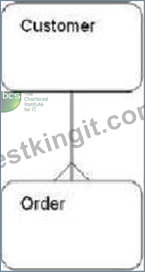
Which of the following business rules is correct?
- A. An order need not be placed by a customer.
- B. An order may be placed by many customers.
- C. A customer may never place an order
- D. A customer may place many orders.
Answer: D
NEW QUESTION # 52
Cars, trucks and motorbikes are all types of vehicle.
What structure could be used on a class model to model this
- A. Generalisation
- B. The <> construct
- C. Association class
- D. Exclusivity relationship
Answer: A
NEW QUESTION # 53
Which of the following BEST describes an ethnographic study?
- A. A study of users in their workplace undertaking representative simulated scenarios.
- B. A study which ensures that the needs of a wide range of ethnic groups are considered.
- C. A study where the analyst spends an extended period of time in the target environment.
- D. A study which uses prototype graphical screens to demonstrate a user requirement.
Answer: C
NEW QUESTION # 54
Which modelling technique organises the business analyst's thinking by using a series of topic-related branches and sub-branches radiating from a central point?
- A. Business analysis process model
- B. Process map.
- C. Mind map.
- D. Entity relationship diagram.
Answer: C
Explanation:
The technique described is a Mind map. A Mind Map is a non-linear, visual tool used for structuring information and generating ideas around a central concept. It is characterized by having a central image or topic from which topic-related branches and sub-branches radiate. The structure helps the business analyst (or a group in a workshop) to organize complex, unstructured thoughts, visualize associations, and explore an area holistically. This technique is often used in the initial stages of investigation, such as problem analysis or requirements elicitation, to help gain a broad understanding of the scope and related issues. This is distinct from a Process map (which shows the flow of activities), an Entity relationship diagram (which models data structures), or the Business analysis process model (which models the BA's work steps).
(Reference: BCS Foundation Certificate in Business Analysis / BCS Business Analysis Practice - Investigative Techniques, Mind Maps)
NEW QUESTION # 55
Which of the following statements about a BAM is correct?
- A. There will be one BAM for each business perspective.
- B. The BAM is concerned with who carries out the activities.
- C. The BAM is an AS-IS model of the real world.
- D. The BAM is concerned with where activities are carried out.
Answer: A
NEW QUESTION # 56
In option development, which of the following is NOT a type of option considered?
- A. Basic option
- B. Exhaustive option.
- C. Executive option
- D. Extended option
Answer: B
Explanation:
When developing options for a business change, the business analyst must consider a range of solution types, which often fall into categories to ensure all possibilities are explored. While the exact naming conventions can vary, the following three core types are commonly considered and often named as:
Basic (or "Do Minimum") option: A low-cost, minimal-effort option to address the problem without major change (often including the "Do Nothing" or "Do Nothing Different" option for comparison).
Extended (or "Do Something" option): The preferred or main option, representing the full-scale, major change recommended to achieve the business objectives.
Executive (or "Commercial Off-The-Shelf (COTS)") option: An option based on purchasing an existing system or service, rather than custom-building a solution.Exhaustive option is NOT a standard or recognised category of business change option within the BCS syllabus.
(Reference: BCS Business Analysis Practice - Business Case, Identifying Options)
NEW QUESTION # 57
An analyst has discovered that a company wishes to hold information about departments and employees. A department may have many employees in it, but each employee can, at any one time, only work in one department. There is no requirement to store historical information. However, there are currently eight departments and over one hundred employees.
How would this relationship be shown on an Entity Relationship diagram?
- A. As a one-to-one between Department and Employee.
- B. As (8..100) at the Department end of the relationship.
- C. As a many-to-many between Department and Employee.
- D. As a one-to-many between Department and Employee.
Answer: D
NEW QUESTION # 58
Which of the following diagrams helps the business analyst to document a range of issues that have been uncovered about a business situation?
- A. The use case diagram.
- B. The business activity model
- C. The 'to be' process model.
- D. The rich picture.
Answer: D
NEW QUESTION # 59
Which of the following would you describe about each stakeholder?
- A. Resolution.
- B. Owner.
- C. Justification.
- D. Attitude.
Answer: D
NEW QUESTION # 60
Which type of feasibility assessment would consider whether a proposal matches the objectives and strategy of the organisation?
- A. Business
- B. Technical
- C. Legal
- D. Financial
Answer: A
Explanation:
Feasibility assessment is a critical part of developing the Business Case and typically involves four key areas: Business, Technical, Financial, and Legal/Ethical. The assessment that addresses whether a proposed solution or change initiative aligns with the organisation's overall objectives, mission, and strategy is Business Feasibility. This check is vital because if a proposal does not support the strategic direction, it will not deliver the expected value, regardless of its technical or financial viability. It ensures that the change is the right thing for the business to do at a strategic level.
(Reference: BCS Business Analysis Practice - Feasibility Assessment, Business Case Development)
NEW QUESTION # 61
Halliday Holdings is embarking on a programme to improve its customer experience On joining the programme. Natasha wants to gain an understanding of how its current brand is perceived Which would be the BEST source of information for Natasha?
- A. Independent industry websites
- B. The company website
- C. The company's complaints procedures
- D. The company's organisational structure
Answer: A
Explanation:
To determine the best source of information for Natasha to understand how Halliday Holdings' brand is perceived, we need to evaluate the options based on their relevance and objectivity.
Evaluation of Each Option:
A . Independent industry websites:
Independent industry websites often provide unbiased insights into how a company's brand is perceived by customers, competitors, and the market. These sources aggregate reviews, ratings, and expert opinions, making them a valuable resource for understanding external perceptions.
Conclusion: This is the best source .
B . The company website:
The company website reflects the organization's internal perspective and branding efforts. While useful for understanding how the company presents itself, it does not provide an external view of brand perception.
Conclusion: This is not the best source .
C . The company's organizational structure:
The organizational structure provides insights into the company's internal hierarchy and operations but does not relate to external brand perception.
Conclusion: This is not relevant .
D . The company's complaints procedures:
Complaints procedures reflect internal processes for handling customer issues but do not provide a comprehensive view of overall brand perception.
Conclusion: This is not the best source .
NEW QUESTION # 62
Which elements are included in a CARDI log?
- A. Constraints, Assumptions, Risks, Dependencies, Identification.
- B. Constraints, Assumptions, Risks, Dependencies, Issues.
- C. Costs, Assumptions, Risks, Dependencies, Issues.
- D. Constraints, Actions, Risks, Dependencies, Issues.
Answer: C
NEW QUESTION # 63
Which of the following roles would NOT form part of the project team in Requirements Engineering?
- A. Project sponsor
- B. Business analyst
- C. Software tester
- D. Project manager
Answer: A
Explanation:
The Project Sponsor is the senior executive or manager who owns the project, champions it, secures funding, and holds ultimate accountability for the benefits. While they are the most important stakeholder and sign off on the requirements, they are typically NOT an active, day-to-day working member of the project team responsible for executing the Requirements Engineering activities. The Project Manager (A), Business Analyst (C), and Software Tester (D) are all core, active members of the project team with specific roles in managing, defining, and validating the requirements, respectively.
(Reference: BCS Requirements Engineering - Roles in Requirements Engineering)
NEW QUESTION # 64
When undertaking business system modelling how many Business Activity Models' (BAM's) are initially produced?
- A. One for each Actor
- B. One to reflect the perspective of the Owner.
- C. One for each CATWOE.
- D. One for each system under consideration.
Answer: C
NEW QUESTION # 65
In a business activity model, which of the following type of activities respond to deviations between actual and planned performance?
- A. Monitoring activities.
- B. Planning activities
- C. Doing activities.
- D. Controlling activities.
Answer: D
NEW QUESTION # 66
Which of the following models might include the documentation of scenarios?
- A. A business activity model.
- B. A use case model.
- C. A corporate data model.
- D. A class model.
Answer: B
NEW QUESTION # 67
During a workshop, it is useful to ask participants to come up with ideas which are listed for later evaluation.
What is this technique called?
- A. Mind Mapping
- B. Mess Finding
- C. Brainstorming.
- D. Round Robin
Answer: C
NEW QUESTION # 68
Which of the following is an example of 'Individual Tacit Knowledge'?
- A. Norms.
- B. Process.
- C. Intuition.
- D. Culture.
Answer: C
NEW QUESTION # 69
......
PC-BA-FBA-20 Exam Dumps Pass with Updated 2026 Certified Exam Questions: https://www.testkingit.com/BCS/latest-PC-BA-FBA-20-exam-dumps.html
PC-BA-FBA-20 Exam Questions - Real & Updated Questions PDF: https://drive.google.com/open?id=1E-8J4yWUuWG5dVokcJGkwkB3dJpdHddg