

[2024] Verified PMI-RMP Dumps Q&As - 1 Year Free & Quickly Updates
Latest 2024 Realistic Verified PMI-RMP Dumps - 100% Free PMI-RMP Exam Dumps
PMI-RMP certification exam is a comprehensive assessment of a candidate's knowledge and skills in the field of risk management. It tests the candidate's ability to identify, assess, and mitigate risks in a project environment. PMI-RMP exam covers various topics such as risk identification, risk analysis, risk response planning, risk monitoring, and communication management. PMI Risk Management Professional certification is highly valued by employers as it demonstrates a candidate's commitment to risk management best practices and their ability to handle complex project risks.
Major Topics to Explore
The PMI-RMP certification exam contains five major domains to be covered. The candidates should develop a solid understanding of these topics before attempting the test. Let’s take a look at these exam objectives.
- Stakeholder Engagement (19-20%)
The second subject area measures the students’ understanding of risk management among the team members as well as their skills in training & coaching the stakeholders on important risk management processes and delivering training for the team members on how to apply risk management processes during the project. It also equips the applicants with the skills required to assess the stakeholder risk tolerance rates as well as identify any attitudes and biases to risks among the stakeholders and keep them enlightened on the prioritization of risks. The domain also provides the examinees with the knowledge of the recommendations they can give to the stakeholders on how to plan and strategize for risks, how they can communicate with the rest of the team, and how to keep the team members involved in the project through efficient communication.
- Risk Monitoring & Reporting (19-20%)
The fourth topic that the PMI-RMP exam deals with covers five tasks. This teaches you how to keep track of the risk management processes in a project by keeping an updated record of all the risk incidences and their responses. It also highlights how to work with a project manager through proper communication, monitoring the response metrics, and analyzing the performance of the proposed risk responses. The domain also covers how to keep the risk management plan updated during a project and how to capture and use lessons learned in risk management in the project.
- Performing Specialized Risk Analysis (14-16%)
The fifth objective focuses on performing specialized risk analyses, which cover the ability to execute the following tasks: monitoring different factors of risks within the project, analyzing the data collected, using the appropriate tools to assist in the stakeholder decision-making processes in regards to risk management.
- Risk Strategy & Planning (19-20%)
The tasks covered in this domain include evaluating risk and setting criteria for risk levels while assessing the tolerance of risk among the stakeholders. It also covers updating risk policies in the project; developing and recommending the appropriate risk strategies; providing a risk management plan; establishing criteria for the risk management process for the project.
- Risk Process Facilitation (25-28%)
The third section of the PMI-RMP certification exam teaches the test takers how to use the risk assessment processes by studying risk tolerance and coming up with projected risk levels. It also covers competency in identifying risks, evaluating identified risks, developing a workable response procedure, as well as creating a contingency reserve according to the risk exposure identified in the project. This area also covers the utilization of data to budget for risk management and utilization of staged scenarios to evaluate the appropriateness of responses.
NEW QUESTION # 48
You are the project manager of a large construction project. This project will last for 18 months and will cost $750,000 to complete. You are working with your project team, experts, and stakeholders to identify risks within the project before the project work begins. Management wants to know why you have scheduled so many risk identification meetings throughout the project rather than just initially during the project planning. What is the best reason for the duplicate risk identification sessions?
- A. The iterative meetings allow the project manager to communicate pending risks events during project execution.
- B. The iterative meetings allow the project manager and the risk identification participants to identify newly discovered risk events throughout the project.
- C. The iterative meetings allow the project manager to discuss the risk events which have passed the project and which did not happen.
- D. The iterative meetings allow all stakeholders to participate in the risk identification processes throughout the project phases.
Answer: B
NEW QUESTION # 49
Mark works as a project manager for TechSoft Inc. Mark, the project team, and the key project stakeholders have completed a round of qualitative risk analysis. He needs to update the risk register with his findings so that he can communicate the risk results to the project stakeholders including management. Mark will need to update all of the following information except for which one?
- A. Prioritized list of quantified risks
- B. Watchlist of low-priority risks
- C. Trends in qualitative risk analysis
- D. Risks grouped by categories
Answer: A
NEW QUESTION # 50
An organization that spans across different countries undergoes a digital transformation project. The project manager has assigned a risk management team leader who is a risk management certified candidate in their domain.
What should the risk management team leader do in the early stages of the project?
- A. Conduct qualitative risk analysis to prioritize potential risks.
- B. Benchmark to an organization which has executed a similar project,
- C. Plan a solid risk response plan and secure the necessary funding.
- D. Educate stakeholders on best practices to perform risk management.
Answer: D
Explanation:
Explanation
In the early stages of a project, the risk management team leader should conduct qualitative risk analysis to prioritize potential risks. This will help the team to focus on the most significant risks and develop appropriate risk response strategies.
According to the PMI-RMP Handbook, the early stages of the project are the best time to establish the risk management plan, which is a document that describes how risk management activities will be structured and performed on the project. It is one of the main outputs of the Plan Risk Management process. The risk management plan should be developed with the involvement and input of key stakeholders, such as the project sponsor, customer, team members, subject matter experts, and other relevant parties. The risk management plan should also define the roles and responsibilities of the stakeholders in risk management, as well as the reporting and escalation mechanisms.
The risk management team leader, who is a risk management certified candidate in their domain, should educate stakeholders on best practices to perform risk management in the early stages of the project. This is because the stakeholders may have different levels of knowledge, experience, and expectations regarding risk management, especially in an organization that spans across different countries. The risk management team leader should provide training, coaching, and guidance to the stakeholders on how to apply the risk management processes, tools, and techniques, as well as how to use the risk management plan. The risk management team leader should also promote a positive risk culture and encourage stakeholder participation and collaboration in risk management activities.
The other options are not valid for what the risk management team leader should do in the early stages of the project:
Conduct qualitative risk analysis to prioritize potential risks: This is not a valid option because the qualitative risk analysis is part of the Perform Qualitative Risk Analysis process, which comes after the Identify Risks process and before the Perform Quantitative Risk Analysis process. The risk management team leader should not conduct the qualitative risk analysis before developing the risk management plan and identifying the risks.
Plan a solid risk response plan and secure the necessary funding: This is not a valid option because the risk response plan is part of the Plan Risk Responses process, which comes after the Perform Qualitative Risk Analysis and Perform Quantitative Risk Analysis processes. The risk management team leader should not plan the risk response plan and secure the necessary funding before developing the risk management plan, identifying, and analyzing the risks.
Benchmark to an organization which has executed a similar project: This is not a valid option because benchmarking is a technique for risk identification, but it is not the only one. The risk management team leader should use a combination of techniques to identify risks, not just focus on one aspect. Also, benchmarking is not the same as educating stakeholders, which implies providing training, coaching, and guidance on risk management best practices.
References: PMI-RMP Handbook1, PMBOK Guide2, Practice Standard for Project Risk Management2
NEW QUESTION # 51
You work as a project manager for BlueWell Inc. You are preparing to plan risk responses for your project with your team. How many risk response types are available for a negative risk event in the project?
- A. Four
- B. One
- C. Seven
- D. Three
Answer: A
NEW QUESTION # 52
You work as a project manager for TechSoft Inc. You, the project team, and the key project stakeholders have completed a round of quantitative risk analysis. You now need to update the risk register with your findings so that you can communicate the risk results to the project stakeholders - including management. You will need to update all of the following information except for which one?
- A. Probabilistic analysis of the project
- B. Trends in quantitative risk analysis
- C. Probability of achieving cost and time objectives
- D. Risk distributions within the project schedule
Answer: D
NEW QUESTION # 53
You are the project manager of the HJK Project for your organization. You and the project team have created risk responses for many of the risk events in the project. Where should you document the proposed responses and the current status of all identified risks?
- A. Lessons learned documentation
- B. Stakeholder management strategy
- C. Risk management plan
- D. Risk register
Answer: D
Explanation:
Explanation
NEW QUESTION # 54
During what process should a project manager assign a risk owner?
- A. Plan Risk Responses
- B. Plan Risk Management
- C. Identify Risks
- D. Monitor Risks
Answer: B
NEW QUESTION # 55
The project risk manager is in the process of identifying risks. The project sponsor has communicated that there is an influential stakeholder who has a senior management position. The other stakeholders do not feel comfortable speaking in front of this stakeholder.
What should the project risk manager do next to identify risks?
- A. Use expert judgment to remove ego or emotional conflict.
- B. Use the brainstorming technique to remove personal bias.
- C. Consider the Delphi technique to gather all stakeholder opinions.
- D. Review the risk breakdown structure to ensure project scope is covered.
Answer: C
Explanation:
Explanation
The Delphi technique allows the project risk manager to gather opinions from all stakeholders anonymously.
This method would enable stakeholders to express their concerns without feeling uncomfortable in front of the influential stakeholder.
The Delphi technique is a tool used to make quick decisions with consensus. This technique consists of sending several sets of anonymous questions to each expert. This is followed by a group discussion after every round. The Delphi technique can help the project risk manager to identify risks by soliciting the opinions of all stakeholders without revealing their identities. This way, the stakeholders can express their views freely and honestly, without being influenced or intimidated by the influential stakeholder. The Delphi technique can also reduce personal bias, ego, or emotional conflict among the participants. The project risk manager can use the results of the Delphi technique to create a list of potential risks and their causes, effects, and probabilities.
References: 3, 2, 5
NEW QUESTION # 56
Donna is the project manager of the QSD Project and she believes Risk Event D in the following figure is likely to happen.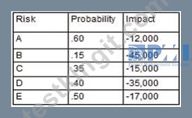
If this event does happen, how much will Donna have left in the risk contingency reserve if none of the other risk events have happened?
- A. $14,000
- B. $6,700
- C. $41,700
- D. $35,000
Answer: B
NEW QUESTION # 57
You are preparing to complete the quantitative risk analysis process with your project team and several subject matter experts. You gather the necessary inputs including the project's cost management plan. Why is it necessary to include the project's cost management plan in the preparation for the quantitative risk analysis process?
- A. The project's cost management plan provides control that may help determine the structure for quantitative analysis of the budget.
- B. The project's cost management plan can help you to determine what the total cost of the project is allowed to be.
- C. The project's cost management plan is not an input to the quantitative risk analysis process.
- D. The project's cost management plan provides direction on how costs may be changed due to identified risks.
Answer: A
NEW QUESTION # 58
Sammy is the project manager for her organization. She would like to rate each risk based on its probability and affect on time, cost, and scope. Harry, a project team member, has never done this before and thinks Sammy is wrong to attempt this approach. Harry says that an accumulative risk score should be created, not three separate risk scores. Who is correct in this scenario?
- A. Harry is correct, because the risk probability and impact considers all objectives of the project.
- B. Sammy is correct, because she is the project manager.
- C. Sammy is correct, because organizations can create risk scores for each objective of the project.
- D. Harry iscorrect, the risk probability and impact matrix is the only approach to risk assessment.
Answer: C
NEW QUESTION # 59
Stakeholder deliverable reviews will start soon and additional work is expected to resolve any issues or required adjustments. Budget overruns during execution have put serious constraints on the remainder of the project's budget.
What should the project manager do next?
- A. Review the consequences of potential changes.
- B. Conduct a risk reassessment and reserve analysis.
- C. Coach stakeholders on risk identification practices.
- D. Request a budget relief using the management reserve.
Answer: B
Explanation:
Explanation
The project manager should reassess the risks and analyze the reserve to determine if any adjustments can be made to accommodate the expected additional work. This will help in identifying potential budget-saving measures and making informed decisions on how toproceed.
NEW QUESTION # 60
You are the project manager of the GHG project. You are preparing for the quantitative risk analysis process. You are using organizational process assets to help you complete the quantitative risk analysis process. Which one of the following is NOT a valid reason to utilize organizational process assets as a part of the quantitative risk analysis process?
- A. You will use organizational process assets to determine costs of all risks events within the current project.
- B. You will use organizational process assets for studies of similar projects by risk specialists.
- C. You will use organizational process assets for risk databases that may be available from industry sources.
- D. You will use organizational process assets for information from prior similar projects.
Answer: A
NEW QUESTION # 61
Fill in the blank with an appropriate phrase.
________is the study of how the variation (uncertainty) in the output of a mathematical model can be apportioned, qualitatively or quantitatively, to different sources of variation in the input of a model.
- A. Sensitivity analysis
Answer: A
NEW QUESTION # 62
David is the project manager of HGF project for his company. David, the project team, and several key stakeholders have completed risk identification and are ready to move into qualitative risk analysis. Tracy, a project team member, does not understand why they need to complete qualitative risk analysis. Which one of the following is the best explanation for completing qualitative risk analysis?
- A. Qualitative risk analysis helps segment the project risks, create a risk breakdown structure, and create fast and accurate risk responses.
- B. It is a rapid and cost-effective means of establishing priorities for the plan risk responses and lays the foundation for quantitative analysis.
- C. All risks must pass through quantitative risk analysis before qualitative risk analysis.
- D. It is a cost-effective means of establishing probability and impact for the project risks.
Answer: B
NEW QUESTION # 63
You are the project manager of a large construction project. Part of the project involves the wiring of the electricity in the building your project is creating. You and the project team determine the electrical work is too dangerous to perform yourself so you hire an electrician to perform the work for the project. This is an example of what type of risk response?
- A. Transference
- B. Avoidance
- C. Mitigation
- D. Acceptance
Answer: A
NEW QUESTION # 64
You work as a project manager for BlueWell Inc. You are preparing for the risk identification process. You will need to involve several of the project's key stakeholders to help you identify and communicate the identified risk events. You will also need several documents to help you and the stakeholders identify the risk events. Which one of the following is NOT a document that will help you identify and communicate risks within the project?
- A. Activity duration estimates
- B. Stakeholder register
- C. Activity cost estimates
- D. Risk register
Answer: D
NEW QUESTION # 65
The project manager and the risk manager of a new project to develop an application to support autonomous driving are meeting with the sponsor and key stakeholders to discuss the project. During the meeting, it is identified that the transport authority is discussing new traffic regulations for the industry that could be in place before the project ends.
How should the project manager and the risk manager handle this situation?
- A. Ensure the project complies with the current traffic regulations and laws.
- B. Send a letter to the traffic authority with the general project information.
- C. Meet with the traffic authority staff in charge of the new regulation.
- D. Perform inquiries on the website of the traffic authority weekly.
Answer: C
Explanation:
Explanation
Meeting with the traffic authority staff responsible for the new regulation allows the project manager and risk manager to understand the potential changes and their impact on the project. This will help them proactively address any potential issues and ensure the project complies with the new regulations.
According to the PMBOK Guide, 6th edition, Chapter 11: Project Risk Management1, the project manager and the risk manager should handle this situation by meeting with the traffic authority staff in charge of the new regulation. This is because:
The new traffic regulation is an external risk that could affect the project objectives, such as scope, schedule, cost, quality, and customer satisfaction. External risks are those that arise from outside the project boundaries and are beyond the control of the project team. Examples of external risks include changes in government policies, regulations, laws, market conditions, environmental factors, etc.
The project manager and the risk manager should proactively engage with the external stakeholders who have the power and influence to create or modify the external risks. By meeting with the traffic authority staff, they can establish a positive relationship, gain insights into the new regulation, and influence its development to align with the project needs. They can also obtain information on the probability and impact of the risk, as well as the potential response strategies.
The other options are not effective in handling this situation because:
Ensuring the project complies with the current traffic regulations and laws does not address the risk of the new regulation that could change the project requirements, scope, or deliverables. It also does not help the project team to prepare for the possible changes and mitigate their negative effects.
Sending a letter to the traffic authority with the general project information does not establish a direct and timely communication channel with the external stakeholder. It also does not provide enough details or feedback to understand the nature and implications of the new regulation.
Performing inquiries on the website of the traffic authority weekly does not allow the project team to influence the development of the new regulation or obtain reliable and updated information. It also does not enable the project team to build trust and rapport with the external stakeholder.
References:
PMBOK Guide, 6th edition, Chapter 11: Project Risk Management1
Risk Management Professional (PMI-RMP) Exam Cert Guide2
NEW QUESTION # 66
There are seven risks responses that a project manager can choose from. Which risk response is appropriate for both positive and negative risk events?
- A. Transference
- B. Sharing
- C. Acceptance
- D. Mitigation
Answer: C
NEW QUESTION # 67
A subcontractor working on a project may cause delays in the construction schedule. The project manager records this risk in the risk register and issues a change request sponsor rejects the change request.
What should the project manager have done differently?
- A. Contacted the other stakeholders so they know the request is in process.
- B. Informed the client and the project sponsor that the request is being submitted.
- C. Performed an analysis to affirm the request is valid before submitting.
- D. Executed the risk strategy response and recorded it in the risk register.
Answer: C
Explanation:
Explanation
The project manager should have performed an analysis to ensure that the change request was valid and well-supported before submitting it to the sponsor. This would help in making a strong case for the change request and increase the chances of its approval.
The project manager should have performed an analysis to affirm the request is valid before submitting, as this would help to justify the need for the change and to demonstrate its impact on the project objectives, scope, schedule, cost, quality, and risk. The project manager should also have consulted with the project team, the subcontractor, and the risk owner to determine the best risk response strategy and to estimate the resources and time required for the change. By performing an analysis, the project manager could have increased the chances of getting the change request approved by the sponsor and avoided wasting time and effort on an invalid request. References: The Standard for Risk Management in Portfolios, Programs, and Projects, page 79; PMBOK Guide, 6th edition, page 115.
NEW QUESTION # 68
Adrian is the project manager of the NHP Project. In her project there are several work packages that deal with electrical wiring. Rather than to manage the risk internally she has decided to hire a vendor to complete all work packages that deal with the electrical wiring. By removing the risk internally to a licensed electrician Adrian feels more comfortable with project team being safe. What type of risk response has Adrian used in this example?
- A. Transference
- B. Avoidance
- C. Mitigation
- D. Acceptance
Answer: A
NEW QUESTION # 69
......
PMI-RMP Dumps PDF and Test Engine Exam Questions: https://www.testkingit.com/PMI/latest-PMI-RMP-exam-dumps.html
Get 2024 Updated Free PMI PMI-RMP Exam Questions and Answer: https://drive.google.com/open?id=1ImKm64o7nnWf_SGA64K1PD9lPVf15gY2