

2023 Valid MCPA-Level-1 test answers & MuleSoft Exam PDF
Free MuleSoft MCPA-Level-1 Exam Questions and Answer from Training Expert TestKingIT
NEW QUESTION 43
What do the API invocation metrics provided by Anypoint Platform provide?
- A. Data on past API invocations to help identify anomalies and usage patterns across various APIs
- B. ROI metrics from APIs that can be directly shared with business users
- C. Proactive identification of likely future policy violations that exceed a given threat threshold
- D. Measurements of the effectiveness of the application network based on the level of reuse
Answer: A
Explanation:
Correct answer: Data on past API invocations to help identify anomalies and usage patterns across various APIs
*****************************************
API Invocation metrics provided by Anypoint Platform:
>> Does NOT provide any Return Of Investment (ROI) related information. So the option suggesting it is OUT.
>> Does NOT provide any information w.r.t how APIs are reused, whether there is effective usage of APIs or not etc...
>> Does NOT prodive any prediction information as such to help us proactively identify any future policy violations.
So, the kind of data/information we can get from such metrics is on past API invocations to help identify anomalies and usage patterns across various APIs.
NEW QUESTION 44
What condition requires using a CloudHub Dedicated Load Balancer?
- A. When API invocations across multiple CloudHub workers must be load balanced
- B. When cross-region load balancing is required between separate deployments of the same Mule application
- C. When server-side load-balanced TLS mutual authentication is required between API implementations and API clients
- D. When custom DNS names are required for API implementations deployed to customer-hosted Mule runtimes
Answer: D
NEW QUESTION 45
In an organization, the InfoSec team is investigating Anypoint Platform related data traffic.
From where does most of the data available to Anypoint Platform for monitoring and alerting originate?
- A. From the Mule runtime or the API Manager, depending on the type of data
- B. From various components of Anypoint Platform, such as the Shared Load Balancer, VPC, and Mule runtimes
- C. From the Mule runtime or the API implementation, depending on the deployment model
- D. From the Mule runtime irrespective of the deployment model
Answer: B
NEW QUESTION 46
How are an API implementation, API client, and API consumer combined to invoke and process an API?
- A. The API consumer creates an API implementation, which receives API invocations from an API such that they are processed for an API client
- B. The ApI consumer creates an API client, which sends API invocations to an API such that they are processed by an API implementation
- C. The API client creates an API consumer, which receives API invocations from an API such that they are processed for an API implementation
- D. The ApI client creates an API consumer, which sends API invocations to an API such that they are processed by an API implementation
Answer: B
Explanation:
Correct answer: The API consumer creates an API client, which sends API invocations to an API such that they are processed by an API implementation
*****************************************
Terminology:
>> API Client - It is a piece of code or program the is written to invoke an API
>> API Consumer - An owner/entity who owns the API Client. API Consumers write API clients.
>> API - The provider of the API functionality. Typically an API Instance on API Manager where they are managed and operated.
>> API Implementation - The actual piece of code written by API provider where the functionality of the API is implemented. Typically, these are Mule Applications running on Runtime Manager.
NEW QUESTION 47
An Order API must be designed that contains significant amounts of integration logic and involves the invocation of the Product API.
The power relationship between Order API and Product API is one of "Customer/Supplier", because the Product API is used heavily throughout the organization and is developed by a dedicated development team located in the office of the CTO.
What strategy should be used to deal with the API data model of the Product API within the Order API?
- A. Implement an anti-corruption layer in the Order API that transforms the Product API data model into internal data types of the Order API
- B. Convince the development team of the Product API to adopt the API data model of the Order API such that the integration logic of the Order API can work with one consistent internal data model
- C. Start an organization-wide data modeling initiative that will result in an Enterprise Data Model that will then be used in both the Product API and the Order API
- D. Work with the API data types of the Product API directly when implementing the integration logic of the Order API such that the Order API uses the same (unchanged) data types as the Product API
Answer: A
Explanation:
Correct answer: Convince the development team of the product API to adopt the API data model of the Order API such that integration logic of the Order API can work with one consistent internal data model
*****************************************
Key details to note from the given scenario:
>> Power relationship between Order API and Product API is customer/supplier So, as per below rules of "Power Relationships", the caller (in this case Order API) would request for features to the called (Product API team) and the Product API team would need to accomodate those requests.
NEW QUESTION 48
What is the most performant out-of-the-box solution in Anypoint Platform to track transaction state in an asynchronously executing long-running process implemented as a Mule application deployed to multiple CloudHub workers?
- A. java.util.WeakHashMap
- B. File-based storage
- C. Redis distributed cache
- D. Persistent Object Store
Answer: B
NEW QUESTION 49
Once an API Implementation is ready and the API is registered on API Manager, who should request the access to the API on Anypoint Exchange?
- A. API Client
- B. Both
- C. None
- D. API Consumer
Answer: D
Explanation:
Correct answer: API Consumer
*****************************************
>> API clients are piece of code or programs that use the client credentials of API consumer but does not directly interact with Anypoint Exchange to get the access
>> API consumer is the one who should get registered and request access to API and then API client needs to use those client credentials to hit the APIs So, API consumer is the one who needs to request access on the API from Anypoint Exchange
NEW QUESTION 50
A company uses a hybrid Anypoint Platform deployment model that combines the EU control plane with customer-hosted Mule runtimes. After successfully testing a Mule API implementation in the Staging environment, the Mule API implementation is set with environment-specific properties and must be promoted to the Production environment. What is a way that MuleSoft recommends to configure the Mule API implementation and automate its promotion to the Production environment?
- A. Use an API policy to change properties in the Mule API implementation deployed to the Staging environment and another API policy to deploy the Mule API implementation to the Production environment
- B. Modify the Mule API implementation's properties in Anypoint Exchange, then promote the Mule API implementation to the Production environment using Runtime Manager
- C. Bundle properties files for each environment into the Mule API implementation's deployable archive, then promote the Mule API implementation to the Production environment using Anypoint CLI or the Anypoint Platform REST APIsB.
- D. Modify the Mule API implementation's properties in the API Manager Properties tab, then promote the Mule API implementation to the Production environment using API Manager
Answer: C
Explanation:
Correct answer: Bundle properties files for each environment into the Mule API implementation's deployable archive, then promote the Mule API implementation to the Production environment using Anypoint CLI or the Anypoint Platform REST APIs
*****************************************
>> Anypoint Exchange is for asset discovery and documentation. It has got no provision to modify the properties of Mule API implementations at all.
>> API Manager is for managing API instances, their contracts, policies and SLAs. It has also got no provision to modify the properties of API implementations.
>> API policies are to address Non-functional requirements of APIs and has again got no provision to modify the properties of API implementations.
So, the right way and recommended way to do this as part of development practice is to bundle properties files for each environment into the Mule API implementation and just point and refer to respective file per environment.
NEW QUESTION 51
What best describes the Fully Qualified Domain Names (FQDNs), also known as DNS entries, created when a Mule application is deployed to the CloudHub Shared Worker Cloud?
- A. The FQDNs are determined by both the application name and the Anypoint Platform organization
- B. The FQDNs are determined by the application name, but can be modified by an administrator after deployment
- C. A fixed number of FQDNs are created, IRRESPECTIVE of the environment and VPC design
- D. The FQDNs are determined by the application name chosen, IRRESPECTIVE of the region
Answer: C
NEW QUESTION 52
Refer to the exhibit.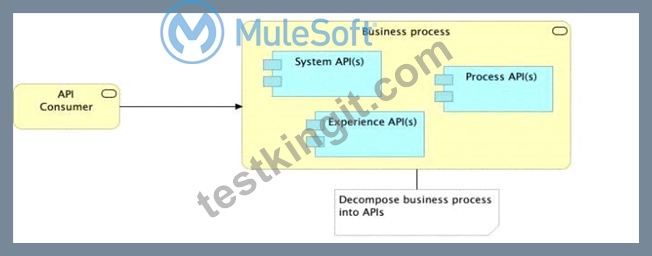
What is the best way to decompose one end-to-end business process into a collaboration of Experience, Process, and System APIs?
A) Handle customizations for the end-user application at the Process API level rather than the Experience API level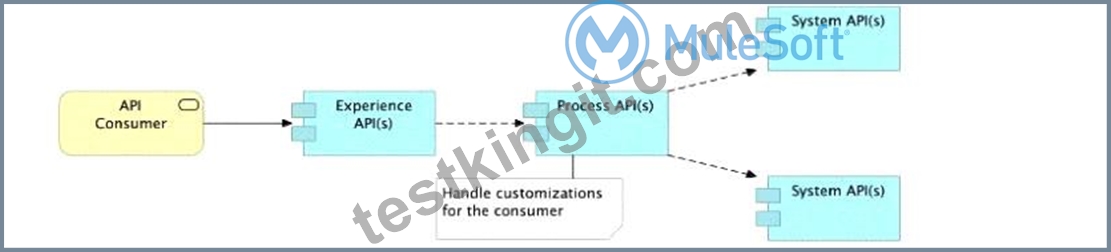
B) Allow System APIs to return data that is NOT currently required by the identified Process or Experience APIs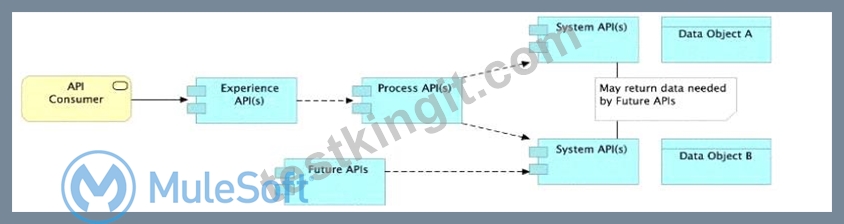
C) Always use a tiered approach by creating exactly one API for each of the 3 layers (Experience, Process and System APIs)
D) Use a Process API to orchestrate calls to multiple System APIs, but NOT to other Process APIs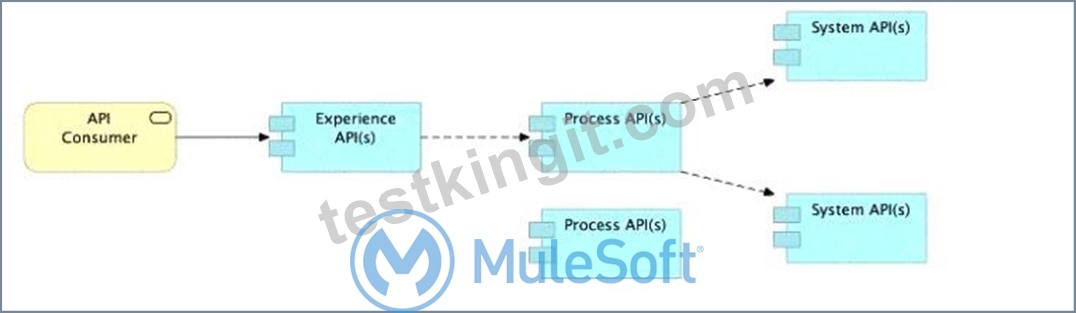
- A. Option A
- B. Option D
- C. Option B
- D. Option C
Answer: D
NEW QUESTION 53
In an organization, the InfoSec team is investigating Anypoint Platform related data traffic.
From where does most of the data available to Anypoint Platform for monitoring and alerting originate?
- A. From the Mule runtime irrespective of the deployment model
- B. From the Mule runtime or the API Manager, depending on the type of data
- C. From the Mule runtime or the API implementation, depending on the deployment model
- D. From various components of Anypoint Platform, such as the Shared Load Balancer, VPC, and Mule runtimes
Answer: A
Explanation:
Correct answer: From the Mule runtime irrespective of the deployment model
*****************************************
>> Monitoring and Alerting metrics are always originated from Mule Runtimes irrespective of the deployment model.
>> It may seems that some metrics (Runtime Manager) are originated from Mule Runtime and some are (API Invocations/ API Analytics) from API Manager. However, this is realistically NOT TRUE. The reason is, API manager is just a management tool for API instances but all policies upon applying on APIs eventually gets executed on Mule Runtimes only (Either Embedded or API Proxy).
>> Similarly all API Implementations also run on Mule Runtimes.
So, most of the day required for monitoring and alerts are originated fron Mule Runtimes only irrespective of whether the deployment model is MuleSoft-hosted or Customer-hosted or Hybrid.
NEW QUESTION 54
An organization is implementing a Quote of the Day API that caches today's quote.
What scenario can use the CloudHub Object Store via the Object Store connector to persist the cache's state?
- A. When there is one CloudHub deployment of the API implementation to three CloudHub workers that must share the cache state.
- B. When there are three CloudHub deployments of the API implementation to three separate CloudHub regions that must share the cache state.
- C. When there are two CloudHub deployments of the API implementation by two Anypoint Platform business groups to the same CloudHub region that must share the cache state.
- D. When there is one deployment of the API implementation to CloudHub and another deployment to a customer-hosted Mule runtime that must share the cache state.
Answer: D
NEW QUESTION 55
An organization makes a strategic decision to move towards an IT operating model that emphasizes consumption of reusable IT assets using modern APIs (as defined by MuleSoft).
What best describes each modern API in relation to this new IT operating model?
- A. Each modern API must be easy to consume, so should avoid complex authentication mechanisms such as SAML or JWT D
- B. Each modern API must be REST and HTTP based
- C. Each modem API must be treated like a product and designed for a particular target audience (for instance, mobile app developers)
- D. Each modern API has its own software development lifecycle, which reduces the need for documentation and automation
Answer: C
NEW QUESTION 56
What do the API invocation metrics provided by Anypoint Platform provide?
- A. Data on past API invocations to help identify anomalies and usage patterns across various APIs
- B. Measurements of the effectiveness of the application network based on the level of reuse
- C. ROI metrics from APIs that can be directly shared with business users
- D. Proactive identification of likely future policy violations that exceed a given threat threshold
Answer: B
Explanation:
Explanation/Reference: https://usermanual.wiki/Document/APAAppNetstudentManual02may2018.991784750.pdf
NEW QUESTION 57
What is true about where an API policy is defined in Anypoint Platform and how it is then applied to API instances?
- A. The API policy Is defined In Runtime Manager as part of the API deployment to a Mule runtime, and then ONLY applied to the specific API Instance
- B. The API policy Is defined In API Manager for a specific API Instance, and then ONLY applied to the specific API instance
- C. The API policy is defined in API Manager, and then applied to ALL API instances in the specified environment
- D. The API policy Is defined in API Manager and then automatically applied to ALL API instances
Answer: A
NEW QUESTION 58
Refer to the exhibit. An organization needs to enable access to their customer data from both a mobile app and a web application, which each need access to common fields as well as certain unique fields.
The data is available partially in a database and partially in a 3rd-party CRM system.
What APIs should be created to best fit these design requirements?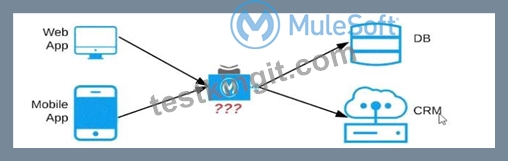
A) A Process API that contains the data required by both the web and mobile apps, allowing these applications to invoke it directly and access the data they need thereby providing the flexibility to add more fields in the future without needing API changes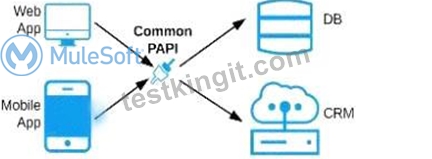
B) One set of APIs (Experience API, Process API, and System API) for the web app, and another set for the mobile app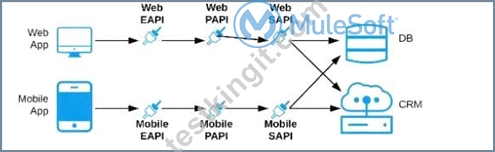
C) Separate Experience APIs for the mobile and web app, but a common Process API that invokes separate System APIs created for the database and CRM system
D) A common Experience API used by both the web and mobile apps, but separate Process APIs for the web and mobile apps that interact with the database and the CRM System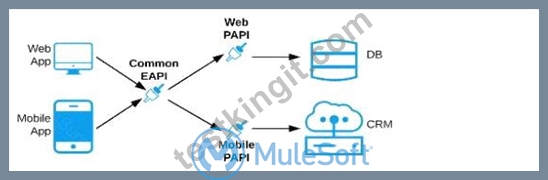
- A. Option A
- B. Option D
- C. Option B
- D. Option C
Answer: D
NEW QUESTION 59
Refer to the exhibit.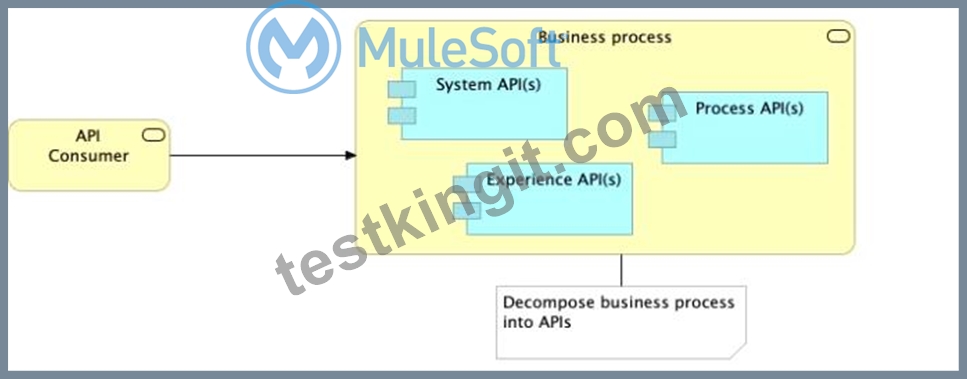
What is the best way to decompose one end-to-end business process into a collaboration of Experience, Process, and System APIs?
A) Handle customizations for the end-user application at the Process API level rather than the Experience API level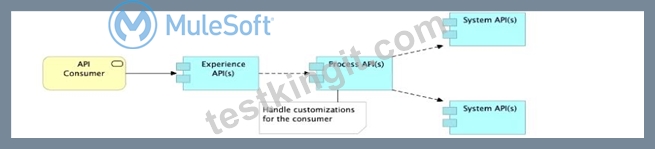
B) Allow System APIs to return data that is NOT currently required by the identified Process or Experience APIs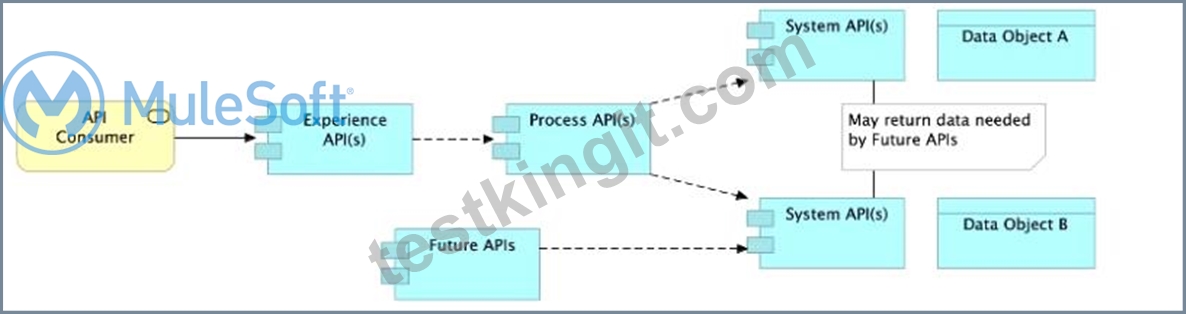
C) Always use a tiered approach by creating exactly one API for each of the 3 layers (Experience, Process and System APIs)
D) Use a Process API to orchestrate calls to multiple System APIs, but NOT to other Process APIs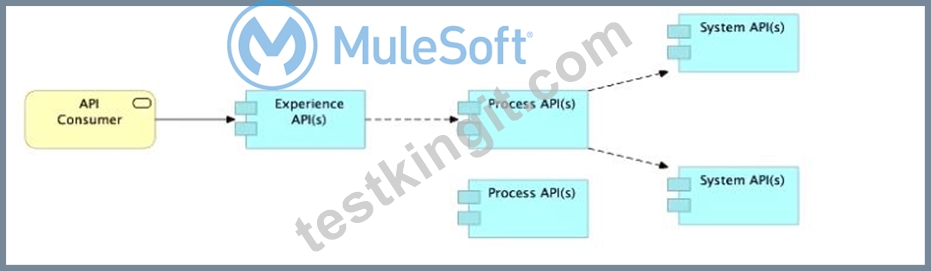
- A. Option A
- B. Option D
- C. Option C
- D. Option B
Answer: D
Explanation:
Correct answer: Allow System APIs to return data that is NOT currently required by the identified Process or Experience APIs.
*****************************************
>> All customizations for the end-user application should be handled in "Experience API" only. Not in Process API
>> We should use tiered approach but NOT always by creating exactly one API for each of the 3 layers. Experience APIs might be one but Process APIs and System APIs are often more than one. System APIs for sure will be more than one all the time as they are the smallest modular APIs built in front of end systems.
>> Process APIs can call System APIs as well as other Process APIs. There is no such anti-design pattern in API-Led connectivity saying Process APIs should not call other Process APIs.
So, the right answer in the given set of options that makes sense as per API-Led connectivity principles is to allow System APIs to return data that is NOT currently required by the identified Process or Experience APIs. This way, some future Process APIs can make use of that data from System APIs and we need NOT touch the System layer APIs again and again.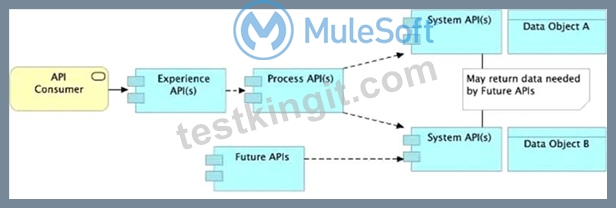
NEW QUESTION 60
What Mule application can have API policies applied by Anypoint Platform to the endpoint exposed by that Mule application?
A) A Mule application that accepts requests over HTTP/1.x
B) A Mule application that accepts JSON requests over TCP but is NOT required to provide a response
C) A Mute application that accepts JSON requests over WebSocket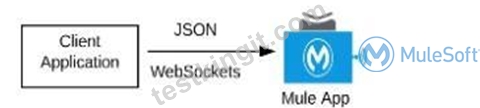
D) A Mule application that accepts gRPC requests over HTTP/2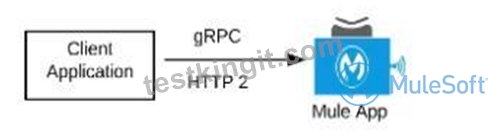
- A. Option D
- B. Option A
- C. Option C
- D. Option B
Answer: A
NEW QUESTION 61
What condition requires using a CloudHub Dedicated Load Balancer?
- A. When custom DNS names are required for API implementations deployed to customer-hosted Mule runtimes
- B. When API invocations across multiple CloudHub workers must be load balanced
- C. When cross-region load balancing is required between separate deployments of the same Mule application
- D. When server-side load-balanced TLS mutual authentication is required between API implementations and API clients
Answer: C
NEW QUESTION 62
......
Top MuleSoft MCPA-Level-1 Courses Online: https://www.testkingit.com/MuleSoft/latest-MCPA-Level-1-exam-dumps.html