

1Z0-1068-20 Training & Certification Get Latest Oracle Commerce Cloud Updated on Dec 25, 2021
Certification Training for 1Z0-1068-20 Exam Dumps Test Engine
Oracle 1Z0-1068-20 Exam Syllabus Topics:
| Topic | Details |
|---|---|
| Topic 1 |
|
| Topic 2 |
|
| Topic 3 |
|
| Topic 4 |
|
| Topic 5 |
|
| Topic 6 |
|
| Topic 7 |
|
| Topic 8 |
|
| Topic 9 |
|
| Topic 10 |
|
| Topic 11 |
|
| Topic 12 |
|
| Topic 13 |
|
| Topic 14 |
|
NEW QUESTION 30
An account buyer receives an email notification that their order has been approved and they can pay for the order. Once they click the associated link, it brings them to the B2B Checkout Payment After Approval layout.
Which two are valid statements regarding the B2B Checkout Payment After Approval layout? (Choose two.)
- A. The layout allows the buyer to modify the order details and input payment information
- B. The layout is of type Checkout and is displayed to account shoppers only
- C. The layout is only displayed when the order status is PENDING_PAYMENT
- D. This is an out-of-the-box layout that provides payment options for orders requiring approval
Answer: C,D
Explanation:
Orders that meet the criteria for requiring approval are sent back to OCC and put into the out-of-the-box order approvals workflow. Set the layout to be displayed when the Order Status is PENDING_PAYMENT Reference:
https://blogs.oracle.com/occs/whats-new-in-174-release
https://docs.oracle.com/cd/E97801_04/Cloud.19B/ExtendingCC/html/
s1806checkoutflowforpaymentafterappro01.html
NEW QUESTION 31
Which use case does NOT require the use of multiple sites or multiple instances?
- A. A company wants to expand their brand to multiple countries with multiple languages and currencies. The stores sell different products and have different promotions, but share shoppers
- B. A company has two brands with mostly different products. The brand stores have separate carts, payment gateways, and tax providers, with a unique look and feel
- C. A company has stores in multiple countries and their stores only differ by the languages and currencies they support
- D. A company operates three distinct brands operating as separate business units with different teams. The brands share no layouts, promotions, content, products, or shoppers
Answer: B
NEW QUESTION 32
If your storefront has both B2B and B2C implementations, you will need to have one Order History Layout for B2B as well as a different Order History Layout for B2C.
What is the reason for this?
- A. If implemented, delegated administrators can view a list of all previous orders placed from the account shopper.
- B. You cannot have one layout used for both B2B and B2C shoppers.
- C. Each layout will use different instances of the Secondary Navigation widget, depending if the shopper is account based or not.
- D. Account-based orders are tied to an Account, and the Order History Layout for B2B needs a B2B Order History widget instance.
Answer: D
NEW QUESTION 33
A company has Site A as its default site. It has created and enabled Site B and is ready to make Site B the default site and delete Site A.
Which statement describes the steps involved in deleting Site A?
- A. You must first make Site B the default site and then you can delete Site A
- B. Disable the default Site A first and then delete it
- C. When you delete Site A, Site B will be set as the new default site automatically
- D. It is not possible to delete a site. You can disable it using the updateSite endpoint
Answer: D
NEW QUESTION 34
Which two describe the assets contained in a storefront extension .zip archive? (Choose two.)
- A. a hierarchy of folders and files that are specific to the extension type
- B. configurations for function and event webhooks related to the extension
- C. language translation resources for each language used on the storefront
- D. the defined format of expected JSON request and response payloads
Answer: A,D
NEW QUESTION 35
Oracle Commerce Cloud allows developers and business users to change the shopper experience to suit their needs by modifying components within page layouts via the REST APIs or via the Administration UI.
How can you create a new page layout instance?
- A. Determine the type of layout and create a new blank instance
- B. Upload a new storefront extension that defines the new layout instance
- C. You cannot create a new layout instance since there is a fixed number of layouts that cannot be updated
- D. Create a new layout instance by cloning an existing layout instance
Answer: B
NEW QUESTION 36
Given the example widget configuration definition:
Which two statements are correct? (Choose two.)
- A. The widget configuration setting does not have a default value
- B. You can reference the configuration in the widget JavaScript as site.enabled()
- C. You can reference the configuration in the widget JavaScript as widget.enabled()
- D. The value can be either true or false
- E. The widget configuration setting will appear as a dropdown
Answer: D,E
NEW QUESTION 37
A developer is customizing the payment methods widget to enable the shopper to store a credit card when checking out. The widget needs to add three properties to the payments object of the JSON authorization request when creating the order:
saveCard(Boolean)
nickname(String)
setAsDefault(Boolean)
Each of the properties needs to be bound to a particular view model for the properties to be added to the payments object.
Which is the correct view model?
- A. widgetPaymentViewModel
- B. orderViewModel
- C. paymentViewModel
- D. cartViewModel
Answer: A
NEW QUESTION 38
The Payment Processing menu on the Settings page of the Administration UI has a Payment Options property with two choices: Full Payment Required and Allow Partial Payment.
When should the Allow Partial Payment option be selected?
- A. The storefront uses standard payment widgets
- B. One of the supported payment methods used on the order requires shopper action during payment processing
- C. All payment methods used on the order can be processed at the same time
- D. If one payment of a partial payment fails, the successful payments are voided immediately and the order stays incomplete
Answer: B
Explanation:
Reference:
s3202understandthepaymentoptionssetti01.html
NEW QUESTION 39
What does a slot component reserve space in a layout to display?
- A. a group of related widgets that constitute a composite shopper-based function
- B. the header of footer of a page that contains configurable elements
- C. an ordered set of widgets specified in a tabular format
- D. a widget determined in real-time based on variable criteria
Answer: D
NEW QUESTION 40
What are the three main technologies employed in widget development? (Choose three.)
- A. Node.js
- B. React
- C. CSS/Less
- D. HTML 5
- E. JavaScript
Answer: B,C,D
NEW QUESTION 41
An account buyer logs into the storefront, but does not see the addresses associated with their account on the My Account page.
What is the reason for this behavior?
- A. The Contact Login (for Managed Accounts) element is configured on the header widget which only supports B2C login
- B. The Profile Navigation - Account Shoppers widget instance settings was not configured to include an option for Account Address Book
- C. By default, the account buyer needs to create an order before the Account Address Book is displayed
- D. The account buyer did not have the correct storefront role to access the Account Address Book
Answer: B
NEW QUESTION 42
A company has created and configured a new site with the ID 10012 and is ready to enable it.
What step do they need to do to enable the site?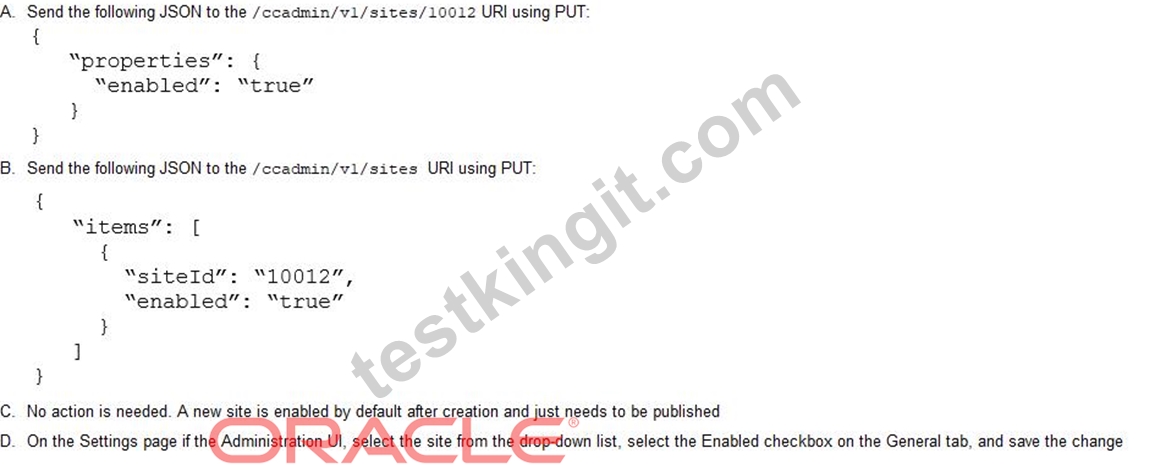
- A. Option D
- B. Option A
- C. Option C
- D. Option B
Answer: D
NEW QUESTION 43
Given the example element.json element configuration:
What does the inline attribute determine?
- A. whether the translation text is inserted into the element source
- B. whether the element can be included in another element
- C. whether the element should be inserted as an HTML span or as a div
- D. the display characteristic of the element
Answer: B
NEW QUESTION 44
Given the configuration:
US Catalog and Mexican Catalog share some of the products.
Which two methods enable a merchandiser to enter Spanish translations in the products? (Choose two.)
- A. Select Spanish from the Content Language drop-down and edit the products that need Spanish translations
- B. Import the translations by setting LOCALE=es in the CSV import file
- C. Select Spanish from the Content Language drop-down and create new products with Spanish entries in the relevant fields
- D. Select the site on the Catalog page and edit the products that need Spanish translations
Answer: A,B
NEW QUESTION 45
When configuring sites, you have two properties related to price groups: the default price group and additional price groups. Consider the following scenario:
Site US has the US Dollar price group set as its default price group.
Site Canada has the Canadian Dollar price group as its default price group, but needs a second price group for US dollars.
It can either share the US Dollar price group with Site US or have a separate US Dollars2 price group.
Under what condition should Site Canada use the separate US Dollars2 as its additional price group?
- A. US dollar prices differ between Site US and Site Canada
- B. The two countries have different sales tax rate calculations
- C. Reports in Oracle Business Intelligence Enterprise Edition need to separate sales totals in US dollars by site
- D. Site Canada has two languages and two currencies, and therefore needs dedicated price groups to accurately display prices
Answer: B
NEW QUESTION 46
......
Step by Step Guide to Prepare for 1Z0-1068-20 Exam: https://www.testkingit.com/Oracle/latest-1Z0-1068-20-exam-dumps.html