

[Jun 07, 2026] Get to the Top with IFC Practice Exam Questions
Use Real IFC Dumps Free Sample Questions and Practice Test Engine
CISI IFC Exam Syllabus Topics:
| Topic | Details |
|---|---|
| Topic 1 |
|
| Topic 2 |
|
| Topic 3 |
|
| Topic 4 |
|
NEW QUESTION # 49
What entity receives all fund money obtained from investors buying units/shares?
- A. Fund manager
- B. Registrar
- C. Dealer
- D. Custodian
Answer: D
Explanation:
The custodian, typically a trust company, receives and holds all funds from investors and other sources, managing the fund's assets and expenses. The feedback from the document states:
"The Custodian. When a mutual fund is established, a separate organization, most often a trust company, is appointed as the fund's custodian. The custodian receives and holds the fund's money obtained from all sources - investors buying the fund's units or shares, income earned by the fund's investment portfolio, proceeds from the sale of the fund's investments, holds all the fund's assets and distributes the fund's money to pay the fund's expenses." Reference: Chapter 10 - The Modern Mutual FundLearning Domain: The Modern Mutual Fund
NEW QUESTION # 50
Tristan is evaluating different mutual fund options for his client. What mutual fund option would be the most expensive to buy in dollar terms?
- A. Purchase $1500 at 3% front-end load
- B. Purchase $5000 at 1% front-end load
- C. Purchase $1000 at 4% front-end load
- D. Purchase $3000 at 2% front-end load
Answer: B
Explanation:
A front-end load is a sales charge paid at the time of purchase, calculated as a percentage of the investment amount.
A). $1,500 × 3% = $45
B). $1,000 × 4% = $40
C). $5,000 × 1% = $50
D). $3,000 × 2% = $60
# Most expensive = $60 (Option D)
Correction: Answer = D. Purchase $3,000 at 2% front-end load
NEW QUESTION # 51
What type of investment account has the option to open it with rights of survivorship?
- A. Registered
- B. Non-registered
- C. Corporate
- D. Trust
Answer: B
Explanation:
Rights of survivorship means that if one account holder dies, their share of the assets automatically transfers to the surviving holder(s).
This feature is available in joint non-registered accounts.
Registered accounts (A) (e.g., RRSP, TFSA) are individual accounts and cannot be opened jointly with rights of survivorship.
Trust accounts (B) follow trust law, not survivorship rules.
Corporate accounts (D) belong to the company, not individuals.
NEW QUESTION # 52
A client has $100,000 in savings, $5,000 in bank accounts, and $10,000 in loans. Calculate his net worth.
- A. $115,000
- B. $95,000
- C. $105,000
- D. $90,000
Answer: B
Explanation:
Net worth is calculated as total assets minus total liabilities. The client's assets are $100,000 (savings) +
$5,000 (bank accounts) = $105,000. The liabilities are $10,000 (loans). Thus, net worth = $105,000 - $10,000
= $95,000. The feedback from the document confirms:
"Net worth is calculated as the value of all of the client's assets after subtracting outstanding loan and mortgage balances. In this example, the client has $100,000 + $5,000 = $105,000 in assets, and $10,000 in loans. Therefore, his net worth is $105,000 - $10,000 = $95,000." Reference: Chapter 1 - The Role of the Mutual Fund Sales RepresentativeLearning Domain: An Introduction to the Mutual Funds Marketplace
NEW QUESTION # 53
A mutual fund representative meets with a young family whose net worth/level of wealth is categorized as low, but they have the potential to become wealthy. In general, the family seems susceptible to believing that market events are predictable. Also, the family has a stronger impulse to avoid losses than earn gains. How might the mutual fund representative effectively address each of the two biases, respectively?
- A. Conform to both biases identified.
- B. Conform to the first bias and moderate the second.
- C. Moderate both biases identified.
- D. Moderate the first bias and adapt to the second.
Answer: D
NEW QUESTION # 54
An Investor is making annual withdrawals from their mutual fund as follows:
Based on the withdrawal schedule, what type of withdrawal plan are they using?
- A. Lifetime.
- B. Constant
- C. Variable
- D. Ratio.
Answer: D
Explanation:
The correct answer is D. Ratio. According to the Investment Funds in Canada curriculum, a ratio systematic withdrawal plan determines withdrawals as a fixed percentage of the portfolio's value, recalculated each year. As a result, the dollar amount withdrawn varies annually based on market performance and the remaining account balance.
The withdrawal amounts shown in the table decline over time as the portfolio value decreases, which is consistent with a ratio-based approach. Under this method, when the portfolio experiences negative or modest growth, withdrawals naturally fall because they are calculated as a percentage of the current value.
Conversely, in stronger market years, withdrawals would increase.
This differs from a constant withdrawal plan, where the same dollar amount is withdrawn each year regardless of portfolio performance. It also differs from a variable plan, which adjusts withdrawals based on income needs rather than a formula, and a lifetime plan, which is structured to provide income for life based on actuarial assumptions.
The CIFC text emphasizes that ratio plans help reduce the risk of premature depletion of capital, as withdrawals automatically adjust downward during poor market conditions. However, income certainty is lower because payments fluctuate.
Because the withdrawals change each year in proportion to the portfolio's value, the investor is clearly using a ratio systematic withdrawal plan, making Option D the correct and fully CIFC-verified answer.
NEW QUESTION # 55
Which type of fixed income fund has a short duration, with the objectives of preserving capital and generating better current income than a money market fund?
- A. Preferred dividend fund
- B. T-bill fund
- C. Mortgage fund
- D. Short-term bond fund
Answer: D
Explanation:
Comprehensive and Detailed Explanation From Exact Extract:
A short-term bond fund combines characteristics of money market and bond funds, aiming to preserve capital while generating higher income than a money market fund due to its short duration. The feedback from the document states:
"A short-term bond fund is part money market fund and part bond fund. You would expect its investment objectives to reflect this combination. A short-term bond fund's objectives are to preserve capital and generate better current income than is likely from a money market fund. Although there is some capital gain potential, you would not expect this to be a key objective given the short duration of this type of fixed-income fund." Reference:Chapter 11 - Conservative Mutual Fund ProductsLearning Domain:Analysis of Mutual Funds
NEW QUESTION # 56
Cristina wants to add a mutual fund to her portfolio offering dividend income. She is considering either a preferred dividend fund or a standard equity fund. What is an important difference for Cristina to consider when comparing these two types of funds?
- A. The standard equity fund would track an index and have less volatility.
- B. A preferred dividend fund would offer more opportunity for capital gains and appreciation.
- C. A preferred dividend fund takes a more passive approach to investing.
- D. The standard equity funds are willing to put capital at substantially greater risk.
Answer: D
NEW QUESTION # 57
Jack and Jill hold a mutual fund account as tenants in common. What conditions would apply to their account?
Should either die, full ownership of the account would pass to the other Each would be the owner of 50% of the account's assets Either could issue trading instructions on all account assets Each would be required to provide KYC information
- A. 2 and 4
- B. 1 and 4
- C. 1 and 3
- D. 2 and 3
Answer: A
Explanation:
In a tenants in common account, each owner holds a pro-rata share (e.g., 50%) and can only issue instructions for their portion, with no right of survivorship. KYC information is required for both owners. The feedback from the document states:
"If more than one person owns an account and it is not specifically identified as being a joint account, each owner owns a pro-rata share of the account, unless ownership is divided in another manner and noted on the account. Where an account is held as tenants in common, there is no right of survivorship and each owner, unless otherwise specified, can only give instructions with regard to the pro-rata portion of the account." Reference: Chapter 17 - Mutual Fund Dealer RegulationLearning Domain: Ethics, Compliance and Mutual Fund Regulations
NEW QUESTION # 58
For the last year, an investor earned a return before adjustment for inflation of 2% on a money market fund, while inflation averaged 1.5%. What was his nominal rate of return?
- A. 0.50%
- B. 2.00%
- C. 1.50%
- D. 3.50%
Answer: B
Explanation:
Comprehensive and Detailed Explanation From Exact Extract:
The nominal rate of return is the return before adjustment for inflation, which is given as 2%. The real rate of return would be adjusted for inflation (2% - 1.5% = 0.5%), but the question asks for the nominal rate. The feedback from the document states:
"It is important to consider the effects of inflation on investments because we can isolate the difference between nominal and real returns. Investors are more concerned with the real rate of return - the return adjusted for the effects of inflation. A nominal return is a return that has not been adjusted for the impact of inflation. The approximate real rate of return is calculated as: Real Return = Nominal Rate - Annual Inflation Rate." Reference:Chapter 8 - Constructing Investment PortfoliosLearning Domain:Understanding Investment Products and Portfolios
NEW QUESTION # 59
What is an implicit cost of principal protected notes?
- A. Structuring costs and guarantee fees
- B. Commissions
- C. Early redemption fees
- D. Performance participation caps
Answer: D
Explanation:
Implicit costs of principal protected notes include performance participation caps, which limit the potential returns and are not always explicitly disclosed. The feedback from the document states:
"Implicit costs include fees borne by investors that may or may not be immediately visible and that may or may not be openly disclosed in the documents. Of the items listed, three are explicit costs, and only Performance Participation Caps are an implicit cost." Reference: Chapter 13 - Alternative Managed ProductsLearning Domain: Understanding Alternative Managed Products
NEW QUESTION # 60
Which organization regulates mutual and investment funds?
- A. Securities commissions
- B. ICE Futures Canada
- C. Bourse de Montreal
- D. Investment Industry Regulatory Organization of Canada (IIROC)
Answer: A
Explanation:
Securities commissions are responsible for regulating mutual and investment funds in Canada. The feedback from the document confirms:
"The responsibility of regulating mutual funds lies with the securities commissions." Reference: Chapter 2 - Overview of the Canadian Financial MarketplaceLearning Domain: An Introduction to the Mutual Funds Marketplace
NEW QUESTION # 61
What stage in the business cycle typically has increasing wages, rising inflation, rising interest rates with slowing sales, and decreasing business investment?
- A. Peak
- B. Recovery
- C. Expansion
- D. Trough
Answer: A
Explanation:
Comprehensive and Detailed Explanation From Exact Extract:
The peak stage of the business cycle is marked by demand exceeding supply, leading to rising wages, inflation, and interest rates, while sales slow and business investment decreases. The feedback from the document states:
"The top of the cycle is called a peak. A peak is characterized by the following activities: demand begins to outstrip the capacity of the economy to supply it; wages increase; inflation rises; interest rates rise and bond prices fall; sales begin to decline; business investment slows, and stock market activity begins to decline." Reference:Chapter 3 - Economic PrinciplesLearning Domain:An Introduction to the Mutual Funds Marketplace
NEW QUESTION # 62
What term refers to the minimum rate at which the Bank of Canada lends money on a short-term basis to chartered banks?
- A. Target rate
- B. Prime rate
- C. Nominal rate
- D. Bank rate
Answer: D
Explanation:
The correct answer is A. Bank rate. The Investment Funds in Canada curriculum defines the bank rate as the minimum rate at which the Bank of Canada makes short-term loans to major financial institutions, including chartered banks. It serves as a key benchmark in the Canadian financial system.
The prime rate is set by individual banks and is typically higher than the bank rate. The nominal rate simply refers to the stated interest rate without inflation adjustment. The target rate (overnight rate target) is the Bank of Canada's policy objective, not the actual lending rate.
Because the question asks specifically for the minimum lending rate, the correct and CIFC-verified answer is Option A.
NEW QUESTION # 63
For what reason do different entities have securities created and sold?
- A. The issuance of securities is a method used by corporations to redistribute their wealth to investors to lower taxes.
- B. When common shares are initially sold, the capital raised will increase the issuing corporation's retained earnings.
- C. Government debt is reduced due to the capital that is received from investors when their securities are purchased.
- D. Governments can address financial needs and support initiatives when securities are first sold.
Answer: D
Explanation:
One of the main reasons why different entities have securities created and sold is to raise funds for various purposes. Governments, for example, can issue securities such as bonds or treasury bills to finance public spending, such as infrastructure, education, health care, or social programs. By selling securities to investors, governments can borrow money at a lower cost than other sources of funding, and can also stimulate the economy and create jobs12 References = Canadian Investment Funds Course (CIFC) - Module 2: Investment Products - Section 2.1:
Money Market Instruments3 and web search results from search_web(query="reasons for issuing securities")
12
3: https://www.ifse.ca/wp-content/uploads/2021/08/CIFC-Module-2.pdf
NEW QUESTION # 64
When must client complaints be acknowledged in writing?
- A. Any time the client has made a verbal or written complaint
- B. When complaints are made repeatedly by the same client with respect to the same representative
- C. When the client has made a written complaint in any format
- D. When the client has made a written complaint in letter format
Answer: C
Explanation:
Comprehensive and Detailed Explanation From Exact Extract:
MFDA Policy No. 3 requires that all written client complaints, including emails, be acknowledged in writing.
The feedback from the document states:
"MFDA Policy No. 3 specifies the minimum procedures for dealing with written client complaints (including emails). All written client complaints must be acknowledged in writing." Reference:Chapter 17 - Mutual Fund Dealer RegulationLearning Domain:Ethics, Compliance and Mutual Fund Regulations
NEW QUESTION # 65
Which of the following statements are CORRECT about labour sponsored investment funds (LSIFs)?
- A. LSIFs are suitable for investors with a low risk tolerance.
- B. All provinces offer some sort of additional tax credit for investors.
- C. LSIFs are appropriate for investors with a short-term time horizon.
- D. Investors will forfeit their tax credits if they redeem their LSIF investment before 8 years have elapsed.
Answer: D
Explanation:
LSIFs are a type of investment fund that provide venture capital to small and medium-sized Canadian businesses, while offering tax benefits to investors. However, LSIFs are also considered high-risk and illiquid investments, as they invest in private companies that may not have a proven track record or marketability.
Therefore, LSIFs are not suitable for investors with a short-term time horizon or a low risk tolerance.
Investors who buy LSIFs receive a 15% federal tax credit and may also receive an additional provincial tax credit, depending on the province where they reside. However, these tax credits are conditional on holding the LSIF investment for at least 8 years. If investors redeem their LSIF investment before the 8-year period, they will have to repay the tax credits they received.
Canadian Investment Funds Course, Chapter 4: Types of Investments1
NEW QUESTION # 66
David had $10,000 in his investment account with Dynamic Investments, a mutual funds dealer. On June 28, David wants to buy 500 units in ABC Canadian Dividend Fund that has a Net Asset Value Per Unit (NAVPU) of $14.10. His friend Robert suggests that he may get a better price if he used the strategy of dollar-cost averaging. David then instructs his Dealing Representative to place a purchase order for 100 units on the first of every month starting July 1st for the next 5 months.
The orders are executed at the following NAVPUs.
July 01, $14.00
Aug. 01, $14.50
Sep. 01, $15.00
Oct. 01, $14.25
Nov. 01, $16.50
Did David get a better purchase price following the dollar-cost averaging strategy compared to making a lump-sum purchase of 500 shares on Jun 28, 20xx?
- A. David got his 500 units at a higher price than the lump sum price he would have paid
- B. David realizes that Dollar cost averaging is the best strategy for getting lower prices.
- C. David got his 500 units at a lower price than the lump sum price he would have paid.
- D. David got his 500 units at the same price as the lump sum price he would have paid.
Answer: A
Explanation:
Dollar-cost averaging is a strategy that involves investing equal amounts of money at regular intervals, regardless of the price of the security. By using dollar-cost averaging, investors may lower their average cost per share and reduce the impact of volatility on their portfolios. However, this strategy does not guarantee a better purchase price than making a lump-sum purchase. In this case, David got his 500 units at a higher price than the lump sum price he would have paid. His average cost per unit was $14.65, while the lump sum price was $14.10. Therefore, D is the correct answer. References: What Is Dollar-Cost Averaging?, What Is Dollar Cost Averaging?, Dollar-Cost Averaging: Definition and Examples
NEW QUESTION # 67
In what circumstance would an investor receive a T3 or T5 reporting a capital gain from a mutual fund investment?
- A. When the investor sells her fund units at a price higher than their average cost
- B. When the fund sells investments at a price higher than the average cost of the investment
- C. When the value of the investor's fund units has risen
- D. When the value of the fund's investments has risen
Answer: A
Explanation:
A T3 or T5 slip reporting a capital gain is issued when an investor sells their mutual fund units at a profit, not when the fund itself realizes gains. The feedback from the document states:
"In the normal course of portfolio management, shares are bought and sold either at a gain or at a loss for the fund. By the end of the year, many funds will have generated net capital gains on their portfolio transactions.
The capital gains are distributed in the form of a capital gains dividend reported on a T5 or T3." However, for the investor, the correct answer is A, as clarified by standard tax rules: capital gains are realized by the investor upon selling units at a price higher than their average cost.
Reference: Chapter 16 - Mutual Fund Fees and ServicesLearning Domain: Evaluating and Selecting Mutual Funds
NEW QUESTION # 68
Kerry's total income this past year was $100,000 and she claimed a tax deduction of $2,000. When the tax return is filed, what would be the federal tax payable when applying the following federal tax rates?
(Round to the closest whole dollar for the final answer.)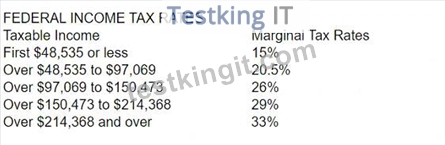
- A. $18,754
- B. $25,480
- C. $24,000
- D. $17,472
Answer: A
Explanation:
Kerry's taxable income would be $98,000 ($100,000 - $2,000). Using the federal tax rates provided in the image, the first $48,535 of her income would be taxed at 15%, the next $48,534 at 20.5%, and the remaining
$931 at 26%. This would result in a total federal tax payable of $18,754.You can see the calculation in detail below:
Taxable Income
Marginal Tax Rate
Federal Tax Payable
$0 - $48,535
15%
$7,280.25
$48,536 - $97,069
20.5%
$9,934.47
$97,070 - $98,000
26%
$539.80
Total
$18,754.52
Note: The final answer is rounded to the closest whole dollar.
Canadian Investment Funds Course, Unit 8, Section 8.2; [4]
NEW QUESTION # 69
......
Pass CISI IFC exam - questions - convert Tets Engine to PDF: https://www.testkingit.com/CISI/latest-IFC-exam-dumps.html
2026 Realistic Verified Free CISI IFC Exam Questions: https://drive.google.com/open?id=1VKK0T8wVofDdDxg-9Chf_yYQ_9CLBSpH